
By Palestine Chronicle Editors
Iran closes Hormuz again after Trump’s claims, rejecting the US narrative and imposing new conditions on war and negotiations.
Key Takeaways
- Iran reimposes strict control over the Strait of Hormuz following continued US blockade and escalating rhetoric.
- Trump claims Iran “agreed to everything” while confirming the blockade will remain in place.
- Tehran rejects US claims as “lies” and conditions further talks on ending the blockade and broader ceasefire commitments.
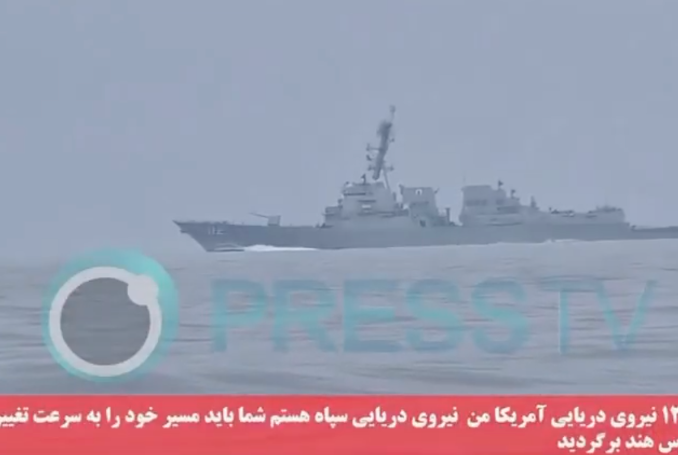
On Saturday, Iran once again imposed strict control over the Strait of Hormuz. The decision was swift, deliberate, and stripped of the usual political theatrics. But it did not come out of nowhere.
It came one day after a series of statements by US President Donald Trump—many delivered on his Truth Social platform—that attempted to recast the reality of the war.
In a Friday phone interview with CBS News, Trump claimed that Iran had “agreed to everything,” including working with Washington to remove its enriched uranium, presenting the situation as a direct result of US pressure.
He insisted that the process would not involve US ground troops, stating, “No. No troops… We’ll go down and get it with them, and then we’ll take it,” adding that “our people, together with the Iranians, are going to work together” to retrieve the material and bring it to the United States.
At the same time, he confirmed that the US naval blockade would remain in place “until we get it done.”
The contradiction was striking: Iran was portrayed as compliant, the war as nearing resolution, and cooperation as already underway—yet the blockade remained fully enforced.
Iranian officials moved quickly to reject these claims. Within hours, a Foreign Ministry spokesman stated that enriched uranium was “as sacred to us as Iranian soil” and “will not be transferred anywhere under any circumstances.” This response directly contradicted Trump’s claims of imminent cooperation.
Trump reinforced that narrative in public remarks, presenting the situation as a breakthrough and framing developments as the result of US pressure. Analysts quickly noted the resemblance to past premature declarations of victory in US wars, where rhetoric raced ahead of reality.
But reality did not cooperate.
Iran had, in fact, reopened the strait only conditionally, linking the move to the Lebanon ceasefire and signaling clearly that it would not hold if US pressure continued.
By maintaining the blockade while claiming success, Washington effectively undermined the very conditions that allowed the reopening to take place.
Tehran’s response a day later was therefore not simply reactive—it was corrective. By shutting down Hormuz again, Iran dismantled the narrative that the United States had attempted to construct. Iranian officials, including Parliament Speaker Mohammad Bagher Ghalibaf, openly rejected Trump’s claims, accusing him of spreading “lies” about concessions and negotiations.
The message was unmistakable: there had been no surrender, no decisive victory, and no agreement on US terms. This moment reveals a deeper pattern that has defined the current phase of the war.
Washington’s strategy appears to rely not only on military pressure but also on narrative control—declaring progress, projecting success, and shaping perception in advance of actual outcomes. This is particularly evident in Trump’s use of transactional language, reducing war, diplomacy, and ceasefire arrangements to the logic of deals and completions.
Tehran, however, is now actively contesting that narrative. Its position has become clearer and more structured: There will be no second round of negotiations in Islamabad under current conditions. Iranian officials have emphasized that no date has been set and that a framework must first be agreed upon—rejecting what they describe as Washington’s “maximalist” approach.
The conditions themselves are not ambiguous. The US blockade must end. The ceasefire in Lebanon must be respected. Any negotiations must proceed based on a defined and mutually agreed framework—not unilateral demands presented as faits accomplis.
This marks a significant shift. In previous rounds of conflict, the United States and Israel often relied on a familiar formula: escalate, impose a ceasefire, and then convert that ceasefire into political advantage. Temporary pauses were used to reshape narratives, allowing leaders in Washington and Tel Aviv to claim victories that were not reflected on the ground.
This pattern was visible in Gaza following the genocide, where ceasefires were repeatedly instrumentalized and habitually violated while the humanitarian catastrophe deepened. It was evident in Lebanon after the October 2024 ceasefire, where Israeli violations continued while Hezbollah initially refrained from escalation, allowing Israel to project dominance despite the absence of a decisive outcome.
What has changed now is not the strategy of Washington and Tel Aviv—but the response to it. Iran’s reimposition of control over Hormuz signals that the expectation of unlimited “strategic patience” is no longer valid. The assumption that violations can be absorbed without consequence has been directly challenged.
This does not eliminate the risks. On the contrary, they remain profound. Any disruption of the Strait of Hormuz carries global economic consequences, while renewed confrontation in Lebanon could once again expose civilian populations to devastating attacks.
But the risks are no longer one-sided. The United States and Israel also face a narrowing strategic margin. The assumption that pressure will produce submission has not materialized. The expectation of a clear military outcome has not been fulfilled. Instead, both now confront a situation in which further escalation may deepen their strategic difficulties rather than resolve them.
Trump’s rhetoric on Friday—particularly his claims of total Iranian compliance—was not merely inaccurate. It was indicative of a broader disconnect between political messaging and operational reality. And it is precisely this disconnect that makes the current moment so volatile.
When war is narrated as a victory before it is resolved, decisions begin to follow the narrative rather than the facts. Policies are shaped not by outcomes, but by the need to sustain the illusion of success. Iran’s move in Hormuz is, in this sense, more than a tactical escalation. It is a refusal to allow that illusion to stand.
If Washington and Tel Aviv continue to rely on the same playbook—escalation, narrative control, and political exploitation of ceasefires—they may find that the conditions which once made that strategy effective no longer exist.
And if that realization does not come soon, the region may once again be pushed toward a wider and far more dangerous confrontation.
(The Palestine Chronicle)


Be the first to comment