
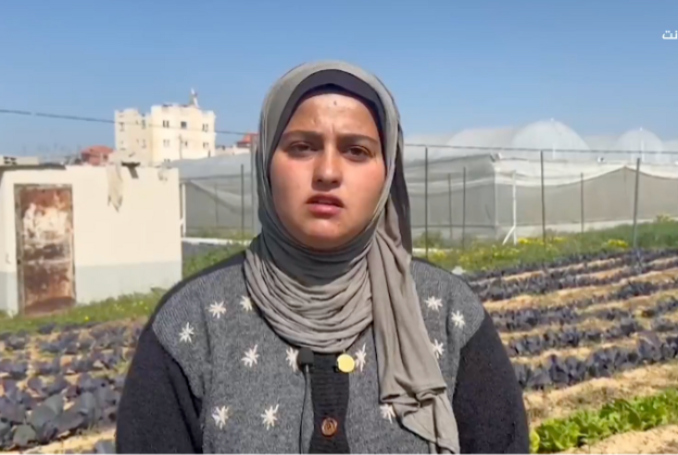
By Benay Blend
Despite Israel’s escalating violence that it hopes will drive out remaining Palestinians from their land, the Gaza Soup Kitchen refuses to give up.
In the summer and fall of 2024 Jerusalem Quarterly (JQ) released two special issues designed to coincide with the one-year anniversary of October 7, a resistance action by the Palestinians that brought swift retaliation from Israel in the form of genocide that is still ongoing.
“The starvation that Israel is imposing on Gaza provides a disturbing backdrop to the contributions to this second of two special issues of JQ devoted to food and foodways,” explain the JQ staff (“A Hunger for Life,” JQ, Issue 98, summer 2024, p. 3). Refusing to portray Palestinians as mere victims of the entity’s horrific siege, several of the articles describe how transmission of traditional cuisine from generation to generation serves as more than mere sustenance for the population.
In “How Dough Rises in Gaza: Palestine’s Foremothers and Recipes Against Genocide,” Lila Sharif argues that through her exploration of olive oil, bread, khubiza (mallow), the use of the tabun oven, and the preparation of traditional dishes like maqluba, it becomes clear that Palestinians continue to practice sumud (steadfastness), thus assuring that the people will continue their relationship with the land and Palestine’s foremothers (JQ, Issue 99, autumn 2024, p. 57).
In this context, traditional foodways emerge as “radical acts of embodied” resistance against Zionist efforts to literally erase the Palestinian presence on their land (p. 58). Referring to Leanne Betasamosake Simpson’s seminal work, Sharif relates that food “enables us to continue ‘as we have always done,’’ thereby linking the Palestinian cause to that of the Nishnaabeg Nation whose land is in present-day central Ontario (p. 58).
In “As We Have Always Done: Indigenous Freedom Through Radical Resistance (2017),” Simpson explains how, like the Palestinians, her people have been displaced and dispossessed of their land for the past two centuries. Again, similar to Palestinians, her people have resisted the settler colonial state.
“Our presence is our weapon,” Simpson writes (p. 6). She sees this at every protest, every mobilization, and at pow wows, events that prove Indigenous people still exist as they have always done (p. 6). For Simpson, and Palestinians, too, sheer survival is a form of resistance.
For most Indigenous people, specific foods are more than sustenance, no matter where they live. In “Freekeh and Fellahin: A Symbiotic Relationship of Sumud,” Amany Ahmad explores how this highly nutritious grain provides a glimpse into Palestinian relationship to the land.
“It is an ingredient that, through its continuous presence in their culinary vernacular,” Amany notes, “affirms the indigeneity of the Palestinian stewards, without whom the instructions for its making would have been entirely lost” (JQ, Issue 98, summer 2024, p. 47).
Despite Zionist efforts to claim freekeh as their own, its presence attests to “Indigenous endurance despite ongoing attempts at erasure” (p. 48).
In “Original Local: Indigenous Foods, Stories, and Recipes from the Upper Midwest (2013),” Heid E. Erdrich (Ojibwe enrolled at Turtle Mountain) relates that the foods associated with her people have long been part of the core knowledge of her family.
The Three Sisters—corn, beans, and squash, along with sunflowers—once the staples of Indigenous North America, now provide sustenance for the world. Manoomin (wild rice) grows only in specific lakes, now threatened by the change in climate.
Akin to Palestinian sumud, tribes in this area are steadfast in their efforts to maintain control of Indigenous foods. Despite climate change, cultivation of wild rice that is not required to be handpicked (similar to freekeh that is not prepared in the traditional way), and other factors, Erdrich has hope that tribal foods will continue on into the next century.
Although tribes tend to be place-based, focused on the local, Simpson explains that Indigenous resistance includes the global, thereby tying together networks of colonized people around the world (2017 p. 57).
In an interview with Naomi Klein, Simpson relates that she thinks of the land as her mother, a familial relationship that she thinks needs to intensify because that bond is one “of nurturing and caring,” a stance that lies outside of Western feminist thought.
Similarly, the production of Palestinian cuisine is almost always gendered. As such, it might be seen by mainstream feminists as oppressive, a stance that ignores the honor placed on women’s responsibility to keep the home as a refuge, especially during times of escalating Israeli violence.
“Historically, the act of cooking and caring for families and sustaining communities has belonged to women. The kitchen was the center of this nurturing,” explains artist, chef and ethnographer Mirna Bamieh in an interview with Christiane Nasser (“Recipes Carry Voices and Stories: An Interview With Mirna Bamieh,” JQ, summer 2024, Issue 98, p. 80). “Even during the Intifada in Palestine,” she continues, “the women were running the kitchens as part of the resistance. So, it was not just cooking for the family but extended to those active in the resistance.”
In the 1970s and 1980s, Bamieh states, there were no women chefs in the public world. But now it is different because no one is running restaurants due to mounting Israeli violence.
In the current culinary realm, Palestinians are “dealing with food as a sphere for saying something, for transmitting a message” (p. 81). Even if women now have the opportunity to train as chefs, it is different, “because it has this resistance approach to it,” Bamieh says (P. 81). Like before, the Occupation has leveled the playing field; everyone is involved in the current Intifada.
Nowhere is the concept of foodways as an element of resistance more evident than in the Gaza Soup Kitchen, a resource that provides food and assistance to families who otherwise would have already succumbed to Israel’s weaponization of food. Faced with the consequences of the entity’s genocide against his people, Hani Almadhoun, senior Director of Philanthropy at UNRWA, USA, started the project that would combat food insecurity among the majority of families still in Gaza (Hani Almadhoun, “The Gaza Food Kitchen: Generosity amid Genocide,” JQ, autumn 2024, Issue 99, p. 101).
Chef Mahmoud, Hani’s brother, “found his purpose” in joining the organization. “He implemented high hygiene standards in the community kitchen, emphasized storytelling, and preserved people’s dignity” (p. 102)—collectivity, self-sufficiency, recipes as stories that reveal the peoples’ longevity on the land, and communal self-respect are all elements of Palestinian sumud. Murdered by an Israeli drone in December of 2024, Chef Mahmoud’s work continued past his martyrdom.
Despite Israel’s escalating violence that it hopes will drive out remaining Palestinians from their land, the Gaza Soup Kitchen refuses to give up its work in Northern Gaza.
“Today’s produce bundles carried peppers, eggplants, and fresh Molokhia leaves,” explains Hani’s most recent post on Facebook. “Simple, humble foods — but for families in tents, they bring both nourishment and a taste of home.”
Elements of resistance, sustenance that allows families to carry on, but not by just any nourishment, for these ingredients are elements of traditional recipes that remind Palestinians of who they are.
“Gaza has borne the brunt of the most severe manifestations of Israeli occupation, apartheid, siege, war, violence, ethnic cleansing, and genocide,” Ramzy Baroud contends. Yet it is the site of ongoing Palestinian resistance, resilience that is due, in part, to the concept of sumud.
“Therefore, a new and transformative understanding of Palestine is not just desirable but absolutely imperative,” Baroud concludes, an understanding that “center[s] Palestinian voices that genuinely reflect the sentiments, wishes, feelings, aspirations, and the authentic popular politics of ordinary people.”
This is particularly important at a time when North American and European countries, along with others, are declaring recognition of Palestinian statehood, acts that Baroud states would have been unlikely if it had not been for the resistance of the Palestinian people, buoyed by popular movements in Western countries that centered the words of Palestinians.
It is also imperative to cast aside certain facets of Western feminism, especially those that view women’s role in the kitchen as an added burden. This position ignores the ways that food serves not only to sustain human bodies but also connections between Palestinians and their land, their culture, and their identity.
“For our family, this work was not just about feeding the hungry,” Hani explains, it was about preserving the dignity and humanity of our community. In the process of helping, we lifted the voices of those we served, telling their stories and sharing their steadfastness with the world” (p. 103).
In this case, food serves as more than sustenance; providers make sure to tell the stories associated with those around them. Both sorrowful as well as sometimes full of joy, these tales are a reminder of what Hani calls “the strength and resilience of the Palestinian people, even in the face of unimaginable hardship” (p. 104).

– Benay Blend earned her doctorate in American Studies from the University of New Mexico. Her scholarly works include Douglas Vakoch and Sam Mickey, Eds. (2017), “’Neither Homeland Nor Exile are Words’: ‘Situated Knowledge’ in the Works of Palestinian and Native American Writers”. She contributed this article to The Palestine Chronicle.

Be the first to comment