
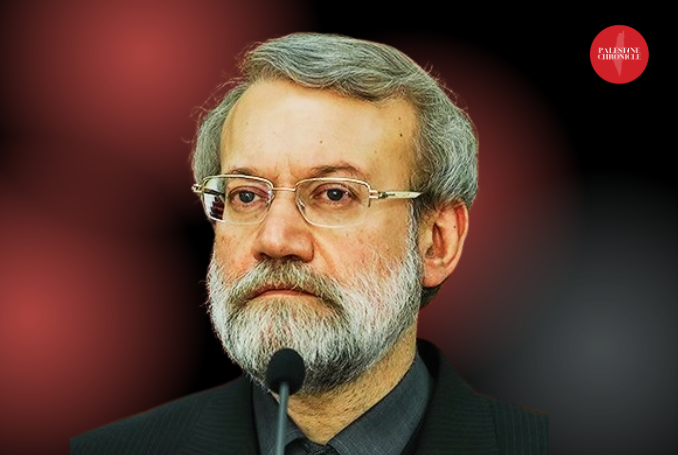

Iran confirmed the killing of the Supreme National Security Council’s Secretary, Ali Larijani, in a US-Israeli attack carried out overnight.
Key Developments
- Iran confirmed on Tuesday the killing of Ali Larijani, Secretary of the Supreme National Security Council, in a strike in Tehran.
- Larijani had urged Muslim governments to clarify their positions just one day before his death.
- Iranian officials signaled continued confrontation, framing the killing as part of a broader regional struggle.
Iran Confirms Killing of Senior Official
Iran’s Supreme National Security Council announced on Tuesday the killing of its Secretary, Ali Larijani, in a US-Israeli attack carried out overnight.
In a statement, the council said Larijani was killed alongside his son, Morteza Larijani, senior aide Ali Reza Bayat, and several guards.
The statement described Larijani as a “lifelong servant” of the Islamic Republic, adding that he had “answered the call of truth” and achieved “the noble rank of martyrdom.”
It further stated that his death would strengthen national resolve, describing it as “a sacred contribution to the path of truth.”
‘What Kind of Islam Is This?’ — Larijani’s Full Message to a Silent Muslim World
Final Message to Muslims Worldwide
Just one day before his death, Larijani issued a message addressed to Muslims worldwide and to the governments of Islamic countries, urging them to clarify their positions in the ongoing confrontation.
“Iran was subjected to a treacherous aggression carried out during negotiations with Washington, and its goal was to dismantle Iran,” he said.
He argued that despite losses, Iran had demonstrated resilience, writing: “The Iranian people, through their strong will, managed to suppress the attacking enemy until it has now become incapable of finding a way out of this strategic predicament.”
Larijani sharply criticized the response of Muslim governments, stating: “The Islamic countries, except for rare cases and within the limits of political positions only, did not stand beside the Iranian people.”
He also questioned governments that opposed Iranian strikes on US-linked targets within their territory.
“Is Iran expected to stand with its hands tied while American bases in those countries are used to attack it?” he asked, dismissing such positions as “flimsy pretexts.”
In one of the most striking lines of his message, Larijani posed a direct challenge: “Which side do you stand on?”
Larijani framed the confrontation in stark terms, describing it as a regional struggle between opposing camps.
“The confrontation today is between America and Israel on one side, and Muslim Iran and the forces of Resistance on the other,” he said.
At the same time, he insisted that Iran was not seeking dominance over other countries.
“Iran does not seek to dominate the Islamic countries. Rather, it offers advice to them,” he wrote.
‘9/11-Type Attack’ — Larijani Warns Epstein Network Plotting to Blame Iran
He emphasized that unity among Muslim countries could ensure long-term security and independence, adding: “The unity of the Islamic nation, if it is achieved with strength, can guarantee security, progress and independence for all its countries.”
He concluded with a warning directed at regional governments: “You know that America has no loyalty and that Israel is your enemy.”
Profile: A Central Figure in Iran’s Political System
Ali Larijani was one of the most prominent figures in Iran’s political and security establishment, with a career spanning decades across multiple institutions.
Born in Najaf, Iraq, in 1958, he came from a prominent clerical family and began his career in the years following the 1979 Islamic Revolution, serving within the Islamic Revolutionary Guard Corps.
He later held senior government positions before becoming head of Iran’s state broadcasting organization, IRIB, in 1994, a role he held for nearly a decade.
In 2004, he was appointed adviser to Supreme Leader Ali Khamenei, moving closer to the core of Iran’s decision-making structure.
His national prominence grew further in 2005, when he became Secretary of the Supreme National Security Council and Iran’s chief nuclear negotiator in talks with Western powers.
PROFILE: Who is Ali Larijani, the Power Broker Guiding Iran through War
From 2008 to 2020, Larijani served as Speaker of Parliament, one of the longest tenures in the position, during which he played a key role in shaping major legislation and supporting the 2015 nuclear agreement.
Although associated with Iran’s conservative camp, Larijani was often described as a pragmatic figure capable of navigating internal political divisions.
At the time of his death, he had returned to the center of Iran’s strategic apparatus as Secretary of the Supreme National Security Council, overseeing coordination of national security and defense policy during a period of escalating conflict.
(PC, Tasnim, Iranian State TV, Al Mayadeen)

Of course they killed him: he wanted peace.
Israelica is a cancer in this world.
I sincerely hope Iran flattens the Israeli Jewish Nazis into dust. Then my shady, corrupt US government and all their proxies will be the only terrorists left in the world.
He was totally exposed, at his daughter’s place, with his son. They’re at war with the supremacist vermin. He exposed himself ! If you want this martyrdom, well OK, but the country needed him ! I very much doubt Pootin’s pets Araghchi and Pezeshkian will suffer his fate though.
Time to seriously hit that Dimona complex. Got nothing to lose now.