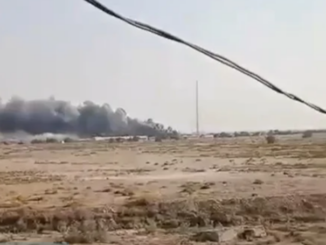
Iran warned that any US attack on its infrastructure would trigger a broader retaliation as the IRGC announced new regional strikes.
Key Developments
- Iran declared US interference in the Strait of Hormuz an “unbreakable red line.”
- Tehran warned attacks on Iranian infrastructure would prompt a broader military response.
- The IRGC said it struck a US command center and aircraft hangar at Al-Azraq Air Base in Jordan.
- The IRGC again called on Jordanians and Kuwaitis to oppose the US military presence.
Iran Declares Hormuz a ‘Red Line’
Iran warned on Thursday that any US attack on its critical infrastructure would trigger an unprecedented military response, while the Islamic Revolutionary Guard Corps (IRGC) announced new strikes targeting US military facilities in Jordan as the confrontation between Tehran and Washington continued to escalate.
Speaking on behalf of the Khatam al-Anbiya Central Headquarters, spokesperson Lieutenant Colonel Ibrahim Zolfaghari said Iran would never permit US interference in the Strait of Hormuz.
“The United States continues its arrogance and destabilizes the region’s security,” Zolfaghari said, stressing that Iran “will not allow, under any circumstances or in any way, the United States, as a country from outside the region, to interfere in the Strait of Hormuz.”
He described the strategic waterway as “an unbreakable red line.”
His remarks came days after Iran announced the closure of the Strait of Hormuz until US military intervention in the region comes to an end.
US Bombing Campaign Continues: Children’s Hospital Hit, Iran Retaliates
Warning over US Threats
Zolfaghari warned that if Washington follows through on President Donald Trump’s threats to strike Iranian infrastructure, Tehran’s response would extend across the region.
“If the recent threats by the hollow US president to target the infrastructure of the Islamic Republic of Iran are carried out, everything that has remained intact so far—the infrastructure in the region—will be crushed under the blows of the Iranian armed forces,” he said.
He added that Iran’s retaliation would not be limited to a proportional response.
“It will not be a symmetrical strike, but a superior strike—more intense, wider and more destructive than ever before,” he said, warning that “the fire of the wrath of a people who have never surrendered will burn the aggressor.”
Trump has recently threatened to target Iran’s power plants, bridges, oil facilities and water infrastructure unless Tehran accepts US demands regarding the Strait of Hormuz.
IRGC Announces Strike on US Base in Jordan
Separately, the IRGC announced that its Aerospace Force had destroyed a hangar housing US fighter aircraft and a newly established American command-and-control center at the US-operated Al-Azraq Air Base in Jordan.
According to the IRGC, the strike was carried out using advanced Khaibar Shakan ballistic missiles.
The statement described the operation as a successful strike against “a very large base belonging to the American occupation forces” in Jordan’s Azraq region.
Ghalibaf Warns of ‘Existential War’ as US Escalation Threatens Diplomacy
Messages to Jordan and Kuwait
The IRGC again appealed directly to the Jordanian people, urging them not to allow their territory to be used for military operations against Iran.
“You are the ones who have experienced firsthand the crimes of America and the Zionists more than any other people,” the statement said.
It called on Jordanians to “strike American interests with all your might” and to “cleanse your land of the American occupiers.”
The Guard also reiterated its message to Kuwait, saying Tehran harbors no hostility toward the Kuwaiti people while maintaining that US military bases on Kuwaiti territory have played a role in operations against Iran.
The latest statements follow another night of US attacks targeting southern Iran, including Bandar Abbas, Rask, Konarak, Ahvaz and areas surrounding Qeshm Island.
Iran has responded with successive waves of missile and drone strikes against US military installations and strategic facilities across the region, as military exchanges between the two countries continue to intensify.
(PC, Al Mayadeen, IRGC)