
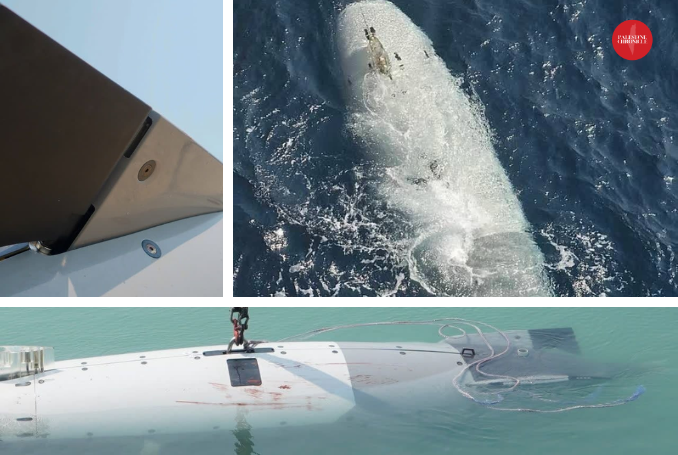

Iran’s IRGC Navy captured an advanced US unmanned underwater vehicle near Hormuz, hours after Iranian forces downed another American drone nearby.
Key Developments
- The IRGC Navy said it captured an advanced US unmanned underwater vehicle at the entrance to the Strait of Hormuz in a dawn intelligence and military operation.
- Iranian media identified the captured platform as the Dive-LD, an autonomous underwater vehicle manufactured by US defense company Anduril Industries.
- The operation came the same day Iran announced it had shot down a US MQ-1 drone over Bandar Abbas, amid escalating military confrontation around Hormuz.
IRGC Announces ‘Complex’ Capture Operation
Iran’s Islamic Revolution Guards Corps Navy announced on Tuesday that it had captured an advanced US unmanned underwater vehicle at the entrance to the Strait of Hormuz.
In a statement, the IRGC Navy said the vehicle was seized at dawn in what it described as a “complex intelligence and military effort.”
The IRGC described the captured platform as one of the newest and most advanced unmanned underwater systems in the US military fleet, equipped with sophisticated subsea technology.
Iranian state television had earlier signaled that the IRGC was preparing an announcement concerning what it called a significant “fishing operation” carried out by its naval forces in the Strait. The IRGC also released images of the captured vehicle.
⚡️BREAKING: The IRGC has released Footage of the Seizure of US Navy's Advanced Dive-LD Autonomous Underwater Vehicle
The United States was using it to Detect Mines in the Strait of Hormuz
The Dive-LD contains Classified Technology and Iran will likely Share it with Russia and… pic.twitter.com/JznS0A2C7T
— Iran Observer (@IranObserver0) September 8, 2026
Tasnim News Agency subsequently identified the system as a Dive-LD autonomous underwater vehicle developed by US defense technology company Anduril Industries.
The announcement came only hours after the Iranian Army said its forces had shot down a US MQ-1 unmanned aerial vehicle over Bandar Abbas, the strategically important Iranian port city overlooking the Strait of Hormuz.
What is the Dive-LD?
The Dive-LD is a large autonomous underwater vehicle designed to conduct extended missions without a crew.
According to specifications cited by Tasnim, the platform is approximately 5.8 meters long and weighs nearly three tons.
It can reportedly operate autonomously underwater for up to 10 days and descend to depths of approximately 6,000 meters.
The system uses a modular architecture and 3D-printed components, allowing different sensors and payloads to be incorporated according to the requirements of individual missions.
Its potential military applications include intelligence, surveillance and reconnaissance; intelligence preparation of the operational environment; mine warfare; and precision placement of equipment beneath the surface.
Iranian media also listed seabed mapping, mine detection, inspection of underwater cables and pipelines, support for anti-submarine operations and intelligence collection among potential applications.
The platform’s modular architecture allows mission equipment and sensors to be changed without redesigning the entire vehicle, significantly shortening the process of adapting it for different operations.
According to Tasnim, the first Dive-LD system was delivered in 2025 to a US Navy unit specializing in unmanned undersea systems.
🇮🇷🇺🇸 Iran dragged an American underwater drone out of the Strait of Hormuz, and this could become one of the most humiliating technological losses of the war.
The captured vessel appears to match Anduril's Dive-LD autonomous underwater vehicle, the kind of system America needs… pic.twitter.com/pTBNMlL2tc
— Mario Nawfal (@MarioNawfal) September 8, 2026
Escalation around Strait of Hormuz
The capture, if confirmed as described by the IRGC, would give Iran physical possession of a sophisticated US autonomous underwater platform at a particularly sensitive moment in the confrontation around the Strait of Hormuz.
The strategically vital waterway has increasingly become a focal point of direct military operations involving Iranian and US forces.
Tuesday’s announcement followed Iran’s reported downing of the MQ-1 over Bandar Abbas earlier in the day.
Two days earlier, the IRGC said it had targeted a US aircraft carrier and destroyer with ballistic missiles, reporting that the vessels were hit and subsequently forced to withdraw.
The IRGC has warned that continued attacks against Iran would trigger increasingly large retaliatory operations.
The latest incidents indicate that the confrontation is extending across multiple military domains around Hormuz, involving ballistic missiles, aerial drones, naval forces and now unmanned underwater systems.
(PC, Al Mayadeen, IRGC, Tasnim)



Be the first to comment