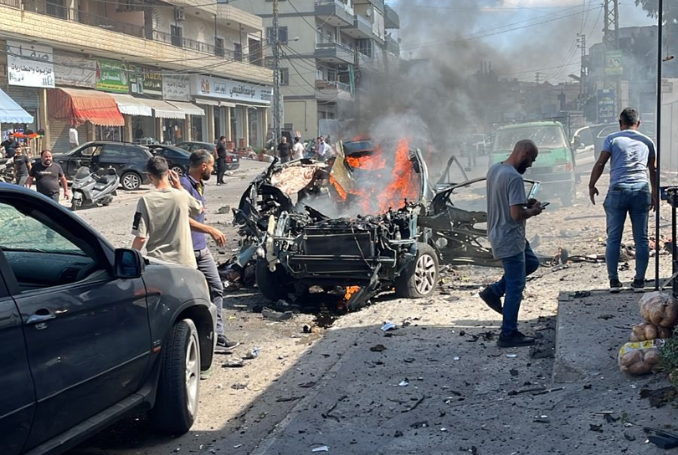

The Israeli army claimed that it had, “based on intelligence,” targeted Hezbollah infrastructure.
The Israeli occupation army launched a series of airstrikes on areas in South Lebanon on Thursday, yet another violation of the ceasefire agreement that came into effect exactly one year ago.
Israeli aircraft struck near the town of Zibqin in the Tyre district and also carried out two separate airstrikes on an area between the towns of Deir Siryan and Yahmar al-Shaqif in the Nabatieh district, Al-Jazeera Arabic reported.
According to a report by the Lebanese state news agency NNA, cited by the Anadolu news agency, the attacks targeted the towns of Mahmoudiya and Jarmak in the Iqlim al-Tuffah area.
Footage documents the Israeli airstrikes on al-Mahmoudiya in South Lebanon, in yet another violation of the ceasefire agreement.#Lebanon #SouthLebanon #BreakingNews pic.twitter.com/KgnfpVw81S
— Al Mayadeen English (@MayadeenEnglish) November 27, 2025
The Israeli army claimed that it had, “based on intelligence,” targeted Hezbollah infrastructure in several areas in south Lebanon.
The army also “struck a warehouse containing weapons” and “military positions” used by Hezbollah, claiming the presence of these infrastructures “constitute a violation of the understandings between Israel and Lebanon.”
Over 600 Airstrikes
Israel has carried out 669 airstrikes on Lebanon since a ceasefire took effect in November 2024, at a rate of two attacks per day, according to an Israeli security institute cited by the Anadolu news agency.
In the report, the Alma Research and Education Center found that 699 airstrikes were launched by the Israeli army across Lebanon over the past year on claims of targeting Hezbollah infrastructure, Anadolu reported.
A series of intense Israeli airstrikes hit Al-Jarmaq and Al-Mahmoudiya in southern Lebanon. pic.twitter.com/aqV4fOl1pU
— Quds News Network (@QudsNen) November 27, 2025
According to the report, 47 percent of the airstrikes hit south of the Litani River, and 38.4 percent north of it. The Bekaa region in eastern Lebanon was targeted by 13 percent of the attacks, while the remaining 1.6 percent which corresponds to 11 strikes, hit the capital Beirut, and its surrounding areas.
A ceasefire was reached between Tel Aviv and Beirut on November 27, 2024, after more than a year of attacks against the backdrop of Israel’s genocidal war on Gaza. Over 4,000 people were killed, and 17,000 others were injured in the attacks, the report added.
51 Strikes per Month
The majority of the attacks occurred in the first months of the ceasefire, with an average of 51 strikes per month.
The Israeli institute found that December 2024 and March 2025 recorded the highest number of airstrikes.
As Israel Hunts Leaders, Hezbollah Waits: What Will Another Israeli War on Lebanon Look Like?
On Sunday, senior Hezbollah commander Haitham Ali Tabatabai was killed in an Israeli airstrike in Beirut.
Under the ceasefire, the Israeli army was supposed to withdraw from south Lebanon this January, but instead only partially pulled out and continues to maintain a military presence at five border outposts.
Israeli Troop Withdrawal
Al-Jazeera Arabic reported on Thursday that Lebanese Parliament Speaker Nabih Berri said he was informed by the US that the Israeli army would withdraw on February 18 from the villages it occupies in south Lebanon but would remain at five border points inside Lebanon.
Berri said he had informed the head of the ceasefire agreement monitoring committee, US General Jasper Jeffers, on behalf of the President and the Prime Minister, of the absolute rejection of the continued presence of Israeli forces.
On to the Next Front: Israel Threatens Lebanon with a New War
For his part, Lebanese Defense Minister Michel Mansour said that the Lebanese government is working to secure the Israeli withdrawal from the south of the country. Mansour added that Lebanon is striving to implement UN Security Council Resolution 1701, but that Israel is obstructing its implementation.
Israel had previously announced that it wanted to keep its forces at five locations in southern Lebanon after February 18, a demand that Beirut strongly rejected, the report added.
UNIFIL Forces
Meanwhile, Paris announced on Thursday that it had proposed the deployment of UN peacekeepers (UNIFIL) in Lebanon, including French troops, to positions still occupied by the Israeli army in southern Lebanon, in order to facilitate a “complete and final Israeli withdrawal.”
Under the ceasefire agreement between Israel and Lebanon, in effect since November 27, the Lebanese army was to deploy in the south alongside the UN peacekeeping force, while the Israeli army was to withdraw within 60 days, a period later extended to February 18.
The agreement also stipulates that Hezbollah dismantle its military infrastructure in southern Lebanon, near the border with Israel, and withdraw from all areas south of the Litani River during this period.
(AJA, Anadolu, PC)