

Israeli forces killed three Lebanese soldiers while Israeli media criticized official narratives surrounding the occupation of Beaufort Castle.
Key Developments
- An Israeli airstrike killed two Lebanese Army officers and a soldier on the Kfartebnit-Khardali road in Nabatieh.
- Israeli attacks continued across southern Lebanon, killing at least six people in Saksakiyeh and striking multiple towns.
- Yedioth Ahronoth criticized Israel’s announcement of occupying Beaufort Castle, calling it an attempt to repackage a failing campaign.
Lebanese Officers Killed
Three members of the Lebanese Armed Forces were killed on Saturday after an Israeli strike targeted a military vehicle on the Kfartebnit-Khardali road in southern Lebanon.
In a statement, the Lebanese Army said two officers—a brigadier general and a captain—along with a soldier were killed in the attack.
The strike occurred in the Nabatieh governorate amid continuing Israeli military operations across southern Lebanon.
The Lebanese Army condemned the attack and accused Israel of deliberately targeting both the Lebanese state and its armed forces.
“The continued brutal, deliberate and repeated Israeli aggression against Lebanon, its people and its army only strengthens our determination, faith and resolve,” the army said.
The statement added that the attacks aim to undermine efforts to achieve stability, secure a comprehensive ceasefire and ensure an Israeli withdrawal from occupied Lebanese territory.
Israeli Attacks Continue
The strike on the military vehicle was part of a broader wave of Israeli attacks reported across southern Lebanon throughout Saturday.
According to Al-Mayadeen correspondents, Israeli warplanes and drones targeted multiple towns in Nabatieh, Sidon, Tyre and Jezzine districts.
Israeli attacks struck Deir al-Zahrani, Abba, Jwaya, Mashghara, Qatrani, Toul, the outskirts of Zebdine, Armata, Kfarhouneh, Ain Baal, Ansariyeh, Harouf, Arabsalim and Siddiqine.
Lebanon’s National News Agency reported that six people were killed and four others wounded in Israeli strikes on the town of Saksakiyeh.
Additional attacks continued throughout the afternoon as Israeli aircraft carried out successive raids on towns across the south.
بتاريخ ٦ / ٦ / ٢٠٢٦، استهدفت غارة عدوانية همجية إسرائيلية آلية عسكرية على طريق كفرتبنيت – الخردلي (النبطية)، أدت إلى استشهاد ضابطيَن، برتبتَي عميد ونقيب، وجندي.
إنّ استمرار العدوان الإسرائيلي الوحشي المتعمد والمتكرر على لبنان وشعبه وعلى الجيش، يزيدنا صلابةً وإيمانًا وعزمًا على… pic.twitter.com/B3xzC2HuTs— الجيش اللبناني (@LebarmyOfficial) June 6, 2026
Beaufort Castle Narrative
While military operations continued on the ground, Israel’s Yedioth Ahronoth newspaper published a sharply critical assessment of the government’s handling of the battle over Beaufort Castle, known in Arabic as Qalaat al-Shaqif.
The newspaper argued that this week’s announcement regarding the occupation of the historic site was primarily intended to serve domestic political objectives.
According to the report, Prime Minister Benjamin Netanyahu used the announcement as part of an effort to improve public opinion and “re-market the limping battle in the north.”
Yedioth Ahronoth drew comparisons with Israel’s 1982 invasion of Lebanon, which led to an 18-year military presence in southern Lebanon and significant Israeli casualties.
The newspaper noted that for many Israelis, Beaufort Castle evokes memories not of victory but of one of the most difficult chapters in Israel’s military involvement in Lebanon.
“The return to Beaufort Mountain carries no feeling of euphoria,” the newspaper wrote, arguing that the site remains associated with memories of prolonged conflict and loss.
The report further argued that symbolism has increasingly replaced strategic clarity in Israel’s current military campaign.
According to Yedioth Ahronoth, official narratives emphasizing concepts such as “absolute victory” have often overshadowed unresolved military and political realities on the ground.
“The symbolic dimension represents everything,” the newspaper wrote, criticizing efforts to frame battlefield developments through political slogans rather than measurable outcomes.
The paper also acknowledged that Israel today faces a far more complicated strategic environment than it did during the 1980s.
It argued that Israel emerged from Lebanon without what it described as a satisfactory settlement, allowing Hezbollah to grow into a far more powerful force over subsequent decades.
The newspaper additionally stated that Israel is fighting “with one hand tied behind its back,” claiming that US restrictions have limited its ability to pursue broader military objectives.
Israeli Media: Hezbollah Drones Have Become Army’s Deadliest Threat
Hezbollah Footage
The criticism from Israeli media followed the release of new reconnaissance footage by Hezbollah’s military media.
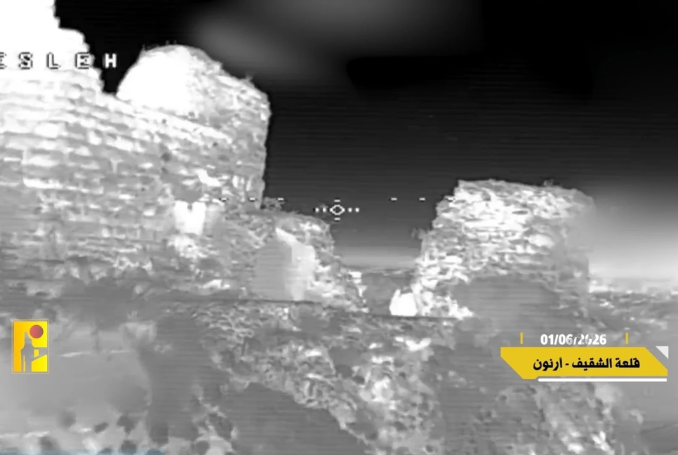
The video showed thermal-imaging footage recorded by an Ababil reconnaissance drone flying over Beaufort Castle and surrounding areas during the night.
The footage appeared to show the castle devoid of Israeli troops despite official Israeli claims regarding complete control of the site.
Hezbollah’s military media accompanied the footage with the message: “We came and did not find you.”
The statement suggested that Israeli declarations regarding control of the castle amounted to what Hezbollah described as a symbolic or propaganda victory rather than a sustained military presence.
The footage quickly gained attention across Lebanese and Israeli media, adding a new dimension to the debate over the strategic significance of the site and the reality of Israeli military deployments in southern Lebanon.
(Al-Mayadeen, NNA, Israeli Media, PC)



Weren’t the Lebanese soldiers helping Israel to eliminate Hezbollah? Well, doesn’t matter. Israel is no respecter of persons.