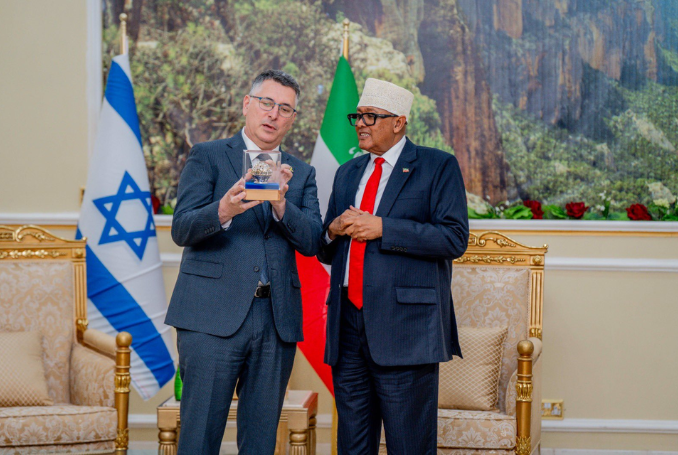

Gideon Saar’s trip underscored Israel’s intent to formalize ties with Somaliland despite strong regional opposition.
Israeli Foreign Minister Gideon Sa’ar visited Somaliland on Tuesday, Reuters reported, citing two sources. The visit came ten days after Israel formally recognized the self-declared Republic of Somaliland as an “independent state,” a move that marked an unprecedented break with international consensus on Somalia’s territorial integrity.
A senior Somaliland official said Saar met with President Abdirahman Mohamed Abdullahi to discuss ways to enhance bilateral ties, while a second source confirmed the Israeli foreign minister’s presence in the region.
Once a British protectorate, Somaliland declared independence from Somalia in 1991 but had remained diplomatically unrecognized for more than three decades.
Israel Recognizes Somaliland, Citing Abraham Accords Framework
Despite operating its own government, military, and currency, the territory has long relied on bilateral agreements with foreign governments and corporations—particularly in the fields of security and infrastructure—to strengthen its bid for international legitimacy.
Strategically located along the Gulf of Aden and bordering Ethiopia and Djibouti, Somaliland occupies a critical position near major maritime chokepoints linking the Red Sea to the Indian Ocean. Its port city of Berbera has increasingly attracted foreign military and commercial interest, particularly amid heightened regional tensions in the Red Sea.
Israel’s recognition of Somaliland followed more than two years of deepening diplomatic strain with several allies over its genocide in Gaza and escalating aggression across the occupied West Bank.
Analysts say the move reflected Tel Aviv’s broader effort to counter growing international isolation by expanding its strategic reach into Africa and the Horn of Africa in particular.
US Will Not Follow Israel’s Recognition of Somaliland, Trump Says
On December 26, Israeli Prime Minister Benjamin Netanyahu announced that Israel would formally recognize Somaliland as an “independent state,” 35 years after the territory declared independence.
Netanyahu framed the decision as consistent with the “spirit” of the US-brokered Abraham Accords, which normalized relations between Israel and several Arab states in 2020.
The announcement appeared to catch Washington off guard. The United States Department of State reiterated that it continued to recognize Somalia’s territorial integrity, including Somaliland. US President Donald Trump, when asked whether Washington would follow Israel’s lead, said the issue was “under study” and questioned Somaliland’s international standing.
Somaliland’s leadership welcomed Israel’s decision. President Abdullahi said at the time that Hargeisa would seek to join the Abraham Accords, portraying the recognition as a step toward regional and global peace.
Regional reaction, however, was swift and hostile. The African Union warned that recognizing Somaliland undermines Somalia’s sovereignty and risks setting a dangerous precedent for separatist movements across the continent. More than 20 Arab, Muslim, and African states—including Saudi Arabia, Egypt, Jordan, and Turkey—issued a joint statement warning of “serious repercussions” from the move.
Ansarallah Pledges Action Against Any Israeli Presence in Somaliland
Arab and Muslim states expressed particular concern that Israel’s recognition signaled a more assertive regional posture following Operation Al-Aqsa Flood, potentially granting the Israeli occupation a strategic foothold along the Gulf of Aden and the Red Sea.
Analysts warned that recognition could pave the way for Israeli military or intelligence access in Somaliland, strengthening operations aimed at countering Ansarallah, which has targeted Israeli-linked shipping and territory.
(PC, Al Mayadeen, Reuters)