
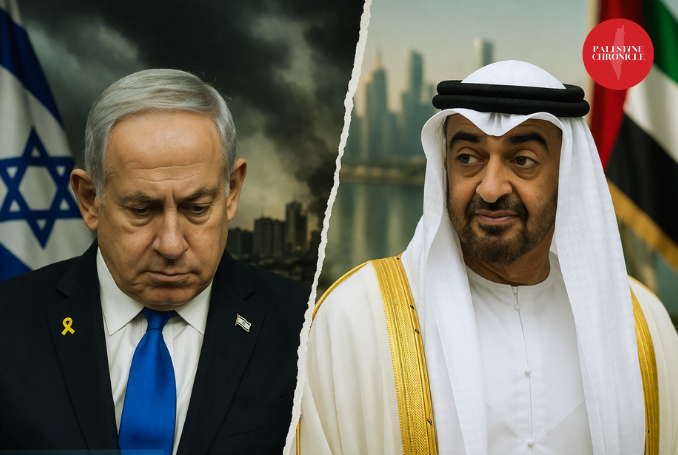

Israeli officials warn Iran war weakened normalization prospects, pushing Gulf states toward Tehran and Ankara amid shifting regional alliances.
Key Takeaways
- Israeli assessment says war “reduced chances” for normalization with Gulf and broader Muslim states.
- Gulf states expected to move closer to Iran and Turkey “not out of love, but necessity.”
- Senior Israeli official admits outcome “less good,” warning Israel emerges weaker across most of the region.
‘Reduced Chances for Normalization’
Israeli political and security circles are expressing growing pessimism over the future of normalization with Gulf states following the war with Iran, according to a report in Yedioth Ahronoth.
Senior Israeli officials now assess that “the results of the war with Iran, at least for now, are reducing the chances for normalization and alliances between Israel and Arab and moderate Muslim countries,” signaling a shift in regional expectations.
While Israel may have gained “a few points” for its willingness to confront what the report describes as “the monster of the Islamic Republic,” the broader outcome tells a different story.
“In the test of results,” the report states, “it appears that Gulf states will now want to move closer to Iran and Turkey—not out of love, but out of necessity.”
Strategic Repositioning
The report highlights that Gulf states, despite facing direct threats, deliberately avoided full alignment with Israel during the confrontation.
A senior Israeli official explained that “when you look at the final chord of the war, Gulf states knew exactly why they did not join the strikes on Iran,” even as they “absorbed ballistic missiles and drones almost submissively.”
Behind the scenes, however, the picture was different.
“They ran to the Americans behind closed doors and begged them not to stop and to bring down the regime,” the official said, while “outwardly projecting weakness.”
This dual approach, he suggested, was driven by fear that “the story would not end” and that “the United States would not finish the job,” leaving them exposed.
“They were afraid Iran would take revenge if they joined Israel and the United States,” he added, concluding that Gulf states calculated that “if they sat on the fence, they might have a chance at some forgiveness and leniency from the Iranians.”
‘They Will Pay a Heavy Price’
Despite this cautious strategy, the Israeli assessment carries a warning.
The same official argued that Gulf neutrality will ultimately come at a cost, stating that “they will pay a heavy price for this, especially in the Strait of Hormuz.”
This reflects Israeli frustration that regional actors chose risk avoidance over alignment, undermining efforts to build what Tel Aviv had envisioned as a broader security coalition.
‘Less Good for Now’
The most striking admission comes in the official’s summary of the war’s outcome.
“The result is less good for now,” he said, acknowledging that the war has “reduced the chances for normalization and alliances.”
He added that Gulf states “will want to move closer to Iran and will go with the Turks,” concluding bluntly: “In the Gulf, we are coming out weaker—except with the United Arab Emirates.”
UAE as the Exception
Amid the broader regional shift, the report identifies the United Arab Emirates as a notable exception.
“The security alliance and alignment of interests between it and Israel have strengthened greatly during the war,” the article notes, suggesting that cooperation between Abu Dhabi and Tel Aviv may continue—possibly even expanding “behind the scenes.”
However, even this exception does not offset the wider setback, as “on the surface, normalization appears to have taken a hit.”
Expanding Regional Impact
Israeli concerns extend beyond the Gulf.
According to the report, political circles in Tel Aviv are also observing a shift in North Africa and other regions, where countries are increasingly gravitating toward “the Turkish axis and forces associated with the Muslim Brotherhood.”
This trend is visible, the report notes, in countries such as Libya, Sudan, and Somalia, indicating a broader regional realignment that moves away from Israel.
Recalculating Alliances
Comments from Emirati officials further underscore the changing landscape.
Anwar Gargash, adviser to the UAE president, said that “it is too early to draw conclusions from the Iranian escalation,” emphasizing that the UAE will continue a “rational review of national priorities.”
He added that Abu Dhabi would “analyze carefully its regional and international relationships and identify its key partners,” framing future alliances around “the ability to protect national security.”
A Reversal of Expectations
Taken together, the Israeli assessment reflects a reversal of earlier expectations that the war would accelerate normalization and strengthen regional alliances.
Instead, officials now acknowledge a more complex and less favorable reality—one in which Gulf states hedge their positions, Iran retains influence, and Israel faces a region that is increasingly cautious about aligning too closely with it.
Ceasefire or Pause? The Gulf Held Hostage by Netanyahu’s War
(Yedioth Ahronoth, Israeli Media, PC)




As i’ve said for years, Judaism is a mental illness. ALL religists are literally delusional, but some people need something in their lives to provide some ‘ reward ‘ at the end. Why would there be a reward?
I feel for people who are duped into religiosity, it’s not their fault. But the Zionists, and some Judaists are exploiting the ethnic Jews. They are scummy people who would shoot children just to get their own way. That, and that alone should be the reason they are shunned and rejected. Yet most people – including lots of Israelis – are afraid to not embrace them.
Psychological terrorism 101.
The KEY to a peacful future is an independent sovereign PALESTINE STATE within 1967 boundaries, or a one state with EQUAL RIGHTS. Israel cannot bomb its way, or lobby out of this reality.