
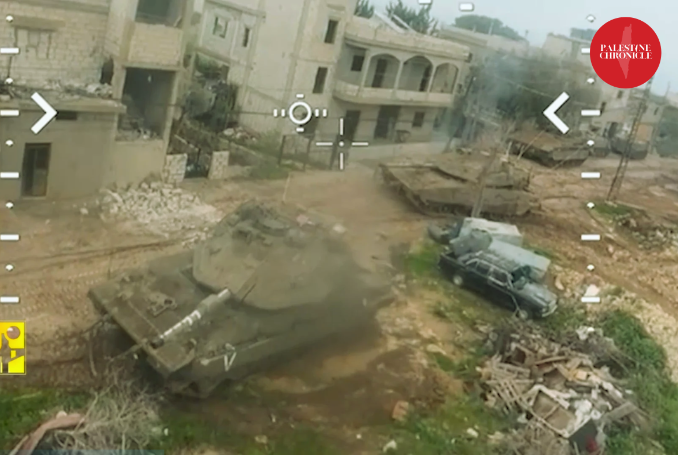

A Wall Street Journal report says Hezbollah’s expanding drone capabilities have become the leading cause of Israeli battlefield deaths.
Key Developments
- Hezbollah’s explosive drones have become the primary cause of Israeli military deaths since the April ceasefire, according to Israeli officials.
- The group is increasingly employing first-person-view drones, fiber-optic guidance systems and night operations inspired by battlefield developments in Ukraine.
- The growing threat has intensified pressure on Prime Minister Benjamin Netanyahu to escalate military operations in Lebanon.
Israel’s Primary Battlefield Concern
Hezbollah’s expanding use of explosive drones has become Israel’s most urgent military challenge on the Lebanese front, overtaking more traditional threats such as anti-tank missiles, according to a report published by the Wall Street Journal on Friday.
Israeli officials cited by the newspaper said Hezbollah drones are now responsible for the majority of Israeli battlefield fatalities since the ceasefire between Israel and Lebanon came into effect in April. Seven of the 11 Israeli soldiers killed during that period were reportedly killed in drone attacks.
The report describes a rapid evolution in Hezbollah’s drone operations, with fighters increasingly employing first-person-view (FPV) drones, night-vision capabilities and advanced guidance systems to strike Israeli forces and equipment.
Guerilla Warfare 101: Israel Has Fallen into Hezbollah Trap in Lebanon
Ukrainian Battlefield Tactics
According to the Wall Street Journal, recently released Hezbollah footage shows FPV drones targeting vulnerable sections of Israeli military vehicles, particularly fuel tanks, in tactics similar to those used extensively during the war in Ukraine.
Military analysts interviewed by the newspaper said the attacks appear designed to maximize secondary explosions and damage.
The report also noted evidence of Hezbollah deploying night-vision technology and conducting operations after dark, expanding the group’s operational flexibility beyond daylight hours.
Samuel Bendett, an adviser with CNA’s Russia Studies Program, told the newspaper that Hezbollah operators are steadily improving through combat experience.
“With each flight, each mission, Hezbollah pilots gain experience, whether the mission is successful or not,” Bendett said. “That’s how it works in Ukraine.”
Fiber-Optic Drones
A major issue highlighted in the report is Hezbollah’s increasing use of fiber-optic-guided drones.
According to an Israeli security official cited by the newspaper, approximately 80 percent of Hezbollah’s drones are controlled through fiber-optic cables rather than radio signals, making them largely immune to conventional electronic jamming systems.
The development significantly complicates Israeli counter-drone efforts and mirrors trends seen on the Ukrainian battlefield, where fiber-optic systems have increasingly been adopted to overcome electronic warfare measures.
The Israeli military told the newspaper that it is accelerating training efforts and expanding protective measures, including installing netting around vehicles and positions.
Hezbollah Drone Attack Kills Israeli Soldier as Resistance Mourns Mohammed Awda
Israeli Battlefield Vulnerabilities
Several drone warfare specialists interviewed by the Wall Street Journal argued that Hezbollah’s successes are not solely the result of technological advances but also reflect weaknesses in Israeli battlefield practices.
The report notes that Hezbollah footage appeared to show Israeli vehicles and equipment concentrated in exposed positions, with insufficient protection against drone attacks.
Former Ukrainian Unmanned Systems Forces officer Dmytro Putiata said some of the scenes reminded him of mistakes made by Russian forces during the early stages of the Ukraine war.
“What I see from Israel, it’s not acceptable,” Putiata told the newspaper. “How is it possible to ignore everything that has happened here in Ukraine?”
The report added that Israeli soldiers interviewed by the newspaper described a lack of specific training on how to confront the evolving drone threat.
One Israeli soldier stationed in Lebanon said troops had largely been instructed to remain indoors and rely on protective netting for equipment and weapons.
Political Pressure Builds on Netanyahu
The growing effectiveness of Hezbollah’s drone operations has intensified political pressure inside Israel.
According to the WSJ, lawmakers from both the governing coalition and opposition parties, along with residents of northern Israel, have criticized restrictions on Israeli military operations and called for stronger action against Hezbollah.
Israeli Prime Minister Benjamin Netanyahu responded this week by pledging to intensify operations in Lebanon.
“We are deepening our operation in Lebanon,” Netanyahu claimed, according to the report.
The newspaper noted that Israel has expanded strikes in southern Lebanon and issued wider evacuation warnings to civilians in areas targeted by military operations.
(PC, WSJ)



Be the first to comment