
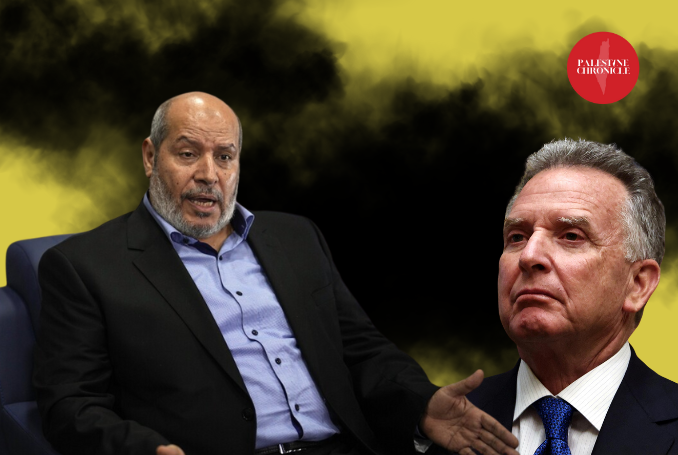

Ceasefire talks in Cairo stall amid US pressure to disarm resistance and Palestinian rejection of proposals lacking guarantees.
Key Developments
- Cairo talks stall amid tense meeting between Hamas and international envoy.
- US pressure to disarm resistance rejected by Palestinian factions.
- Palestinian groups present unified initiative to preserve ceasefire framework.
- Egyptian “bridging proposal” seeks phased implementation and renewed negotiations.
Tense Cairo Meeting Ends Without Breakthrough
Efforts to advance a ceasefire agreement in Gaza have suffered a setback following a tense round of negotiations in Cairo involving Palestinian factions, mediators, and international representatives.
According to informed sources cited by Al-Hadaf News and cited by Quds News Network, a meeting on April 13 between Hamas and the envoy of the so-called Peace Council, Nikolay Mladenov, was described as “stormy and tense” and failed to produce any concrete results.
The discussions broke down amid Mladenov’s insistence on securing Palestinian approval for a proposal centered on disarming the resistance, without addressing core Palestinian demands, including an end to Israeli attacks, humanitarian relief, and a political process leading to statehood.
US Pressure Deepens Tensions
The meeting was further complicated by what sources described as violations of agreed protocol.
These included the brief presence of the commander of the so-called International Stabilization Force, as well as the unexpected participation of Aryeh Lightstone, an advisor to US President Donald Trump.
According to sources, Lightstone adopted a confrontational tone, pressing for concessions and warning of escalatory consequences, contributing to heightened tensions during the talks.
Palestinian political groups viewed the intervention as an attempt to impose political conditions outside the framework of agreed negotiations.
Palestinian Factions Present Unified Position
Despite the failed meeting, Palestinian factions maintained coordination and agreed on a unified initiative to be presented through mediators.
The proposal emphasizes completing the implementation of the first phase of the agreement as a prerequisite for any further negotiations, describing it as a test of the seriousness of the process.
It also includes measures aimed at stabilizing conditions in Gaza, including establishing an administrative committee, supporting civilian resilience, and preventing collaboration with Israeli forces.
The initiative further calls for the deployment of international forces east of the Green Line as part of a phased Israeli withdrawal, ultimately leading to a political process culminating in Palestinian statehood.
Egyptian Proposal Seeks Breakthrough
Parallel to these developments, mediators, led by Egypt, have reportedly introduced what sources described as a “bridging proposal” aimed at breaking the deadlock.
The proposal calls for completing the remaining elements of the first phase while simultaneously launching negotiations on the second phase.
It also includes mechanisms designed to prevent Israel from advancing between phases without fulfilling its obligations, addressing concerns that the agreement could be used to evade commitments.
Negotiations Continue Under Pressure
Sources indicated that communication channels remain open despite the lack of progress, with intensified contacts ongoing between factions and mediators in an effort to prevent further escalation.
However, Palestinian officials warned that negotiations lacking tangible improvements on the ground—particularly an end to Israeli attacks—risk losing credibility.
They also cautioned that continued pressure and threats, coupled with what they described as “complete bias” by international actors, could undermine the entire negotiation process.
(PC, QNN, Arab media)


Rabbi Aryeh Lightstone, https://www.jpost.com/opinion/meet-aryeh-lightstone-behind-the-scenes-us-israel-facilitator-653943 and Christians United for Israel “Rabbi Aryeh Lightstone was the Senior Advisor to U.S. Ambassador to Israel David Friedman from 2017 to 2021. He played a key role in advancing U.S.-Israel relations, opening the U.S. Embassy in Jerusalem, and facilitating the Abraham Accords.” https://cufi.org/wp-content/uploads/2022/12/Rabbi-Aryeh-Lightstone-bio.pdf Palestine does not need nor want another Jared!