
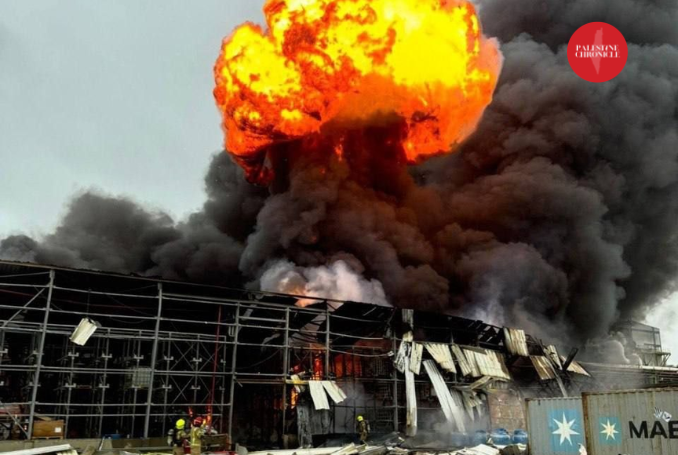

Iran’s strike on a Negev chemical facility signals escalation, targeting infrastructure tied to Israel’s nuclear ecosystem and Gaza war machinery.
Key Developments
- Iran is mirroring Israeli strikes on nuclear and industrial infrastructure with carefully selected high-value targets.
- The targeted facility lies within Israel’s southern industrial belt, near Dimona, where the country’s nuclear reactor is located.
- The same chemical-industrial base is tied, directly or indirectly, to materials used in Israel’s ongoing genocide in Gaza.
Iranian missile strikes hit a sensitive chemical facility in southern Israel on Sunday, injuring several people and triggering warnings of hazardous material leaks, according to Israeli emergency services and media reports.
The targeted site lies within the industrial zone of the Naqab (Negev), near Beersheba, an area that hosts some of Israel’s most critical chemical infrastructure. Israeli authorities confirmed that the facility contains dangerous substances, while reports indicated multiple impact points across the city following the strike, including widespread shrapnel damage.
Reuters reported that the facility struck was part of the Ne’ot Hovav industrial zone, identifying it as a chemical plant operated by ADAMA (Makhteshim Agan), one of Israel’s major agrochemical companies.
The attack formed part of a broader wave of Iranian missile barrages targeting southern and central Israel, including areas near Dimona, where Israel’s nuclear reactor is located.
Lebanese military analyst Brigadier General Hassan Jouni described the exchange as “messages on the edge of danger,” emphasizing that each side is responding with equivalent escalation, both in scale and in the nature of the targets.
🚨⭕️ ISRAELI CIVIL DEFENSE: Commander in Beersheba describes the incident as “difficult” following the strike. pic.twitter.com/l0yYo6uvAD
— The Palestine Chronicle (@PalestineChron) March 29, 2026
What Was Hit — And Why It Matters
The strike appears to have targeted a chemical facility in the Ne’ot Hovav industrial zone, though some reporting has linked the site to Rotem-related infrastructure nearby.
This area concentrates petrochemical plants, toxic waste facilities, and chemical manufacturing sites essential to Israel’s industrial economy.
Companies operating in or linked to the broader Negev chemical sector include major firms such as ADAMA and ICL, both involved in large-scale chemical and phosphate-based production.
At the core of this industrial ecosystem is the processing of chemical compounds derived from natural resources in the Negev, including phosphates. These materials are used in fertilizers and industrial chemicals, but also feed into more advanced chemical processes involving phosphorus compounds.
These compounds sit at the base of multiple industrial chains, including:
- Phosphorus derivatives are used in incendiary and smoke-producing munitions.
- Industrial chemicals used in fuel processing and explosives-related applications.
- Feedstock for broader chemical synthesis networks tied to defense industries.
This places the Negev chemical hub within a dual-use industrial framework, where civilian production overlaps with military capability.
🎦⭕️ WATCH: Additional footage shows the factory targeted in Bir Al-Saba (Beersheba) following the strike. pic.twitter.com/JK8Qo4STLx
— The Palestine Chronicle (@PalestineChron) March 29, 2026
The Nuclear Dimension
The deeper significance of the strike lies in the integration of the Negev’s industrial and nuclear landscape.
The targeted industrial zone lies within the same broader geographic region as the Dimona nuclear facility, widely understood to be central to Israel’s undeclared nuclear program.
Major industrial and mining activities in the Negev, including phosphate extraction, are located in proximity to Dimona, forming part of a wider strategic-industrial environment.
Some analysts and research institutions have noted that phosphate deposits can contain trace uranium and, under specific processes, may be used in uranium extraction.
While there is no verified evidence that the facility directly supports Israel’s nuclear weapons program, the broader ecosystem suggests an interlinked industrial landscape, where:
- Mining, chemical processing, and advanced materials production coexist.
- Industrial outputs can support both civilian and strategic applications.
- Nuclear-related infrastructure exists within the same geographic and industrial cluster.
In this sense, the strike targeted a zone embedded within Israel’s wider strategic depth, rather than an isolated civilian site.
🚨⭕️ BREAKING: Iranian rocket targets a factory in the Naqab (Negev) as smoke rises over Bir Al-Saba (Beersheba) following strikes. pic.twitter.com/Vc8ztRegac
— The Palestine Chronicle (@PalestineChron) March 29, 2026
From Negev to Gaza
The relevance of this infrastructure extends beyond nuclear considerations into the ongoing genocide in Gaza.
Israel’s use of white phosphorus in military operations has been documented and reported by international organizations and media outlets, drawing widespread scrutiny.
While specific production chains are not publicly disclosed, the industrial base that enables phosphorus processing is rooted in facilities like those operating in the Negev.
This creates a broader connection between:
- Phosphate extraction and chemical processing in the Negev.
- Production chains for phosphorus-based compounds.
- Deployment of such materials in military operations.
In the context of Israel’s genocide in Gaza, this industrial base takes on additional significance. It is not merely an economic asset, but part of the infrastructure that sustains prolonged military operations.
Three Salvos in 30 Minutes: Iran Strikes Naqab Chemical Site, Leak Fears Rise
A Calculated Strike
Iran’s choice of target reflects a deliberate and calibrated escalation pattern.
Rather than striking purely civilian areas or directly targeting Israel’s nuclear reactor, Tehran has focused on infrastructure that occupies a critical middle ground — industrial sites with strategic relevance.
The logic behind the strike can be understood through three interrelated signals:
- Precision: The ability to hit a sensitive industrial site despite Israeli air defenses.
- Strategic intent: Target selection within Israel’s industrial and nuclear-adjacent ecosystem.
- Controlled escalation: A message delivered near, but not directly against, the nuclear core.
By striking a site embedded within Israel’s chemical and strategic-industrial landscape, Iran has sent a layered message:
It can reach deep into Israel’s strategic core, disrupt the systems that sustain its military operations, and do so while still stopping short of a direct strike on the nuclear heart itself.
For now, that line remains intact. But it is being tested.
(Palestine Chronicle)






Thank you for your work!!!
Best regards.