
By Palestine Chronicle Editors
Israel’s killing of women journalists exposes a deliberate war on truth, masked by rhetoric of human rights and civilization.
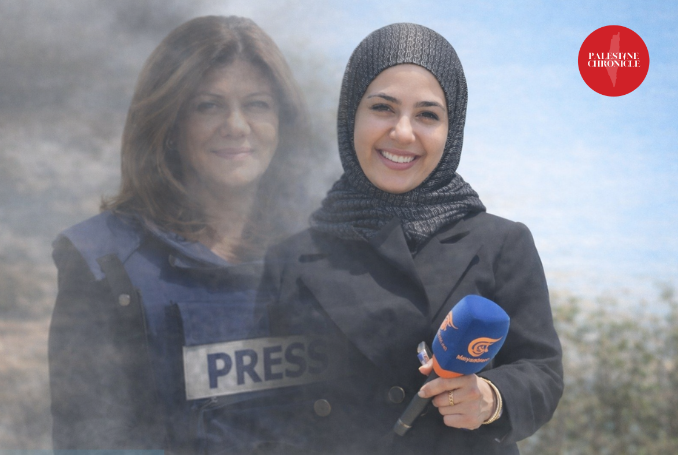
The killing of Shireen Abu Akleh on May 11, 2022, and the killing of Fatima Fattouni on March 28, 2026, are not tragic anomalies. They are part of a clear and ongoing pattern: Israel’s systematic targeting of journalists who document its wars.
Abu Akleh was shot by Israeli occupation forces in Jenin while wearing a clearly marked press vest. Fattouni was killed in an Israeli strike targeting journalists in southern Lebanon while carrying out her reporting duties. Both women were visible, identifiable, and unarmed. Both were documenting realities that contradicted official Israeli narratives. Both were killed.
These killings must be placed within the wider context of Israel’s genocide in Gaza, where more than 270 journalists and media workers have been killed since October 2023, according to aggregated Palestinian and international monitoring data.
The Committee to Protect Journalists has described Israel’s assault as the deadliest conflict for journalists since it began keeping records in 1992, noting that the Israeli military has carried out more targeted killings of journalists than any other government’s military on record. This is not collateral damage.
It is the systematic elimination of witnesses—transforming genocide itself into a war on truth.
In modern warfare, narrative is not secondary to military power—it is central to it. Control the story, and you control perception. Control perception, and you shape political outcomes. Journalists who report from the ground—especially Palestinian and regional journalists—disrupt that control. Their presence exposes the gap between official rhetoric and lived reality. For that reason, they are treated as threats.
The killing of Abu Akleh marked a turning point in global awareness, but not in policy. Despite international outrage, there was no meaningful accountability. The message was clear: even the most prominent Palestinian journalist could be killed without consequence.
Fattouni’s killing follows the same logic, but in a moment of intensified regional war. According to her own network, she played a central role in what was described as a “war of narrative,” confronting Israeli claims with on-the-ground reporting. That role made her a target.
This pattern extends far beyond individual cases. It reflects a broader historical continuity in how power operates.
In the colonial era, European empires justified conquest through the language of civilization. Today, that language has shifted to human rights, democracy, and the protection of women. But the structure remains fundamentally the same: moral language is used to sanitize domination, while the reality on the ground is mass killing, social destruction, and the silencing of those who bear witness.
Gaza is the clearest expression of that logic today. Israel’s assault is not merely another war wrapped in familiar rhetoric. It is genocide, and with genocide comes a parallel campaign of narrative control, intimidation, and erasure.
From Iraq to Afghanistan, from Libya to Gaza, and now Iran, wars have been justified as necessary interventions to protect civilians, uphold law, or defend universal values. Yet the outcomes tell a different story—one of destruction, displacement, and mass civilian death.
Women are central to this contradiction. They are invoked repeatedly in the language of war—used to justify intervention, occupation, bombardment, and sanctions. Yet in practice, they are among the primary victims of genocide and mass extermination.
In Gaza, women and children have made up a huge share of the dead, as entire families have been erased in Israeli airstrikes on homes, shelters, and so-called safe zones—spaces where women and children are most likely to be present. This is not incidental to the military campaign. It is one of its most predictable outcomes.
This pattern is not confined to Gaza or Palestine. In Minab, in Iran’s Hormozgan province, the Shajareh Tayyebeh girls’ primary school was struck on February 28, 2026, during the opening day of the US-Israeli attacks on Iran. UN experts said the strike reportedly killed at least 165 schoolgirls, while Amnesty International later said 168 people were killed, including more than 100 children.
Reporting by The Guardian identified the victims broadly as children and teachers, with at least 160 children and teachers among the dead. The massacre in Minab stripped bare, once again, the lie at the heart of imperial humanitarianism: women and girls are invoked as justification, then slaughtered when war arrives.
At the same time, women who refuse to remain symbols—women who speak, document, and expose—are targeted in a different way. Shireen Abu Akleh and Fatima Fattouni were not passive victims. They were active witnesses. They challenged dominant narratives. They humanized those under attack. For that, they were eliminated.
The selective elevation of certain women’s stories further exposes this contradiction. Figures such as Malala Yousafzai are rightly recognized for their courage, but their global prominence also reflects a broader pattern: women whose stories align with Western narratives are amplified, while those who expose Western-backed or Israeli violence are marginalized.
This is not a coincidence. It is a function of power.
The killing of journalists in Gaza, the assassination of Abu Akleh, and the killing of Fattouni together reveal a consistent strategy: silence the witnesses, control the narrative, and continue the war under the cover of moral language.
Israel’s actions must be understood within this framework. The invocation of security, democracy, and civilization does not obscure the reality on the ground—it enables it. From the genocide in Gaza to the killing of journalists across Palestine and Lebanon, what emerges is not a series of isolated incidents, but a coherent system of violence.
Shireen Abu Akleh and Fatima Fattouni were not exceptions to this system—they were among its most visible victims. Their killing forms part of a broader war on truth, one that accompanies genocide and mass extermination, ensuring that the voices capable of exposing them are silenced.
Israel Targets Media Vehicle, Kills Journalists in Southern Lebanon
(Palestine Chronicle)
It’s time to stop being afraid of Israel, and being afraid to call them out. I love the Jewish people, but not all of them. If you claim to like every last one of them, you’re lying. You like baby-killers? Rapists? People who would shoot a child in the face, and/or head, multiple times…..
A CHILD…
then you are a bad person.
Anyone who doesn’t stop the Israeli Jewish Nazis is also a baby-killer and/or rapist by proxy.