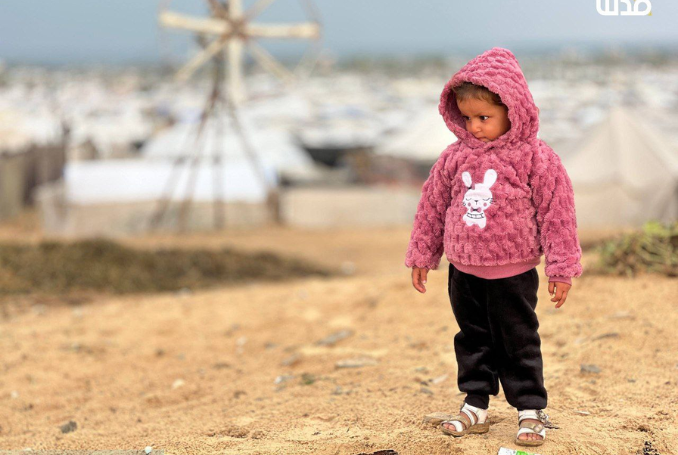
And in the middle of the painting sits the child. The one I saw among the ruins. Her tears have dried. Her eyes are not hopeful, but alive.
All these images. Little girls killed. Little boys mutilated. Women in white shrouds. Men silenced forever. It is as if the world has placed a hand over my mouth and demanded that I remain silent with them.
For a long time, I have been unable to write. An inner silence has lived inside me—not as an escape, but as a space in between. A room where everything suddenly stops and the surface cracks open. In those moments, in the midst of everyday noise, when thoughts finally quiet, there remains only a stillness—an almost sacred nothing. There, I search for the words I know are hiding somewhere. An image. A sentence I once heard. Something waiting to be found.
I try to approach the answer through books, articles, and reports. But it is often music that shows the way—a promise that something important lies just beyond reach, just beyond the outer edge of hearing.
This silence has become precious. In it, I meet myself without masks, without demands. But it is also in the silence that I feel something moving, a thought that refuses to appear yet refuses to be forgotten. Like a melody whose title you never remember, yet keep humming.
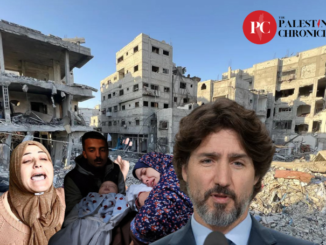
And then—one night around four o’clock—the silence breaks. A child calls out. Not sharply, not in panic, but gently, almost as if she is unsure whether she is allowed to be heard. She sits alone in my dream, small, surrounded by the ruins of a life that once existed. Around her lie the remains of houses, window frames staring blindly into the desolate landscape. Everything is dead. Only she is alive. She looks at me, and her gaze is so heavy I can hardly bear it. When I wake, the image remains. And I do not want to force it away.
In the afternoon, when my daughter Sigrid comes home from school, the house fills with the music she loves. She is fifteen and leads me into new worlds—songs I never would have heard without her. She sings along to Hamilton, fully immersed in a different kind of revolution. And then I hear the final song’s words: “Who lives, who dies, who tells your story.”
It is as if someone turns a key inside me. The words push open the door to what I have been unable to reach. The child from my dream steps forward—sharper, clearer. She is not only a child. She is one all the children in Gaza who never received a voice, a future, a life to be retold.
She is the story silenced by power—by politicians who shut out journalists, who denied the children their history. The Palestinian journalists who remained when the bombing began and who were killed for trying to tell the truth. PRESS on their backs became a target.
In my mind, I see Palmachim and Tel Nof, the bases where buttons are pressed that change lives on the ground. All the technology, the drones, the balloons, the cameras—a technical superiority aimed at people who have nothing. Gaza lies enclosed like a fist that never opens. When the children look up, they do not see sky; they see surveillance. They hear the drone of the machines that carry death. They know no movement is free. That someone far away sees them—and can extinguish their lives.
In bunkers, the soldiers sit protected, fed, with three screens before them. It looks like a video game. The boundary between play and death dissolves. I think of Katya, who recently played Fortnite with her friend in Spain. Battles without winners, only a pause before the next round. She says sometimes that her work feels just as unreal. Hour after hour of monotonous watching: everything registered, everything noted. A couple of children moving south. A shadow behind a wall. More happens in Fortnite. Here, waiting dominates.
She wonders what her colleagues do on the ground. One of them, young like her, carries something he cannot hold back. In a rare moment of vulnerability, he tells her that he had to kill two girls. No screen can protect him from that image. It will follow him every night.
And the weapons are not aimed at the armed. They are aimed at women and children, at journalists who only tried to tell the world. Who lives, who dies, who tells your story. Yet some managed to get out their final words—words that expose what Netanyahu, the Evil, tries to conceal. Evil has taken on a face.
Just over a year ago, I asked my friend Ramzy Baroud how his family in Gaza was doing. He answered briefly: nineteen dead, twelve missing. Thirty-one people—erased from a single family. Killed by young men and women who watched movements on a screen. Who will tell their story?
In a later dream, Evil himself stands in the Knesset. He sets up an easel, furious, and demands the darkest colors. He paints frenetically, layer upon layer of black, brown, earth, and blood. He tries to drive away all light—all hope.
And in the middle of the painting sits the child. The one I saw among the ruins. Her tears have dried. Her eyes are not hopeful, but alive. Surprised. She does not try to flee; she simply exists. Evil tries to paint over her, erase her. He shouts for more paint, darker shades. But her outline breaks through. She refuses to be hidden. Her gaze refuses to yield.
Maybe that is why she came to me.
Maybe she asks me to remember.
To write.
To carry her story a little further.
Maybe that is how silence speaks.
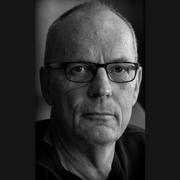
– – Mats Svensson, a former Swedish diplomat has been following the ongoing occupation of Palestine since 2003. He is the author of “Crimes, Victims and Witnesses – Apartheid in Palestine.” (Real African Publishers) and “Apartheid is a Crime – Portraits of Israeli Occupation,” (Cunepress, 2020). Mats contributed this article to Palestinchronicle.com. Mats can be reached at isbjorn2001@hotmail.com