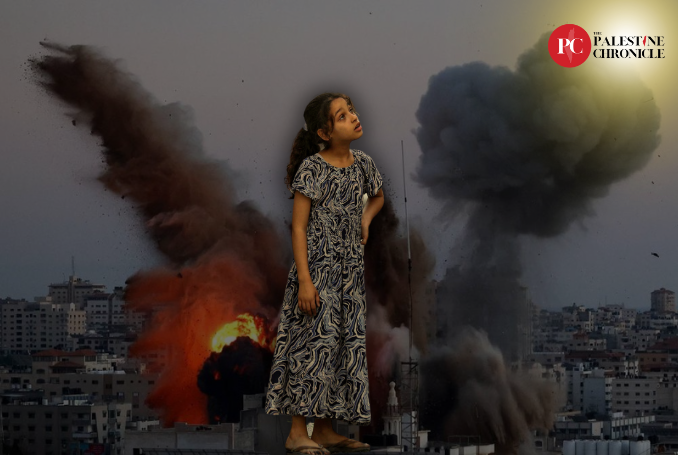

The UN OCHA says aid convoys have faced repeated rerouting orders from Israel for three consecutive days, forcing them to travel through the Philadelphi Corridor along the border with Egypt before moving up the narrow Coastal Road.
A UN official has said that humanitarian operations in the Gaza Strip remain heavily constrained “by ongoing restrictions” despite the ceasefire.
“The Office for the Coordination of Humanitarian Affairs (OCHA) says the scale-up of humanitarian operations continues under the ceasefire, but remains constrained by ongoing restrictions and other impediments,” Farhan Haq, deputy spokesperson for the UN Secretary-General, told reporters at a press briefing on Thursday.
Despite the ceasefire, Israeli forces continue large-scale demolitions and bombardments across Gaza, killing three Palestinians and worsening an already dire humanitarian situation.https://t.co/xUhpLJATYL pic.twitter.com/Ml5j0BPCSy
— The Palestine Chronicle (@PalestineChron) October 31, 2025
The OCHA noted that aid convoys have faced repeated rerouting orders from Israel for three consecutive days, forcing them to travel through the Philadelphi Corridor along the border with Egypt before moving up the narrow Coastal Road.
“This road is narrow, damaged, and heavily congested. Movement remained slower, even after the World Food Program (WFP) repaired the road. Additional crossings and internal routes are needed to expand collections and response,” Haq said.
Medical Point Reopened
He also pointed out that the UNRWA said it had reopened one of its medical points in Gaza City, which is providing essential care to families. In addition, the UN Office for Project Services (UNOPS) distributed nearly 210,000 liters of fuel across southern and northern Gaza.
People in #Gaza need healthcare, medication, and other vital services.
UNRWA has reopened one of our medical points in #Gaza City, providing essential care to many families. This is a lifeline for those most in need.
UNRWA health teams have now provided over 15 million… pic.twitter.com/83OW9DfbnE
— UNRWA (@UNRWA) October 30, 2025
This assists in ensuring critical operations are running in support of water, sanitation, health, food, rubble removal, essential telecommunications, education, protection and humanitarian logistics, Haq noted.
Bread Production
In its latest Situation Report, the OCHA said that two additional UN-supported bakeries resumed bread production in Gaza City.
“Overall, around 100,000 two-kilogram bread bundles are now being produced daily at nine UN-supported bakeries in Deir al Balah and Khan Younis, and 30,000 bundles at eight UN-supported bakeries in Gaza City,” the report stated.
🔴 Fresh bread is once again part of daily life for an estimated 700,000 people in #Gaza.
Bread is supplied through 15 @WFP supported bakeries — six of them are in Gaza City. These bakeries operate 22 hours a day to meet demand.
A bundle covers a family’s bread needs for a day. pic.twitter.com/HdigYoNBlp
— WFP in the Middle East & North Africa (@WFP_MENA) October 31, 2025
UNRWA, meanwhile, stated in its latest Situation Report that the UN agency’s “ability to restore services is limited by restrictions imposed by Israel to bring in vital supplies, including much-needed equipment to repair damaged facilities.”
The agency also continues “to face a ban on bringing humanitarian aid into the Strip”.
“Meanwhile, pre-positioned outside Gaza, UNRWA has enough food parcels for 1.1 million people, flour for 2.1 million individuals, and shelter supplies for up to 1.3 million people,” the agency noted.
Entry of Tents Limited
Gaza’s Government Media Office said on Friday that the Israeli occupation authorities did not allow the entry of the required quantities of tents, emphasizing that more than 300,000 tents were urgently required to meet the needs of the displaced population.
Over 250,000 Tons of Waste, Sewage Leaks, Water Shortage Endanger Gaza Lives
The Media Office said in a statement earlier this week that 7,000 trucks have entered the Strip since the start of the ceasefire on October 10, including only 1,500 aid trucks, “while the rest are commercial trucks sold to citizens.”
Staggering Death Toll
A US-brokered ceasefire came into effect on October 10 in the Strip. Over 200 Palestinians have, however, been killed since then, due to Israel’s violation of the ceasefire.
Starting on October 7, 2023, the Israeli military, with American support, launched a genocidal war against the people of Gaza. This campaign has so far resulted in the deaths of over 68,600 Palestinians, with more than 170,000 wounded. The vast majority of the population has been displaced, and the destruction of infrastructure is unprecedented since World War II. Thousands of people are still missing.
The condition of 15-year-old Helmi Barbakh, who suffers from quadriplegia and severe malnutrition, and was shot in the head by Israeli occupation forces, is worsening.
Even after the ceasefire agreement, Israeli border closures and restrictions preventing injured Palestinians… pic.twitter.com/3UoH6A6ci6
— Quds News Network (@QudsNen) October 31, 2025
In addition to the military assault, the Israeli blockade has caused a man-made famine, leading to the deaths of hundreds of Palestinians—mostly children—with hundreds of thousands more at risk.
Despite widespread international condemnation, little has been done to hold Israel accountable. The nation is currently under investigation for genocide by the International Court of Justice, while accused war criminals, including Prime Minister Benjamin Netanyahu, are officially wanted by the International Criminal Court.
(Anadolu, AJA, PC)