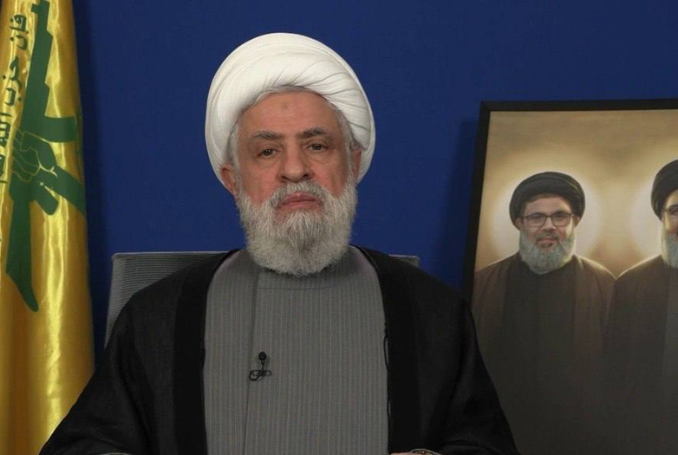

Qassem reaffirmed that Hezbollah’s weapons serve as a deterrent to Israel, and that calls to disarm the resistance align with Israeli strategic interests.
Hezbollah Secretary-General Sheikh Naim Qassem described the assassination of Commander Haitham Ali al-Tabatabai and his comrades as “a blatant act of aggression and a heinous crime,” reiterating that the movement reserves the right to respond at a time of its choosing.
Speaking during a memorial ceremony for the fallen commander and his four companions on Friday, Qassem said the assassination failed to achieve its intended objective and that Hezbollah would continue pursuing the same path. He stated that the killing of a leading figure in the military structure was aimed at undermining morale and creating confusion, but that this attempt had not succeeded.
On November 23, an Israeli airstrike targeted a residential building in Beirut’s southern suburb, killing Haitham Ali al-Tabatabai—Hezbollah’s Chief of Staff—and four others.
Ceasefire as a Strategic Gain
Qassem also addressed the one-year anniversary of the ceasefire and cessation of hostilities agreement, describing it as a victory for Hezbollah, Lebanon, and the Lebanese public. He argued that the agreement prevented Israel from accomplishing its declared objectives, particularly the elimination of the resistance.
Hezbollah Chief Naim Qassem:
The assassination of Tabatabai and his companions is a blatant attack and a clear crime.
We have the right to respond, and we will determine the timing for that. pic.twitter.com/uVZyYX7kbW
— Clash Report (@clashreport) November 28, 2025
He said the confrontation was carried out by a force significantly smaller than its adversary, yet rooted in determination, discipline, and a belief in eventual victory.
According to Qassem, the agreement was achieved because the resistance and its supporters remained steadfast, anchored by ideology, national belonging, and attachment to the land.
Lebanon, Sovereignty, and Resistance Weapons
Commenting on political tensions in Lebanon, including criticism directed at the President and the Army Commander, Qassem said Israeli aggression targets all Lebanese institutions, not just Hezbollah.
He reaffirmed that Hezbollah’s weapons serve as a deterrent to Israel, and that calls to disarm the resistance align with Israeli strategic interests.
While stating that the Lebanese state remains responsible for national defense, Qassem argued that it has neither secured liberation nor provided comprehensive protection. He urged the state to use the capabilities of the resistance to prevent Israel from establishing new facts on the ground.
Qassem also emphasized that opposition to Israel inside Lebanon extends beyond Hezbollah’s support base. Meanwhile, he accused a small domestic faction of working toward Israeli and US political agendas, hindering national unity and stability.
"Sayyed Abu Ali was asked to go to Yemen for training, and he left a clear imprint in that arena, until he became greatly loved by the Yemenis."
– Secretary-General of Hezbollah, His Eminence Sheikh Naim Qassem pic.twitter.com/phFy8965Gt
— مايا 𓂆🫒 (@AlAndalus074478) November 28, 2025
On Threats, Pressure, and Possible Escalation
Responding to international and regional pressure, Qassem said recent statements against Hezbollah amounted to political posturing after a year of unsuccessful attempts to shift the balance. He added that whether escalation or de-escalation occurs depends on decisions made by Israel and the United States.
Qassem maintained that neither Hezbollah nor its constituents would surrender or accept subordination to foreign powers, saying the only path forward is to halt Israeli aggression. If it continues, he said, the Lebanese government must assert itself and use available tools.
He added that the sacrifices of those killed would not be wasted, and called for internal unity, warning that concessions only encourage further coercion.
Additional Remarks
Qassem welcomed the upcoming visit of Pope Leo XIV to Lebanon and said an open letter addressed to him would soon be made public.
He also referred to the recent armed confrontation in Beit Jinn, Syria, calling it evidence that Syrians remain unwilling to accept Israeli control.
Speaking about Haitham Ali al-Tabatabai, Qassem described him as a key architect of the People of Might Battle, highlighting his operational planning, leadership, and readiness for evolving battlefield conditions.
Qassem concluded by reiterating that Hezbollah views the region as an active battlefield in which Israel operates with broad intelligence backing, including from the United States and Arab governments.
(PC, Al Mayadeen)