

The “framework agreement” signed by Israel and Lebanon in Washington on Friday was far from an ordinary event in the history of relations between the two sides.
The agreement quickly revived comparisons with the May 17, 1983 Agreement, signed by former Lebanese President Amin Gemayel and Israel under US mediation, before collapsing less than a year later under the weight of Lebanon’s internal divisions, Syrian opposition, and Israel’s continued occupation.
Today, more than four decades later, Lebanon once again finds itself facing a new agreement, also brokered by the United States, while Israeli forces remain inside Lebanese territory and the country is sharply divided over the future of Hezbollah’s weapons and the role of the Lebanese state in implementing security commitments.
Although the regional circumstances differ between the two periods, the comparison is based not on political or ideological similarities, but on clear objective elements:
Both agreements were signed after major Israeli wars in Lebanon.
Both linked Israeli withdrawal to security arrangements inside Lebanese territory.
Both were brokered by Washington.
And both were presented by the Lebanese authorities as a gateway to restoring sovereignty, while opponents viewed them as entrenching Israeli security demands more than restoring Lebanon’s full national sovereignty.
May 17 Agreement
The May 17 Agreement emerged after Israel’s 1982 invasion of Lebanon, when Israeli occupation forces reached Beirut for the first time, besieging the capital before the withdrawal of the Palestine Liberation Organization’s forces.
Following the assassination of President-elect Bashir Gemayel, his brother Amin Gemayel was elected president in September 1982 and entered indirect negotiations with Israel under US sponsorship, culminating in the signing of the agreement on May 17, 1983.
Those negotiations took place amid a severe imbalance of power. Israel occupied large swaths of Lebanese territory, including Beirut and extensive areas of the south, while the Lebanese state was emerging from civil war, its army weakened and divided, and Syrian forces maintained a presence elsewhere in the country.
This reality gave Israel the stronger negotiating position, allowing it to condition its withdrawal on specific political and security requirements, while the Lebanese government lacked the military means to impose an unconditional Israeli withdrawal.
As a result, the May 17 Agreement went beyond a simple military withdrawal. It included political and security arrangements intended, according to its text, to end the state of war between Lebanon and Israel, prevent attacks against Israel from Lebanese territory, establish mechanisms for security coordination, and provide for a phased Israeli withdrawal linked to the completion of security arrangements inside Lebanon.
That withdrawal, however, was also tied to the withdrawal of Syrian forces—a condition the Lebanese government had no ability to enforce—which later became one of the principal reasons for the agreement’s collapse.
The 2026 Washington Agreement
The June 2026 agreement followed several months of war between Israel and Hezbollah, during which Israeli forces advanced into southern Lebanon, seized border areas, and carried out extensive strikes against Hezbollah’s military infrastructure.
Negotiations sponsored by US President Donald Trump’s administration concluded with the signing of a framework agreement in Washington between representatives of the United States, Israel, and Lebanon, intended as the beginning of a broader political and security process.
The 2026 agreement is built on a similar principle in that it links Israeli withdrawal to security arrangements inside Lebanese territory.
The text refers to a “sequential process,” meaning that implementation will not occur all at once but through successive stages. The Lebanese state, through its army, is to extend its authority over designated areas while the disarmament of armed groups outside state control—chiefly Hezbollah—is verified before Israel proceeds with additional phases of military redeployment.
Another term requiring explanation is “pilot areas,” which appeared in statements by Israeli and American officials following the signing of the agreement.
The term refers to two areas in southern Lebanon where implementation will begin. Israeli forces will gradually withdraw from those areas while the Lebanese Army deploys, after which the success of the process will be assessed before moving on to additional areas.
Implementation is therefore based on the principle of “performance in exchange for withdrawal”: every Israeli step is matched by a Lebanese step toward extending state authority and disarming armed groups. It is worth noting that the agreement contains no timetable for Israeli withdrawal or for launching the pilot-area plan.
Here lies the first major similarity between the two agreements. In both cases, Israeli withdrawal is not presented as an immediate and unconditional obligation but is instead tied to security conditions inside Lebanon.
The difference lies in the nature of those conditions.
In 1983, they centered on preventing armed operations, establishing security arrangements in southern Lebanon, and linking Israeli withdrawal to the departure of Syrian forces.
In the 2026 agreement, they focus on dismantling Hezbollah’s military infrastructure, disarming the group, and deploying the Lebanese Army under a mechanism supervised by the United States through a trilateral military coordination group.
A reading of both the May 17, 1983 Agreement and the June 2026 Washington Agreement shows that, despite their differences, they share the same general philosophy. Both present themselves as a path toward Israeli withdrawal and the restoration of Lebanese state authority, yet both make that withdrawal contingent upon security arrangements inside Lebanon.
Here, “security arrangements” involve more than simply deploying the Lebanese Army. They seek to establish a security reality that prevents any Lebanese, Palestinian, or regional force from threatening Israel from Lebanese territory.
The May 17 Agreement stipulated an end to the state of war between Lebanon and Israel, mutual respect for each side’s sovereignty and territorial integrity, and a commitment by both parties not to use—or allow the use of—their territory for hostile acts against the other.
It also provided for Israeli withdrawal from Lebanon, but that withdrawal was accompanied by an extensive security annex specifying the nature of the Lebanese military presence in the south, troop numbers, permitted weapons, and mechanisms for coordination and oversight.
In that sense, the agreement was not merely a withdrawal agreement but one that reorganized southern Lebanon according to Israel’s security concerns. It gave Israel guarantees extending beyond withdrawal itself, addressing what would happen after Israeli forces left.
The 2026 agreement similarly declares that each side will respect the other’s sovereignty while laying the groundwork for normalization through a gradual process officially framed as restoring Lebanese sovereignty by dismantling Hezbollah’s military structure and disarming the group before Israel withdraws from the territories it occupied during the latest war.
The “gradual process” means Israeli withdrawal will not occur all at once or as an independent obligation. Instead, it will unfold in stages, beginning with the so-called pilot areas, where the Lebanese Army will deploy after Israeli withdrawal from two designated locations in southern Lebanon before implementation expands further.
This means that “sovereignty” is understood differently in the agreements than it is in official political discourse. Officially, Lebanese sovereignty means extending state authority across the country’s entire territory. In practice, however, sovereignty becomes conditional.
In 1983, Lebanon was expected to prevent hostile activity against Israel and implement security arrangements in the south. In 2026, Lebanon must demonstrate its ability to disarm Hezbollah and deploy the army in designated areas before Israel proceeds with broader withdrawal.
This does not mean the two agreements are identical. Rather, both incorporate Israel’s security requirements into the very definition of restoring Lebanese sovereignty.
Both agreements place Israel’s security demands ahead of complete withdrawal, making the Lebanese state responsible for fulfilling internal obligations—chiefly preventing any threat to Israel—before obtaining a full and clearly defined Israeli withdrawal.
In the May 17 Agreement, this appeared in three ways.
First, Israeli withdrawal was linked to security arrangements in southern Lebanon that Lebanon alone did not determine.
Second, Lebanon committed itself to preventing hostile activities against Israel from its territory—a clause that might appear ordinary between sovereign states but, under occupation, was viewed as an obligation imposed before the restoration of full sovereign decision-making.
Third, Israel also linked complete withdrawal to the departure of Syrian forces, a condition beyond the Lebanese government’s control.
For that reason, opponents argued that the agreement effectively granted Israel the right to remain in Lebanon as long as the regional condition remained unmet.
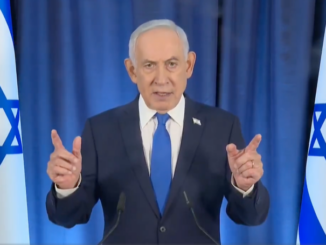
The same logic appears in the 2026 agreement, albeit in a different form. Israel does not simply state that it will withdraw when Lebanon requests it or according to a fixed timetable. Rather, according to statements by Israeli Prime Minister Benjamin Netanyahu, Israel will remain in the “security belt” in southern Lebanon as long as Hezbollah has not been disarmed and as long as Israel considers a threat to persist.
This effectively makes Israel’s own assessment of the security threat—not solely Lebanon’s implementation of the agreement—the criterion for withdrawal.
For Hezbollah and its allies, this means the agreement grants Israel the right to remain under the banner of security while assigning the Lebanese state the task of confronting the resistance before Israel is required to withdraw.
The term “security belt” also requires explanation.
Historically, it refers to an area in which Israel maintains a direct or indirect military presence near the border under the pretext of preventing attacks.
In the Lebanese context, the term is closely associated with Israel’s occupation of southern Lebanon before its withdrawal in 2000. In the 2026 discourse, it refers to areas in southern Lebanon where Israel says it must remain as long as Hezbollah continues to pose a threat.
The use of the term has therefore generated considerable sensitivity in Lebanon because it revives the logic of a temporary occupation that could become prolonged if Israel alone determines when the threat has ended.
From this perspective, Hezbollah’s description of the agreement as “a gift to the Israeli enemy” is based not merely on general political opposition but on the belief that Israel has obtained what it sought: an open-ended temporary military presence, an international mechanism to monitor Hezbollah’s weapons, and pressure on the Lebanese state to implement Hezbollah’s disarmament.
Marketing the Agreements
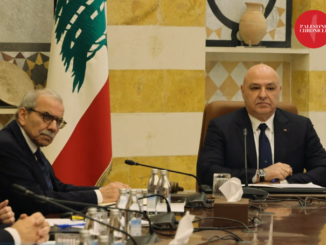
Joseph Aoun and Nawaf Salam have promoted the Washington agreement using language strikingly similar to that employed by Amin Gemayel in 1983: sovereignty, the state, the army, withdrawal, and the return of displaced residents.
According to international and Israeli media, President Aoun described the agreement as “the first step” toward restoring Lebanese sovereignty.
The Lebanese Embassy in Washington said the agreement begins with Israeli withdrawal from two pilot areas in the south and that these measures constitute “the first step toward a gradual and comprehensive withdrawal from all Lebanese territory,” while respecting Lebanon’s sovereignty.
Nawaf Salam likewise linked the agreement to the Taif Agreement and United Nations Security Council Resolution 1701, emphasizing the state’s exclusive right to bear arms and asserting that the ultimate objective is Israel’s withdrawal from all Lebanese territory.
Hezbollah Rejects the Agreement
Hezbollah was quick to respond to the agreement.
Hassan Fadlallah, a member of Hezbollah’s Loyalty to the Resistance parliamentary bloc and one of the party’s senior officials, outlined Hezbollah’s position in detail rather than merely rejecting the deal.
“Our opposition is serious, and we will not allow the authorities to implement their commitments on the ground,” Fadlallah said, arguing that the Lebanese authorities had “offered a gift to the Israeli enemy that will have no practical effect.”
He added that “this authority will not be able to impose its will on the Lebanese people,” claiming that “what happened in Washington is an attempt to derail the Islamabad process, and without the resistance nothing will pass.”
Fadlallah went further, arguing that the authorities “will not be able to implement the agreement signed in Washington unless they launch, with American support, a civil war.” He described the government as lacking constitutional and political legitimacy and said it did not possess the means to impose what he called external dictates.
He concluded with a direct message to Israeli Prime Minister Benjamin Netanyahu:
“We tell Netanyahu that you have reached an agreement with those who do not hold the real decision-making power. The state of hostility toward Israel will remain, and those who shake hands with the enemy do not represent the Lebanese people.”
(This analysis was provided by Quds News Network – translated and prepared by the Palestine Chronicle)



Even before the ink dried, “Israel” bombed an amusement park; zero military value but maximum terrorism. That’s the monster that Aoun and Salam just prostrated themselves.
“Israel” orders Lebanon to be the PA: protect “Israel” and repress the Lebanese people.
Merge Hezbollah with the Lebanese Army, like President Aoun wanted before the US/”Israeli” screaming. Doing this puts all arms under the Lebanese Army and “disbands” Hezbollah. No need to “security belts”. “Israel” must withdraw entirely and at once. Lebanese sovereignty protected by Lebanon alone.
Iuck Fsrael.
Wasrael 2026!