
The Israeli Shin Bet informed Murad that he would be released to his home in Jalbun, but, at the last minute, Abu al-Rub was surprised to learn that he would be deported to Egypt.
A Palestinian prisoner released in the recent deal revealed, in an interview with The Palestine Chronicle, that they were subjected to severe torture until the last moment before their release.
Murad Abu al-Rub, 45, from the village of Jalbun near Jenin, was detained 20 years ago and sentenced to life imprisonment. However, he said that his last day in prison was more difficult than his 20 years.
The Israeli Shin Bet informed Murad that he would be released to his home in Jalbun, but, at the last minute, Abu al-Rub was surprised to learn that he would be deported to Egypt.
Under the recent deal with the Palestinian Resistance, Israel released 250 Palestinian prisoners serving life sentences and long prison terms, as well as 1,700 prisoners from the Gaza Strip who were arrested after the war, in exchange for Hamas releasing the remaining 20 Israeli prisoners.
The Addameer Association for Human Rights reported that, after the deal, more than 9,100 Palestinian prisoners remain in Israeli prisons, including 400 children and 53 women.
‘Emerging from the Jaws of Death’ – Settler Violence Ravages Palestine’s Olive Harvest
Intent to Kill
The day before the deal was harsh; the prisoners included in the deal were transferred from all prisons to Ofer Prison in preparation for their release. However, this journey was accompanied by torture and humiliation.
“They transferred me from Rimon Prison to Ofer Prison, where we stayed from dawn until 10:00 pm. Then they informed me that I wouldn’t be released to Jenin, but would be deported to Egypt because I posed a threat to state security. There, I thought a lot about my family, who were eagerly awaiting my release and had prepared the house to receive me,” Abu al-Rub said.
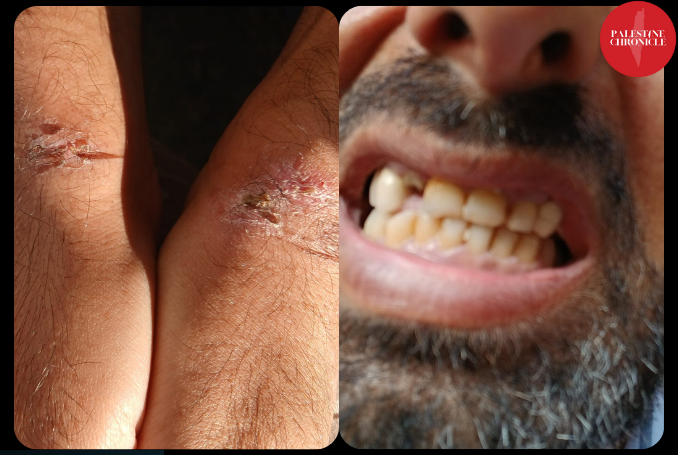
While the prisoners scheduled for release were held in Ofer Prison, they were assaulted several times and beaten with iron rods while handcuffed. Traces of torture and beatings remained on their bodies even after two weeks had passed since their release.
After placing them in specific, dark rooms, masked men entered and began brutally beating the prisoners, deliberately targeting their hands, chests, and heads to cause the greatest possible damage.
“I suffered broken ribs after being repeatedly punched in the chest. My tooth was also broken from the punches I received. Some prisoners suffered fractures in their noses, faces, and hands,” he added.
Six Days Without Food: Umm al-Khair Women Secure Odeh Hadhalin’s Farewell
The handcuffs and leg cuffs were so tight that they dug into the skin and flesh and, for some prisoners, they reached the bone. The lack of medical follow-up led to numerous complications. One prisoner’s leg was constantly swollen and painful. After his release, Abu al-Rub went to the doctor, who found it was broken.
“From the moment we were informed that we would be released, Israel intended to kill us. The iron cuffs remained on our hands for 36 consecutive hours and the day of our release was the most difficult in our twenty years. We were subjected to torture for 15 hours, forced to kneel on a floor covered in gravel and broken glass, barefoot. Our legs bled and the gravel penetrated into our bodies,” he continued.
95 prisoners were released from Nafha and Rimon prisons to their homes in the West Bank, but they were surprised to find that 25 of them were deported at the last minute, while their families were waiting for their arrival in Ramallah.
“I actually cried when I learned I was being deported. No one likes being away from their homeland and their families. It’s a malicious policy because it means deporting entire families outside Palestine as part of a policy of soft displacement,” Abu al-Rub explained.
Torture Centers
According to the Palestinian Authority of Prisoners’ Affairs, Israel intensified its repressive measures against prisoners, coinciding with the outbreak of the war on Gaza in October 2023.
‘I Wished for Death’: A Palestinian Man’s Torture at an Israeli Checkpoint
Abu Al-Rub explained these conditions, having lost 30 kg and considering himself lucky, as many lost 40 or 50 kg due to deliberate malnutrition.
The Israeli Prison Service’s policy was to give prisoners 1,000 calories per day, while the average man needs more than 2,000 calories to perform normal activities. Weight loss and physical sagging were clearly evident on the prisoners.
Breakfast consisted of 5-8 grams of jam, 10-15 grams of yogurt, and four slices of bread. Lunch consisted of five spoonfuls of half-cooked rice, half a small cup of tasteless soup, four slices of bread, and a hard-boiled egg prepared several days earlier.
In addition to the systematic starvation campaign, the prisoners were subjected to constant, unjustified beatings by the so-called Special Forces, to the point that the prisons were transformed into torture centers that witnessed the deaths of 80 prisoners in just two years.
“The Special Forces would suddenly enter the rooms, armed and accompanied by police dogs, claiming that the prisoners had broken the rules when, in fact, there was nothing in the room to break the rules with—just mattresses and nothing else. They would begin to tie us up behind our backs, lower our heads, and beat us severely until we bled,” Abu al-Rub said.
Mustafa Abu Arra, 63, an elderly prisoner, had been held in administrative detention since the beginning of the war and suffered from chronic illnesses. He was severely beaten, despite the guards knowing he was ill. He returned to the room unable to walk, and a day later, he began struggling to breathe.
Losing Deir Dibwan: The New Frontier of Israeli Annexation in the West Bank
“This prisoner was in the section I was in. He suddenly fell to the ground, unable to breathe because they had hit him in the chest. We shouted at them to get him medical treatment, but they didn’t respond. Hours later, when his condition worsened and he fainted, they took him to the hospital, and then we learned he had died,” Abu al-Rub added.
There is no medical follow-up for prisoners inside the prison. Those who take regular medication are denied it from the moment of arrest. Any prisoner who experiences a health problem is left to face their fate alone.
“They would throw us in chains in a yard for a whole day, insulting us and cursing us. Our heads had to be kept on the ground. Then they would fire tear gas at us, and we were powerless. We were suffocated before their eyes, and they didn’t move a finger. Nazi methods were used against us—even more so in food and treatment—and we were prevented from worshipping,” the former detainee explained.
Incomplete Freedom
The footage being published of Israeli National Security Minister Itamar Ben-Gvir insulting Palestinian prisoners breaks the hearts of released prisoners and makes them feel guilty for leaving thousands behind to face an unknown fate.
“We don’t feel completely free because there are more than 9,000 prisoners suffering from systematic oppression, including 125 life-sentenced prisoners whose ages don’t allow them to go on strike or protest. When I saw Ben-Gvir’s video, I said it would have been better if I had stayed in prison with them because it’s an extremely difficult feeling to leave them behind.”
When Abu al-Rub was released from Rimon Prison, an elderly prisoner who had been arrested 33 years earlier and sentenced to life imprisonment said to him, “Don’t forget me.” He wept bitterly and wished that the prisoner’s name had been replaced by his own.
Inside the Torture Cells: How Israel is ‘Slowly Killing’ Palestinian Resistance Leaders
Despite his deportation to Egypt, the Israeli army raided his family’s home in Jenin, destroying its contents and threatening his relatives not to show any signs of joy or celebration of his freedom, warning that the home would be demolished if they did.
To this day, Israel prevents the Abu al-Rub family and the families of most of the released prisoners deported to Egypt from traveling to meet their sons after long years of absence, beginning a second journey of suffering for them.
“I watched an interview with an Israeli journalist and an Israeli officer who told the journalist, ‘My mission is to prevent the teeth of the released prisoners from showing—that is, to prevent even their smiles.’ The journalist responded: ‘But inside they are happy.’ The officer said, ‘I cannot prevent their happiness inside, but it is forbidden for them to show any happiness.’ Happiness is forbidden in any Palestinian home,” Abu al-Rub concluded.
(The Palestine Chronicle)
– Fayha’ Shalash is a Ramallah-based Palestinian journalist. She graduated from Birzeit University in 2008 and she has been working as a reporter and broadcaster ever since. Her articles appeared in several online publications. She contributed this article to The Palestine Chronicle.




Be the first to comment