
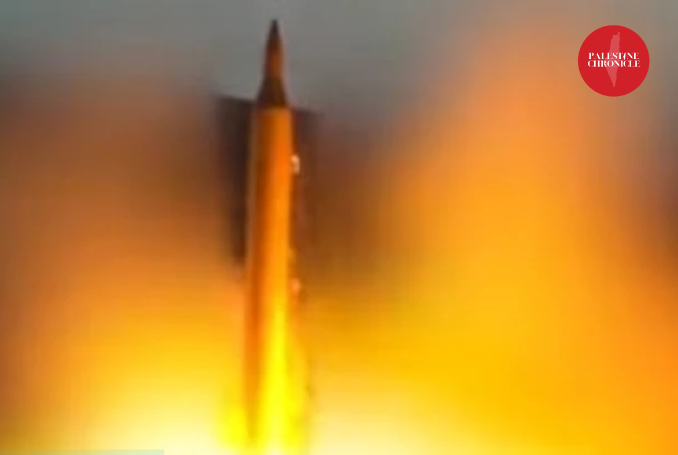

Iran announced final pre-ceasefire escalation with sweeping strikes across regional energy and military targets, framing it as a decisive closing operation.
Key Takeaways
- Iran declares “100th wave” as final large-scale operation before ceasefire.
- Strikes targeted energy infrastructure, military sites, and US-linked facilities across the region.
- Tehran frames operation as decisive “last shot” before negotiations phase.
Final Wave Before Ceasefire
Iran’s Revolutionary Guard announced the launch of the 100th wave of Operation True Promise 4, presenting it as a culminating military action carried out just before the ceasefire took hold.
The operation, conducted using ballistic missiles, cruise missiles, and drones, was described as targeting more than 25 strategic sites across the region, including energy infrastructure, military installations, and technological facilities linked to the United States and Israel.
The timing and scale of the announcement position the operation as what Iranian messaging suggests was effectively the last major strike before the truce—a final demonstration of force before negotiations move forward.
Wave 100 of the Islamic Revolutionary Guard Corps is dedicated to Sayyed Hassan Nasrallah and the martyred Bahraini, Muhammad al-Musawi. pic.twitter.com/WUwjC4AqDF
— S. Blackwood | Briefs (@BlackwoodBrief) April 8, 2026
Energy Infrastructure at the Center
A significant portion of the targets listed by the Revolutionary Guard focused on energy infrastructure tied to US companies and regional supply chains.
Among the sites cited were oil and gas facilities associated with Chevron in Saudi Arabia, ExxonMobil and Dow Chemical in Jubail, and multiple refineries and pipelines across Saudi Arabia, the UAE, Qatar, Bahrain, and Kuwait.
Facilities in Yanbu, Ras Laffan, Al-Ahmadi, and Zirkuh island were all identified, alongside infrastructure linked to the Dolphin gas project and major refining complexes such as SATORP and Al-Munifa.
The selection of targets reflects a focus on global energy flows, particularly infrastructure connected to exports, refining capacity, and routes designed to bypass chokepoints like the Strait of Hormuz.
Military and Strategic Targets
Alongside energy infrastructure, the operation included strikes on military and strategic sites.
The Revolutionary Guard listed Ben Gurion Airport, the Haifa oil refinery, and command and intelligence centers in Tel Aviv among its targets, as well as technological facilities in Beersheba.
It also claimed to have struck US Central Command-linked positions in the Azraq region of Jordan, along with logistical and security installations.
These targets align with a broader pattern seen throughout the war, combining economic pressure with strikes on military and command infrastructure.
Iran to Table 10-Point Framework in Islamabad Talks after Ceasefire on Its Terms
Maritime Dimension and Naval Pressure
The IRGC also highlighted a maritime component to the operation, stating that its naval forces continued to exercise what it described as “intelligent control over maritime routes in the Strait of Hormuz.”
It claimed that a US amphibious assault ship was hit by cruise missiles, causing damage and forcing its withdrawal, and that another aircraft carrier sustained drone damage before retreating.
Additional targets included an American base in Kuwait and facilities linked to US energy investments in the Gulf.
While such claims remain part of Iranian official messaging, their inclusion underscores Tehran’s attempt to frame the operation as spanning land, air, and sea domains.
A ‘Closing Statement’
Beyond the military details, the announcement carried a strong political message.
The Revolutionary Guard said the operation was carried out “as a dedication to the nation’s leader, the martyr Sayed Ali Khamenei,” framing it within a narrative of continuity and sacrifice.
In a message to the Iranian public, it praised what it described as sustained popular mobilization, stating: “Your sincere and amazing presence for forty days and nights in the streets of the Islamic homeland of Iran has created an unparalleled historical epic.”
“Through your sincerity, struggle, sacrifices, insight, lofty vision, and learned understanding, along with your unity, loyalty, and love for the state, you have presented a complete picture,” it added.
The statement concluded by asserting that Iranian forces had responded decisively, saying they “performed their duty to the fullest extent.”
(PC, Iranian media, IRGC Statement, Al Mayadeen)

One of my friends told me today, ” the leaders of Iran used children as human shields on the bridges so they wouldn’t be struck… ”
🤦♂️
ok, so…they’ve literally won both
” wars ” over the past year alone. Why would they need to do that?
No, they asked the citizens to show solidarity and surround vital areas that might have been bombed, like…go ahead we dare you to strike civilians standing up for themselves. Most people are brainwashed. The Main Stream Media is the same as MKUltra.