
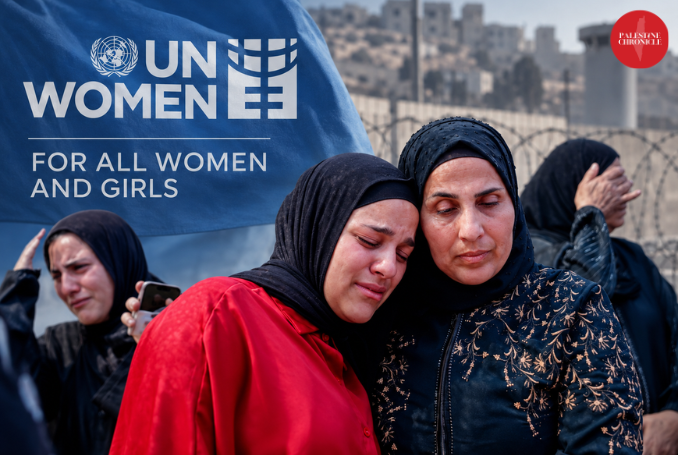

One in eight West Bank households is headed by a woman, with UN Women estimating some 83,200 women-headed households.
Key Takeaways
- Women-headed households face disproportionate displacement and hardship: 40% have been displaced, half are skipping meals and two-thirds have resorted to loans.
- Checkpoints compound the risks: every woman household head surveyed said she avoided checkpoints, while nearly nine in ten said they made travel feel unsafe.
- Palestinian women are increasingly carrying responsibility for keeping families together amid displacement, economic hardship and unprecedented movement restrictions across the occupied West Bank, a new UN Women analysis has found.
The UN agency estimates that approximately 83,200 households — one in every eight in the occupied West Bank — are now headed by women, warning that the figure is likely an underestimate.
For these women, assuming responsibility for a household often means simultaneously finding income, securing food and humanitarian assistance, caring for children and deciding how to keep their families safe amid escalating Israeli military operations, settler violence, demolitions and displacement.
“Women who suddenly find themselves heading households must earn an income, secure assistance and protect their families under extremely difficult conditions,” Sofia Calltorp, UN Women’s chief of humanitarian action, said.
The findings, released Tuesday, provide a detailed picture of how the rapidly deteriorating situation in the West Bank is affecting Palestinian women differently — and, in several areas, more severely.
Women Carry the Household
Among Palestinian women formally recognized as household heads, 82 percent manage household income, according to UN Women.
Another 77 percent are responsible for childcare, while 75 percent make all decisions concerning the safety of household members.
Nearly two-thirds — 65 percent — handle humanitarian aid registration alone.
These responsibilities are being assumed amid widespread displacement. More than 41,500 Palestinians have been displaced across the occupied West Bank, including more than 20,000 women and girls.
Women-headed households appear particularly vulnerable: 40 percent are no longer living in their original homes, compared with 30 percent of households headed by men.
The consequences extend directly to food and other basic necessities. Two-thirds of women-headed households surveyed said they were coping by taking out loans, while half reported skipping meals.
Among households containing someone with a chronic illness, more than half reported unmet cash needs.
925 Obstacles to Movement
For Palestinian women attempting to sustain their families, simply moving through the West Bank has itself become a source of insecurity.
UN Women said there are now 925 movement obstacles, including Israeli checkpoints, road barriers and trenches, across the occupied territory — the highest number recorded in two decades.
Nearly nine in ten women heading households said checkpoints made traveling feel unsafe.
Every woman heading a household interviewed for the report said she avoided checkpoints altogether.
More than half said Israeli movement restrictions were preventing them from accessing livelihoods.
The restrictions can affect virtually every aspect of daily life: reaching work, collecting humanitarian aid, accessing healthcare or moving children and other relatives to safety.
Forty percent of all checkpoints are concentrated in the H2 area of Hebron (Al Khalil).
Fear of Violence
The restrictions come amid increasing fears of violence. UN Women said one in five women heading households feared gender-based violence, more than twice the rate reported among women living in male-headed households.
Women navigating checkpoints, collecting assistance and moving through public spaces face disproportionate exposure to harassment, intimidation and gender-based violence, the agency said.
The problem forms part of a broader climate of insecurity in which more than three-quarters of Palestinians surveyed in the West Bank said they felt unsafe in their everyday lives.
Women also reported fears of detention. Fifty-seven percent of women heading households said they feared being arrested.
Displacement, Illness and Hunger
The findings reveal how multiple pressures can accumulate within the same household.
Nearly two-thirds of women heading households reported chronic illness among family members, compared with 41 percent of male-headed households.
More than one-quarter of women household heads themselves reported having a disability.
That combination can reduce a family’s capacity to earn an income while increasing its need for medicines, healthcare, transportation, and care.
Yet one in four women-headed households receives no humanitarian assistance at all, according to UN Women.
Even among those receiving assistance, cash remains the largest unmet need. More than 70 percent of respondents said they had not been consulted during the previous year about how, when or where humanitarian assistance should be delivered.
Protecting Women
The findings come as Israeli military operations, settler attacks, demolitions and displacement have intensified across the occupied West Bank and East Jerusalem.
For Palestinian women, UN Women’s analysis suggests that these developments are not experienced simply as a broader security crisis.
They are reshaping everyday responsibilities inside Palestinian families — placing women at the center of efforts to secure income and food, care for children and sick relatives, obtain humanitarian assistance and navigate an increasingly fragmented territory.
UN Women called for an immediate end to violence, movement restrictions and home demolitions and urged dedicated assistance for women-headed households combining livelihoods, social protection, healthcare, shelter and protection services.
The agency said it continues working with Palestinian women-led organizations, providing legal assistance, psychosocial support, protection and access to aid.
Palestinian Detainee Gives Birth in Israeli Prison after Six Months without Charge
(PC, UN Women, Anadolu)




Be the first to comment