
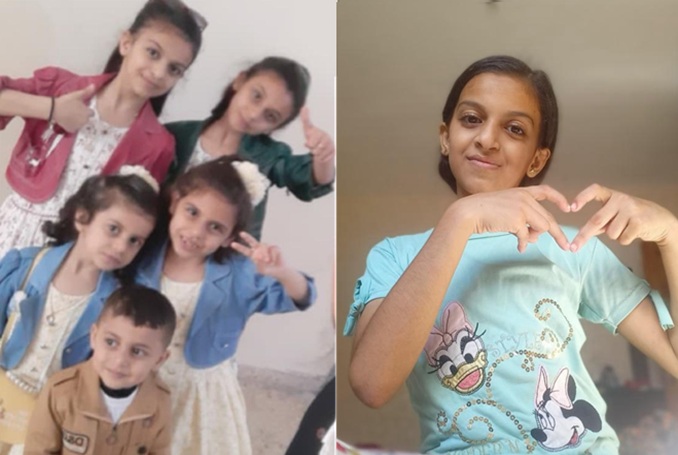
For her uncle, Palestinian author and political analyst Ramzy Baroud, Lama “embodied the strength, resilience, bravery, and studiousness of a Palestinian child, coupled with incredible innocence.”
In the ruins of Gaza, an 11-year-old girl dreamed of becoming a journalist.
She was intelligent, confident, and determined, filming videos from within Gaza’s shelters, practicing her English, speaking directly to the camera with a calm demeanor well beyond her years.
She wanted to be the voice of her generation, especially of the children growing up beneath drones and warplanes. One day, she, too, became a victim of the genocide she was documenting.
On July 15, an Israeli air strike flattened the six-story building where Lama Nasser Al-Badrasawi and her family had taken shelter after being displaced multiple times. Lama was killed along with her mother, father, and four siblings — Salma, Nada, Sham, and Aziz.
Lama is among an estimated 17,000 children killed in Israeli attacks since October 7, 2023, as per data provided by the Palestinian Education Ministry till April this year.
With bodies pulled from rubble and entire families vanishing without a record, the actual number is believed to be much higher.
For her uncle, Palestinian author and political analyst Ramzy Baroud, Lama “embodied the strength, resilience, bravery, and studiousness of a Palestinian child, coupled with incredible innocence.”
“Lama had the makings of a great journalist,” Baroud tells TRT World.
Our beautiful little cousin, the aspiring 11 year old journalist Lama was killed by an Israeli bomb along with her parents and siblings.
Lama wanted to be a journalist and understood, despite her age, that the the English language was critical to conveying the message and pain… pic.twitter.com/Gc0i00739s
— Ramzy Baroud (@RamzyBaroud) July 15, 2025
Lama came from a working-class family in Gaza’s Shati refugee camp. Her lineage traced back to Nakba survivors Mohammed and Madallah, her great-grandparents.
She was a fourth-generation Palestinian refugee raised in a household that valued faith, learning, and community. She and her siblings had memorized large sections of the Quran.
“At the war’s outset, Lama’s mother asked me to amplify her daughter’s voice,” Baroud recalls. “I was struck by Lama’s English proficiency, political awareness, and her desire to be a voice for survivors among her family and neighbors.”
In one of Lama’s videos, a group of children stood beside her and shouted, “Stop the genocide.” Baroud would later learn that those children were sitting near their parents’ mass grave.
“They were orphans, living in shelters, relying upon their friendship to survive the horrific traumas of mass extermination,” he says.
Victims of ‘Flour Massacre’
Lama’s courage and talent were not shaped in ease. Her family had already endured staggering losses early in the war. Several of her uncles, aunts, and their children were killed.
Her grandfather, Nasser, died during the ‘Flour Massacres’, a series of attacks where Israeli forces targeted civilians queuing for food aid.
“According to eyewitnesses, shrapnel severed Nasser’s arm. He bled to death while still clutching a plastic bag filled with bread and water for Lama and her siblings,” says Baroud.
The family, repeatedly displaced, sought refuge in various so-called safe zones, none of which offered protection from relentless Israeli bombing.
“Lama’s family, a branch of the Baroud family, has a legacy of journalists and intellectuals in Gaza and abroad,” Baroud says. “Her parents chose her to carry on this tradition, recognizing her intelligence, outspoken nature, sharpness, and kindness.”
It was also the partnership she shared with her mother that made her stand out, according to Dr. Zarefah Baroud, a young scholar and activist, and Lama’s cousin.
“Much of this must be credited to her mother, Samah. Despite living through a genocide and supporting five children through such horror, she did everything she could to uplift and empower her daughter.”
“Samah saw what Lama was capable of and refused to let it be pushed to the wayside,” Zarefah tells TRT World.
Zarefah describes Lama as “the brightest and most intelligent child,” but emphasizes that it was her wisdom born out of lived experience that made her extraordinary.
View this post on Instagram
“She channeled her loss and pain into a dream to advocate for her community, especially other children,” she says. “Lama particularly cared to speak on behalf of Gazan children and provided an invaluable glimpse into the world of the resilient children of Palestine.”
The loss of Lama and her family was among the most devastating blows of this war for the Barouds, adding to the loss of over 100 family members since the war began.
Her story could have unfolded differently. Ramzy had envisioned Lama as the first participant in a post-war media training initiative to cultivate authentic Palestinian voices.
“I had planned to help her achieve this dream; now her legacy and hope for a better future can be honored by supporting other equally ambitious, articulate, strong, and beautiful children.”
“We were all so excited to see what monumental impact Lama would make in her life – we all knew she was capable. That is what makes her death particularly difficult to process,” says Zarefah.
“Lama, like all the martyred children of Gaza, deserved to age.”
– This article was originally published in TRT World.

This happened because…
Judaism.
She was a very bright, very talented girl. i saw a clip from one of her videos recently. She could have changed the world.
R.I.P.
Worse, this happened because … Zionism!
Yes, of course. But the Judaists did nothing to stop it.