
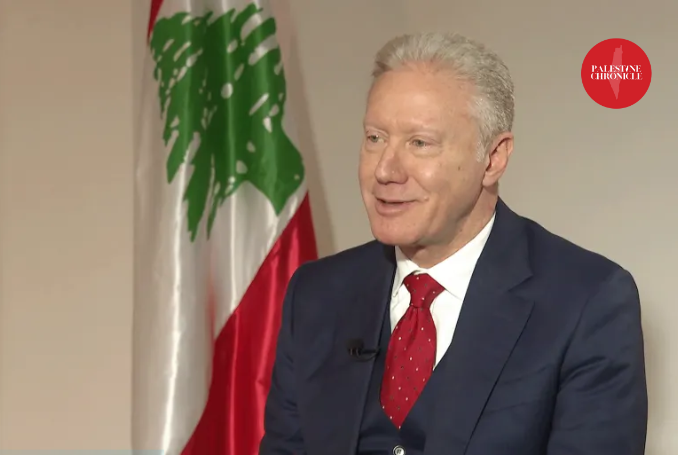

Lebanese foreign minister’s comments justifying continued Israeli attacks on Lebanon triggered widespread anger and controversy, as many view them as legitimizing aggression against Lebanese territory.
Lebanese Foreign Minister Youssef al-Raji sparked widespread anger and controversy in Lebanon after comments suggesting that Israel had the right to continue attacks on Lebanese territory if Hezbollah’s weapons were not fully disarmed.
In a television interview with Sky News Arabia, al-Raji said that the government-approved ceasefire agreement implied the restriction of Hezbollah’s arms in exchange for an end to Israeli attacks. He stated that as long as the disarmament of Hezbollah was not complete, Israel would, unfortunately, have the right to continue its military operations.
His remarks were met with shock and condemnation across social media platforms, where many Lebanese expressed disbelief that a senior government official appeared to justify attacks on his own country. Some critics described the comments as providing cover for Israeli bombardment.
Supporters of the minister argued that his statements reflected the official Lebanese government position and its commitment to the ceasefire agreement. They said the political track had been clear from the start, including agreement on the monopoly of arms by the state.
Opponents, however, sharply criticized al-Raji’s comments, saying they represented a dangerous precedent. One commentator said no foreign minister in the world would justify an enemy’s killing of its own citizens, accusing the government of sending a perilous message to communities in southern Lebanon, the Beqaa, and the southern suburbs.
The controversy comes as Israel continues to violate the ceasefire agreement with Hezbollah that ended major hostilities in November 2024 and as Israeli forces maintain control of strategic positions inside Lebanon.
Iranian Defense Minister Warns of ‘Devastating Response’ to Any Attack
Israel’s continued military pressure on Lebanon has gone beyond tactical strikes, forming part of a broader strategy aimed at exhausting Lebanese society as a whole.
Through repeated ceasefire violations, targeted attacks, and the normalization of insecurity along the border, Israel has sought to impose a state of permanent instability that affects civilians, infrastructure, and livelihoods.
This approach mirrors Israel’s wider regional strategy of coercion and deterrence, in which sustained pressure on civilian populations is used to reshape political realities, weaken resistance environments, and force internal divisions within targeted societies.
(PC, AJA, Social Media)





Be the first to comment