
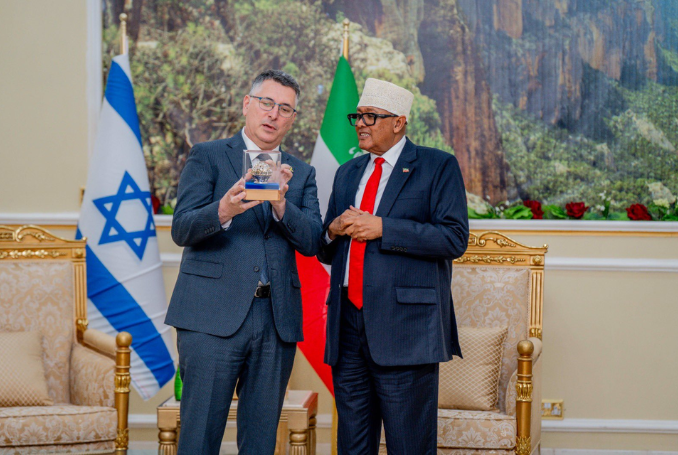

Israel’s recognition of Somaliland has been met with fierce condemnation from world leaders.
Saudi Arabia is finalizing an agreement to form a new military alliance with Somalia and Egypt, according to a Bloomberg report, amid Israel’s recognition of the breakaway region of Somaliland.
Somalian President Hassan Sheikh Mohamud will soon travel to Saudi Arabia to conclude the agreement, which aims to enhance strategic cooperation in Red Sea security, as well as deepen military cooperation, according to two sources cited in the report.
African Union Urges Reversal of Israel’s Somaliland Recognition after Saar Visit
The move, coming amid heightened tensions between Saudi Arabia and the United Arab Emirates (UAE), appears to be part of Riyadh’s objective to diminish the latter’s influence in the region, the report noted.
Somalia has severed all agreements with the UAE, including security, defense, and economic agreements, accusing Abu Dhabi of undermining its sovereignty.
In a post on X, Defence Minister Ahmed Moallim Fiqi said the decision was based on “reliable reports and evidence indicating practices linked to the United Arab Emirates that undermine the sovereignty of the Somali Republic, its national unity and political independence”.
The Federal Government of Somalia has terminated all agreements with the United Arab Emirates, covering port operations, government institutions, and security and defense cooperation.#Somalia #Somali #UAE pic.twitter.com/Br5xgGJg6b
— Ministry of Foreign Affairs 🇸🇴 (@MOFASomalia) January 12, 2026
According to Bloomberg, spokespeople for the Saudi government and Defense Ministry did not respond to requests for comment. The Egyptian government also did not respond to enquiries regarding the deal.
Abraham Accords
On December 26, Israel announced its official recognition of the Republic of Somaliland as an independent and sovereign state, making Tel Aviv the only country to recognize Somaliland. This move was met with international and Arab condemnation, as well as from the Organization of Islamic Cooperation (OIC).
A statement issued by the Prime Minister Benjamin Netanyahu’s Office reportedly said the move was framed as part of the regional normalization framework known as the Abraham Accords, launched under US President Donald Trump.
OIC’s Condemnation
Last weekend, Saudi Arabia mobilized members of the OIC to reject Israel’s “illegal action,” according to Al-Jazeera Arabic.
The OIC issued a statement in which the organization “strongly condemns and categorically rejects the actions by Israel.”
The Council of Foreign Ministers of the Organization of Islamic Cooperation (OIC) was held today in Jeddah to discuss developments in Somalia.
H.E. Secretary-General Hissein Brahim Taha emphasized that the recognition of the so-called “Somaliland” by #Israel, the occupying… pic.twitter.com/NIf9L0QKrA
— OIC (@OIC_OCI) January 10, 2026
It stressed that the move by Israel “is a flagrant violation of international law, the United Nations Charter and a gross violation of the principle of respect for sovereignty and territorial integrity of states and a direct threat to the peace and security of the Horn of Africa and Red Sea region, with dangerous implications for international security and peace.”
Strategic Location
Israeli Foreign Minister Gideon Sa’ar has visited Somaliland, drawing sharp condemnation from Somalia and regional actors. Sa’ar said in an interview with Somali TV that Somaliland “is located in a highly important strategic position.”
Somaliland’s location along the Bab al-Mandeb Strait, which connects the Red Sea to the Gulf of Aden, gives it major geopolitical significance, the Anadolu news agency reports. The waterway is vital for global trade and has been disrupted by attacks from Yemen’s Ansarallah movement since the start of Israel’s genocidal assault on Gaza in October 2023.
Israeli Foreign Minister Gideon Saar Visits Somaliland after Recognition Move
Formerly a British protectorate, Somaliland declared independence from Somalia in 1991 but has remained diplomatically unrecognized for more than three decades. The region lies along the strategically vital Gulf of Aden, bordering Ethiopia and Djibouti, and has long pursued bilateral agreements with foreign governments on investment and security.
Somalia has repeatedly rejected any foreign engagement with Somaliland without federal consent, maintaining that the region remains an integral part of the Somali state and warning that unilateral recognition threatens regional stability.
(The Palestine Chronicle)


Be the first to comment