
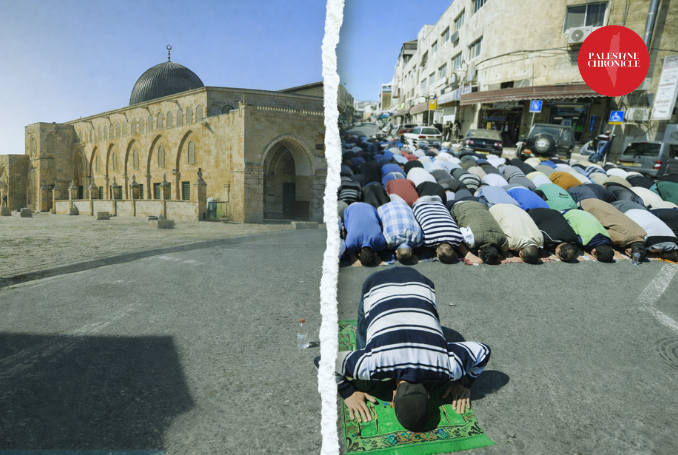

Experts warn Israel’s closure of Al-Aqsa during Ramadan signals a dangerous shift toward full control over the mosque.
Key Takeaways
- Israel has kept Al-Aqsa Mosque closed for nearly two weeks during Ramadan, barring Palestinians from prayers.
- Analysts warn the move undermines the historical “status quo” governing the holy site.
- Palestinian officials say the closure coincides with wider regional escalation and Israeli attempts to consolidate control.
Ramadan Without Al-Aqsa
For nearly two weeks, Palestinians have been barred from entering Al-Aqsa Mosque, one of Islam’s holiest sites, during the final and most spiritually significant days of Ramadan.
Israeli authorities closed the mosque compound shortly after the US-Israeli attacks on Iran began on February 28, citing emergency regulations and restrictions on public gatherings.
The decision has prevented thousands of Palestinians from attending prayers, including two consecutive Friday prayers and nightly Tarawih prayers, Palestinian officials say.
Maarouf al-Rifai, media advisor to the Jerusalem Governorate, said the closure represents a serious escalation.
“Israeli occupation authorities continue to close Al-Aqsa Mosque and prevent worshippers from praying there during the last days of Ramadan,” al-Rifai told Anadolu Agency.
“These measures represent a violation of freedom of worship and an escalation targeting the historical and legal status quo at Al-Aqsa Mosque.”
Al-Rifai also warned that the closure prevents Palestinians from observing Laylat al-Qadr, the holiest night in Islam, when the mosque usually receives massive numbers of worshippers.
A Strategic Shift
Experts say the closure should not be viewed as a temporary security measure but rather as part of a broader political strategy.
Jerusalem affairs researcher Hisham Yaqub warned that closing the mosque effectively dismantles the historical arrangements governing the site.
The status quo, established during Ottoman rule and maintained through subsequent political agreements, recognizes the Islamic Waqf as the authority responsible for administering the mosque.
By closing the compound unilaterally, Yaqub said, Israel is signaling its intention to redefine that arrangement.
“The closure legally undermines the historical status quo,” Yaqub told Al Jazeera Arabic, noting that the decision asserts Israeli authority over the mosque’s administration.
Jordan has historically supervised the Islamic Waqf in Jerusalem. Its custodianship dates back to 1924, when Jerusalem’s religious leadership recognized Sharif Hussein bin Ali as guardian of the holy sites.
The arrangement was reaffirmed in the 1994 Wadi Araba treaty between Jordan and Israel and again in a 2013 agreement between Jordan’s King Abdullah II and Palestinian President Mahmoud Abbas.
Yet analysts warn that recent Israeli actions increasingly sideline the Waqf and challenge its authority.
‘An Existential War’ — Hamas, Islamic Jihad Link Attack on Iran to Gaza Genocide
Ramadan and Political Timing
The timing of the closure has raised particular concern among experts.
Ramadan traditionally represents the most sensitive period in Jerusalem, when the mosque compound becomes the focal point of religious and political activity.
Jerusalem affairs expert Hassan Khater described the closure as an unprecedented escalation.
Closing the mosque during the final days of Ramadan amounts to “a declaration of war,” Khater said.
Khater also noted that extremist settler groups have openly celebrated the closure on social media, framing it as a victory in their long campaign to assert Jewish control over the site.
At the same time, incursions by settlers into the compound had continued even before the closure, often under heavy Israeli police protection.
Experts say these developments form part of a broader effort by far-right groups to alter the religious and political character of the compound.
Long-Term Objectives
Israeli affairs analyst Imad Abu Awad argues that the closure must be understood within a long-term process that has unfolded over decades.
In the 1990s, settler incursions into the compound were rare.
Today, tens of thousands of settlers raid the site each year under Israeli military protection.
This shift reflects a gradual normalization of Israeli presence inside the compound.
According to Abu Awad, the next stage of this strategy may involve dividing the mosque complex.
Some settler organizations advocate allocating sections of the compound for Jewish prayer, similar to the division imposed on the Ibrahimi Mosque in Hebron after the 1994 massacre. Others go further.
Abu Awad warned that extremist groups openly discuss plans to demolish the Dome of the Rock and construct a Jewish temple in its place. “We are approaching a very dangerous moment,” Abu Awad told Al Jazeera Arabic.
Millions of Iranians Rally for Palestine on Quds Day amid US-Israeli Aggression
Regional Context
The developments at Al-Aqsa are unfolding amid one of the most volatile regional crises in decades.
The closure of the mosque coincides with the ongoing US-Israeli aggression on Iran, as well as continued attacks on Gaza, and fighting in Lebanon.
For many Palestinians, this broader context reinforces fears that the crisis around Al-Aqsa could escalate rapidly.
The mosque has historically served as a flashpoint capable of triggering widespread unrest across the region.
Analysts say that by closing the compound during Ramadan, Israel risks inflaming tensions at a moment when the region is already on edge.
A Critical Moment
For Palestinians, Al-Aqsa is far more than a religious site.
The mosque symbolizes Palestinian political, religious, and national identity. Its courtyards are among the few spaces where Palestinians from Jerusalem, the West Bank, Gaza, and Palestinian communities inside Israel can gather around a shared cause.
In that sense, Al-Aqsa remains one of the most powerful unifying symbols of Palestinian life.
For Israel, that symbolism carries a different meaning.
Control over the mosque compound has increasingly become a display of political and military power. By restricting access or closing the site altogether, Israel signals its authority over one of the most sensitive centers of Palestinian life.
Many analysts say Israeli leaders believe that controlling Al-Aqsa allows them to assert dominance not only over a religious site, but over the broader political and cultural aspirations of Palestinians.
For Palestinians, however, the mosque represents something entirely different.
Al-Aqsa has repeatedly served as a focal point of collective resistance. Despite the fragmentation created by occupation, checkpoints, and political divisions, it remains one of the few places capable of bringing Palestinians together around a shared identity.
It is this profound symbolic weight that makes the current moment particularly dangerous.
Changes to the status quo at Al-Aqsa have historically triggered major political upheavals. Many analysts warn that attempts to impose new realities at the site could once again ignite a much wider confrontation.
(AJA, Anadolu, PC, Palestinian Media)




Be the first to comment