
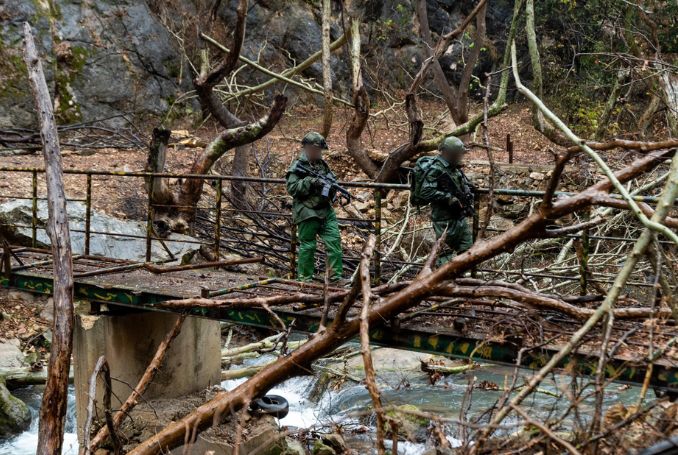

Israel orders strikes on Litani bridges as Hezbollah escalates operations, intensifying northern front and deepening humanitarian risks in south Lebanon.
Key Developments
- Israel orders “immediate” strikes on Litani bridges, expanding campaign targeting infrastructure in south Lebanon.
- Hezbollah intensifies operations with sustained rocket, drone, and direct engagements across the northern front.
- Attacks threaten to isolate south Lebanon and disrupt vital civilian supply routes, raising humanitarian concerns.
Israel Orders Immediate Strikes on Litani Bridges
Israeli Prime Minister Benjamin Netanyahu ordered the military on Sunday to “immediately” strike bridges over the Litani River in southern Lebanon, according to Israeli media.
Defense Minister Israel Katz said the order allegedly aims “to prevent the passage” of Hezbollah fighters and weapons southward.
The Israeli army confirmed plans to target the Qasmiya Bridge on the coastal highway, claiming the structure is used for “militant activity” and the transfer of operatives “under the cover of the civilian population.”
Katz further stated that he instructed the military “to accelerate the destruction of Lebanese homes in the line of contact villages, to thwart threats to Israeli communities, in accordance with the model of Beit Hanoun and Rafah.”
🚨⭕️ ISRAELI DEFENSE MINISTER: “The Prime Minister and I have ordered the army to immediately destroy all bridges over the Litani River.” pic.twitter.com/wOkR3hhil4
— The Palestine Chronicle (@PalestineChron) March 22, 2026
‘War of Bridges’
The targeting of the Qasmiya Bridge forms part of what military analysts call a “war of bridges.”
Israeli occupation forces had already targeted major crossings in the south, including the Zahrani Bridge and a secondary bridge in Qasmiya, before striking the main bridge.
The Qasmiya Bridge is located on the coastal road linking Sidon and Tyre, approximately 6 kilometers from Tyre and 30 kilometers from Sidon, and is considered one of the most vital arteries in south Lebanon.
It is one of five main bridges connecting the two banks of the Litani River, meaning its destruction effectively isolates south Lebanon and severs communication between the northern and southern banks.
Ahead of the strike, UNIFIL forces and Lebanese security units evacuated positions near the bridge following Israeli warnings, amid heavy aerial overflights and alerts to civilians.
Humanitarian Impact and Supply Risks
The impact of targeting the bridge extends beyond military objectives. The surrounding area serves as a critical corridor for food and medical supplies into Tyre and the surrounding districts, where approximately 20% of the population south of the Litani remains.
Cutting these routes risks triggering a severe humanitarian crisis affecting hundreds of thousands.
Israeli occupation forces have repeatedly warned residents south of the Zahrani River to evacuate north, amid growing indications of a wider ground operation and efforts to establish what Israeli officials describe as a “security buffer zone.”
Iran launches multiple missile waves targeting Israel and US bases, as strikes follow Natanz attack and Hezbollah escalates northern operations.
Read the key developments and the full report here: https://t.co/9x4Q1igh6C pic.twitter.com/Bv9gaNvEP0
— The Palestine Chronicle (@PalestineChron) March 22, 2026
Hezbollah Operations Intensify
The Lebanese resistance movement Hezbollah carried out a sustained series of coordinated operations targeting Israeli troop concentrations, military sites, and settlements across the northern front, as clashes expanded along multiple border areas.
The attacks focused on key locations including al-Odeisaa, Markaba, al-Taybeh, and al-Khiam, where Israeli forces and military vehicles were repeatedly targeted with rocket barrages, artillery fire, and drone strikes throughout the day.
According to Hezbollah’s military statements, operations unfolded in rapid succession, with multiple waves of rockets and kamikaze drones striking Israeli positions, barracks, and settlements such as Avivim, Misgav Am, Dishon, and sites facing Alma al-Shaab and Houla.
At the same time, Hezbollah fighters engaged Israeli occupation forces in direct confrontations, particularly near Naqoura and inside Al-Khiam, using light and medium weapons alongside rocket fire.
Israeli troop gatherings and operational positions were repeatedly struck, including areas surrounding detention facilities, forward military sites, and elevated positions used for surveillance and control.
The pattern of attacks reflected a sustained effort to maintain continuous pressure, with repeated targeting of the same locations within short intervals, suggesting an intent to disrupt Israeli movement and limit operational consolidation.
Additional artillery strikes were reported in areas southwest of Taybeh, while engagements inside Al-Khiam extended across multiple points, including newly established Israeli positions.
The movement confirmed that its operations remain ongoing, emphasizing that the attacks are being carried out in response to Israeli incursions into Lebanese territory and are aimed at engaging forces at close range while targeting military concentrations along the border.
Meanwhile, at least one Israeli was killed after an Israeli vehicle was struck with a guided missile in the Misgav Am settlement.
Simultaneously, rocket fire continued to target the same area, underscoring the intensity and persistence of operations along the northern front.
(PC, Al Mayadeen, Israeli media, Anadolu)



Be the first to comment