
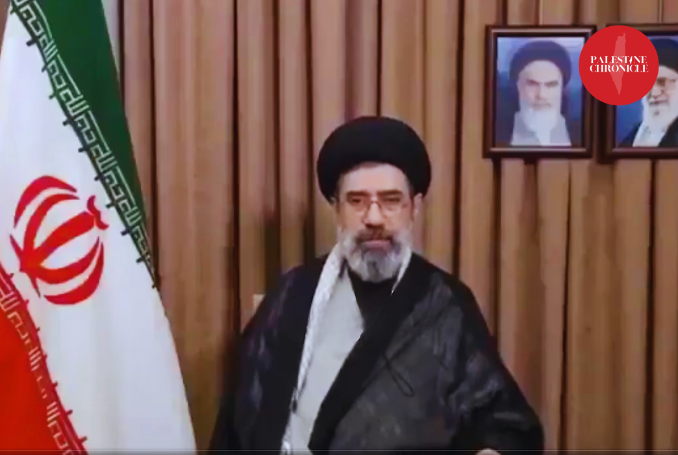

Iranian supreme leader says post-war regional order is emerging as Tehran asserts control over Gulf security and Hormuz stability.
Key Developments
- Sayyed Mojtaba Khamenei says Persian Gulf future will be “bright” without US presence.
- Iranian leadership vows to secure Strait of Hormuz and confront foreign interference in regional waters.
- IRGC calls Iran a “strong, reliable, and credible pillar” of Gulf stability.
Vision for a Post-US Gulf
Iran’s Supreme Leader, Mojtaba Khamenei, declared on Thursday that the future of the Persian Gulf region would be shaped without American influence, presenting Iran as the central guarantor of regional security and stability.
Speaking on the occasion of ‘Persian Gulf Day’, Khamenei said the Iranian people would defend their national wealth and maritime interests just as firmly as they protect their territorial borders.
He stated that Iran would secure the Persian Gulf and maintain control over the strategic Strait of Hormuz, warning against what he described as enemy violations of the waterway.
“The future of the Persian Gulf region will be a bright future without the United States,” Khamenei said, adding that such a future would bring “progress, comfort, and welfare” to the peoples of the region.
‘US Warships Will Burn’: Iran Signals New Naval Capabilities
Control over Strait of Hormuz
Khamenei emphasized the importance of the Strait of Hormuz as both a strategic maritime corridor and a symbol of Iranian historical identity.
He said new legal and administrative frameworks for the strait would help establish regional stability, economic prosperity, and secure navigation.
Describing the Gulf as “part of our identity and civilization,” he argued that the waterway has historically been targeted by colonial powers seeking domination over regional trade and resources.
Khamenei accused Western powers of repeatedly attempting to control the Strait of Hormuz, citing historical Portuguese, Dutch, British, and American involvement in the region.
‘New Regional Order’ Emerging
Referring to recent regional confrontations, Khamenei said the “series of victories achieved by Iran” marked the beginning of a new regional and international order.
He claimed that the region had witnessed “remarkable scenes of steadfastness, awareness, and jihad” during the recent period of confrontation.
Khamenei also said that, following what he described as the failure of American plans and the “humiliating defeat” of the United States after months of conflict, a “new chapter” for the Persian Gulf and Strait of Hormuz was beginning to emerge.
Praise for Iranian Naval Forces
The Iranian leader praised both the regular navy and the naval branch of the Islamic Revolutionary Guard Corps, saying their resilience demonstrated rejection of foreign domination in the region.
He added that Iran and neighboring states bordering the Gulf and the Sea of Oman share a “common destiny,” warning that foreign powers have no legitimate place in regional affairs.
“There is no place for foreign intruders except the bottom of the Gulf,” he said.
PROFILE: Who Is Mojtaba Khamenei, a Key Figure in Iran’s Leadership Debate?
IRGC Reaffirms Iran’s Role
In a separate statement marking the occasion, the Islamic Revolutionary Guard Corps described Iran as a “strong, reliable, and credible pillar” of regional stability.
The IRGC said Iran’s strategy in the Persian Gulf is based on collective security, shared development, mutual respect, and sustainable regional balance.
At the same time, the statement sharply criticized the United States and Israel, accusing them of undermining regional security through military interventions and aggressive policies.
The IRGC added that its naval forces would continue safeguarding the Strait of Hormuz and protecting what it described as the legitimate rights of the Iranian people.
(PC, Al Mayadeen)


Be the first to comment