
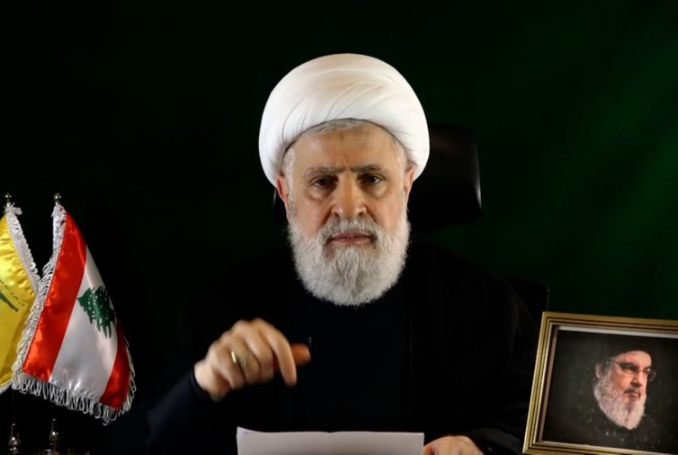

Hezbollah leader Naim Qassem warns of a response to violations, rejects US-imposed terms, and outlines conditions for a Lebanon ceasefire.
Key Takeaways
- Qassem warned that Hezbollah will respond to any ceasefire violations.
- He rejected US-imposed ceasefire language and direct negotiations with Israel as “humiliation”.
- Qassem outlined five conditions, including Israeli withdrawal and reconstruction of Lebanon.
Ceasefire ‘Conditional’
Hezbollah Secretary-General Sheikh Naim Qassem said the ceasefire in Lebanon was the direct result of battlefield developments, stressing that resistance forced Israel into accepting it.
In a statement on Saturday, Qassem stated that “the field has proven that it has the final say,” adding that political outcomes must build on battlefield results to secure Lebanon’s sovereignty and rights.
He said the temporary ceasefire “would not have happened without the jihad of the resistance,” describing their performance as “legendary” despite a vast imbalance in military power.
Qassem added that Israel had mobilized “100,000 soldiers” yet was unable to reach the Litani River, neither in the first week as planned nor after 45 days.”
He also emphasized that the resistance’s strength lies in what he described as a “three-dimensional weapon: faith, will, and capability,” which he said proved “stronger than all the armies of aggression.”
‘All Lebanon is Its South’
Qassem stressed that internal criticism or attempts to weaken morale would not affect the resistance’s trajectory.
He said fighters are supported by a broad social base that has endured displacement, destruction, and loss, adding that this support spans “all sects, regions, and communities.”
In a widely symbolic statement, he said: “All Lebanon is its south; if the south smiles and is liberated, all of Lebanon smiles and is liberated.”
Warning: Response to Any Violations
Qassem emphasized that the ceasefire is conditional and requires a complete halt to hostilities.
He warned that Hezbollah does not trust Israel, stating that fighters remain ready on the ground.
The resistance “will respond to any violations,” he said, stressing that combatants remain with “their hands on the trigger.”
Rejecting ‘Humiliation’ of Direct Negotiations
Qassem strongly criticized a US State Department statement on the ceasefire, describing it as an imposition on Lebanon.
He said the document, titled “Ceasefire Agreement between Lebanon and Israel – April 2026,” was issued after the ceasefire took effect and “means nothing in practical terms,” but constitutes “an insult to our country.”
He added that the statement falsely claimed Lebanese government approval, noting that “the Lebanese government did not meet and did not approve this statement.”
Qassem rejected what he described as attempts to impose direct negotiations with Israel, calling them “humiliating,” and warned against accepting externally dictated terms.
Iran, Pakistan, and the Hormuz Sequence
Qassem credited Iran for supporting the resistance and linking developments in Lebanon to broader regional dynamics.
He said Iran tied the ceasefire in Lebanon to agreements reached through Pakistan, and that when the United States violated the ceasefire, Tehran responded by closing the Strait of Hormuz.
According to Qassem, this escalation led to US “submission” and forced Israel to halt its operations, after which the Strait of Hormuz was reopened.
He also thanked Pakistan for its role in facilitating ceasefire efforts and acknowledged international support for Lebanon.
Five Conditions for the Next Phase
Qassem outlined five priorities for the next stage following the ceasefire.
These include a permanent halt to aggression across Lebanon, the full withdrawal of Israeli forces from occupied territory, the release of detainees, the return of displaced residents to their homes, and reconstruction supported by international and Arab actors under national responsibility.
Call for Internal Unity
Qassem said Hezbollah is open to cooperation with Lebanese authorities, calling for a unified national approach based on sovereignty, stability, and preventing internal division.
He stressed coordination between the army, the people, the resistance, and political leadership to protect Lebanon’s independence and prevent external interference.
‘Israel Did Not Defeat Us’
In closing, Qassem rejected claims that Israel had achieved victory.
“Israel, along with the tyrants of the world, did not defeat us and will not defeat us,” he said.
He added that Lebanon will remain strong through the sacrifices of its people, fighters, prisoners, and martyrs, emphasizing that the country’s resilience remains intact.
‘Seven Lies’: What Iran Is Really Saying About Hormuz and US Negotiations
(Military Media, Al Mayadeen, PC)


Be the first to comment