
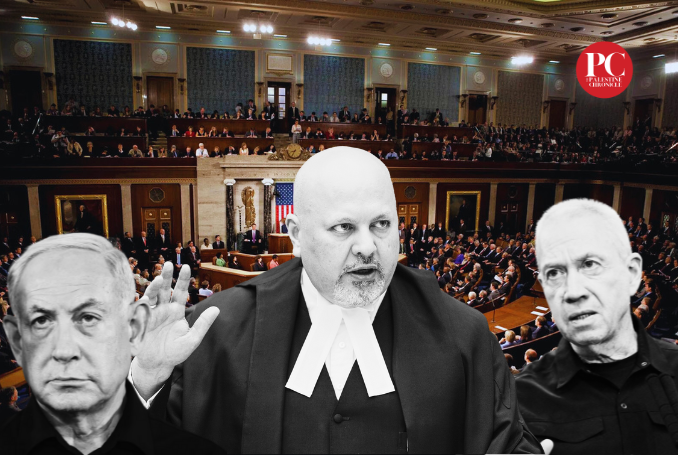

The ICC faced what Le Monde has called its “black year” in 2024, a period marked by intense political pressure, sanctions, espionage, and internal turmoil — all aimed at derailing investigations into alleged Israeli war crimes in Gaza and the West Bank.
In a detailed investigation published on Friday, the French daily reported that the International Criminal Court (IC) had come under an unprecedented campaign led by the United States, Israel, and allied governments to prevent arrest warrants from being issued against Israeli officials, including Prime Minister Benjamin Netanyahu and former Defense Minister Yoav Gallant.
“It was the black year of the International Criminal Court,” Le Monde wrote. “Never since its creation in 2002 has the Hague-based institution faced such headwinds.”
According to the report, the US imposed sanctions on four ICC judges and Prosecutor Karim Khan, while the British government allegedly threatened to withdraw from the Rome Statute if Khan moved forward with the Israel-Palestine file.
“It’s a hydrogen bomb,” UK Foreign Secretary David Cameron reportedly told Khan during a phone call in April 2024. “If you go through with this, we will pull out of the ICC,” Le Monde reported.
British lawyer Andrew Cayley, who was tasked with leading the ICC’s file on Palestine (ICC-01/18), said the months he spent working on the case in The Hague were the most difficult of his life.
“I went through the worst months of my life in The Hague,” Cayley told Le Monde.
He described receiving direct threats, including being told he was “an enemy of Israel” and warned to “watch his back.” He resigned in March 2024.
Le Monde also cited a July 17, 2024, intelligence memo from Dutch authorities warning that the ICC had become a “prime target for espionage and subversive influence” by states whose officials were at risk of prosecution.
The article further revealed that Khan was suspended in May 2025 following sexual assault allegations, which he has “categorically denied.” Former ICC judge Cuno Tarfusser condemned the suspension as a “coup d’état” carried out under political pressure.
American and European officials, including former US Secretary of State Antony Blinken and National Security Adviser Jake Sullivan, reportedly warned Khan that proceeding with the Israel case would endanger Israeli captives and destabilize the region.
Meanwhile, efforts were made to orchestrate backchannel diplomacy. One involved arranging a private dinner between Khan and celebrity lawyer Alan Dershowitz, reportedly engineered by an adviser to Netanyahu.
“Netanyahu and I eating roast turkey while Gazans starve?” Khan was quoted as saying. “It’s like a remake of Oliver Twist — a dangerous idea.”
Khan ultimately proceeded with arrest warrant requests. The ICC judges approved the warrants for Netanyahu and Gallant on November 21, 2024. In February 2025, the US imposed direct sanctions on Khan. Four additional judges were sanctioned in June.
By mid-2025, the investigation into Khan’s conduct had been turned over to a UN-appointed panel of judges.
Meanwhile, Le Monde reported that some Western diplomats were already discussing the possibility of replacing him with “a woman from a small, less powerful country” who might avoid further political confrontation.
In May 2024, Khan reportedly met with international lawyer Nicholas Kaufman, who relayed a warning from Israeli officials.
“They will destroy you,” Kaufman allegedly told him. “And they will destroy the Court.”
Khan, according to Le Monde, refused to back down. Days later, The Wall Street Journal published the sexual assault allegations, effectively freezing proceedings related to additional Israeli officials.
Arrest Warrants
Despite months of pressure, Karim Khan formally requested arrest warrants in May 2024. On November 21, the ICC’s pre-trial chamber approved the issuance of arrest warrants for Israeli Prime Minister Benjamin Netanyahu and former Defense Minister Yoav Gallant on charges related to war crimes and crimes against humanity committed in the Gaza Strip.
The decision marked an unprecedented moment in the Court’s history: it was the first time sitting leaders of a Western-allied state had been targeted by ICC warrants.
Israel denounced the move as “antisemitic and corrupt,” while the United States sharply condemned the Court’s jurisdiction over the matter. In response, the Trump administration imposed direct sanctions on Khan in February 2025, followed by additional sanctions on four ICC judges in June.
Meanwhile, Israeli officials launched legal appeals to invalidate the warrants, and efforts intensified to discredit Khan, stall the investigation, and shift prosecutorial leadership within the Court.
As of August 2025, the arrest warrants remain in force, though enforcement is uncertain. The investigation into Khan’s conduct continues under UN oversight, and the ICC’s internal leadership is under intense scrutiny. The case has laid bare the Court’s deep vulnerability to geopolitical pressure — and raised urgent questions about the future of international justice.
(The Palestine Chronicle)


“a woman from a small, less powerful country” who might avoid further political confrontation — what a misogynist idea! The law is the law! The purpose of the ICC is to address lawlessness regardless of power.