
By Palestine Chronicle Editors
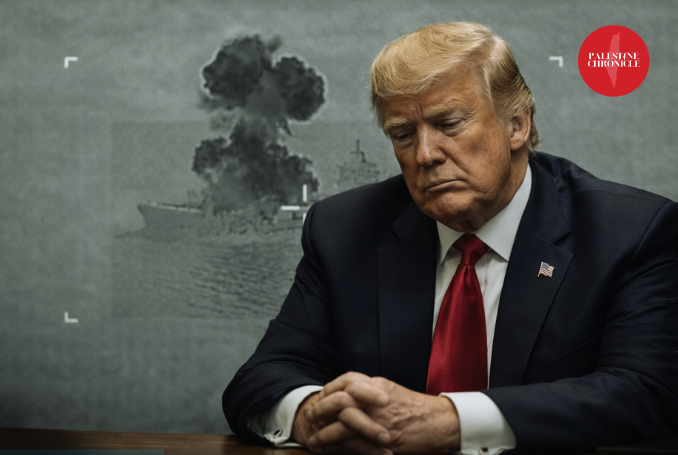
NBC reveals Trump’s war narrative is shaped by curated strike videos, raising concerns over filtered intelligence and distorted battlefield perception.
The News: What Did NBC Reveal?
A new report by NBC News has exposed a striking — and deeply consequential — feature of how President Donald Trump has been consuming information about the ongoing war on Iran.
According to NBC, “each day since the start of the war in Iran, U.S. military officials compile a video update for President Donald Trump that shows video of the biggest, most successful strikes on Iranian targets over the previous 48 hours,” citing three current US officials and one former official.
The briefing, described as a “daily montage,” typically runs “for about two minutes,” and, in the words of one official, consists largely of clips of “stuff blowing up.”
While this video is not the only source of information available to the president, NBC reports that it has become a central feature of how Trump experiences the war. The concern, however, is not merely its existence — but its selective nature.
The same officials warned that the montage “has raised concerns among some of the president’s allies that he may not be receiving — or absorbing — the complete picture of the war.”
The issue is not theoretical. According to NBC, “the information Trump gets about the war tends to emphasize U.S. successes, with comparatively little detail about Iranian actions.”
One concrete example underscores the problem: when Iranian forces struck five US Air Force refueling planes at Prince Sultan Air Base in Saudi Arabia, Trump was not briefed on the incident and instead learned about it through media reports. When he inquired, he was told the damage was minimal.
This asymmetry between battlefield reality and presidential briefing appears to be systematic. As one official put it bluntly: “We can’t tell him every single thing that happens.”
The result is a curated narrative — one that privileges spectacle over substance, success over complexity, and destruction over consequence.
Why Does Trump Believe He Is Winning?
The NBC report offers a rational, evidence-based explanation for a phenomenon that has puzzled observers: Trump’s repeated public assertions that the war against Iran is a decisive success.
The answer lies not in strategy, but in information architecture.
When a president’s daily exposure to war consists of carefully selected images of explosions, destroyed targets, and “successful strikes,” the psychological effect is predictable. The war becomes a sequence of victories — visually confirmed, emotionally reinforced, and politically exploitable.
NBC reports that Trump has repeatedly pointed to the success depicted in these videos to question why the media narrative does not align with what he sees. He has “privately questioned why his administration can’t better influence the public narrative,” asking aides why news coverage fails to reflect the apparent success of operations.
In other words, the president is not merely consuming intelligence — he is consuming a story. And that story is one of uninterrupted triumph.
This helps explain his increasingly combative stance toward media reporting. After learning about the strike on US aircraft through news coverage, Trump publicly accused media organizations of wanting the United States “to lose the War.”
The contradiction is stark: a president watching victory on screen, while reality — fragmented, contested, and costly — intrudes through external reporting.
What Is Missing From the Picture?
The central issue raised by NBC is not that Trump is uninformed, but that his information may be structurally incomplete.
The curated videos, by design, “don’t reflect the full scope of the conflict.” They exclude not only setbacks, but also the broader strategic environment — including Iranian responses, regional escalation risks, and the limits of US military effectiveness.
Officials cited in the report explicitly warned that this imbalance could have serious consequences. Without access to the full picture, Trump “may not be equipped to make critical decisions” about the next phase of the war.
This concern is not new. NBC draws a historical parallel to previous US wars, where administrations were accused of “groupthink” — systematically downplaying inconvenient facts and reinforcing internal narratives of success even as strategies faltered.
From Vietnam to Iraq, the pattern is familiar: selective intelligence produces strategic overconfidence, which in turn sustains escalation. What makes the current case distinct is the medium. This is not merely a filtered briefing — it is a visual narrative, engineered for maximum impact.
Who Benefits From This Narrative?
The NBC report does not directly name the actors shaping these briefings. But the political context makes the direction of influence difficult to ignore.
Many analysts and observers argue that this is, in effect, Israel’s war — or at minimum, a war whose continuation aligns closely with the priorities of Israeli Prime Minister Benjamin Netanyahu.
NBC itself confirms that Trump is in “near-daily conversations” with Netanyahu. That level of coordination is not incidental. It reflects a shared political and military trajectory.
Within Washington, this raises a sharper question: who benefits from a president who believes he is winning?
The answer points toward those inside the administration who are invested in prolonging the war — officials, advisers, and political allies who consistently advocate escalation, not restraint.
If Trump is being shown a steady stream of “successful strikes,” while setbacks and Iranian responses are minimized, then the effect is not neutral. It reinforces a single conclusion: continue.
That conclusion aligns with Netanyahu’s stated objective of sustaining pressure on Iran, and with a broader current inside the White House that views the war as necessary, even desirable.
In that sense, the issue is not simply that Trump is receiving incomplete information. It is that the information he is receiving may be structured to produce a specific outcome — continued war.
This does not make the president an outsider to the process. He is actively amplifying the narrative, repeating claims of victory, and attacking dissenting coverage.
But it does help explain the disconnect between rhetoric and reality — and why the administration’s internal “confidence” appears increasingly detached from the actual trajectory of the war.
The result is a closed loop: curated success feeds political messaging, which in turn justifies further escalation.
And at the center of that loop is a president watching a war that looks very different from the one actually being fought.
Dagger in Hand: Netanyahu Turns on Mossad as His Iran War Unravels – Analysis
(The Palestine Chronicle)





Trump wasn’t fed anything.
He is simply too stupid to understand anything that is put in front of him.
Maybe Iran should add a condition to their war aims with the US; have Trump replaced by J. D. Vance before any consideration would be given to opening talks with the US.
We could use some regime change over here as well…
Rashida Tlaib for POTUS.
Perfect combination – a narcissist Pres who lies, surrounded by sycophants who tell him what he wants to hear, with a media that “doesn’t tell the truth”, augmented by a technology that fabricates and produces fake images – what can go wrong …
The Zionists and FBI are the ones doing the curating: https://thegrayzone.com/2026/03/06/israel-fbi-assassination-plots-trump-iran-war/