
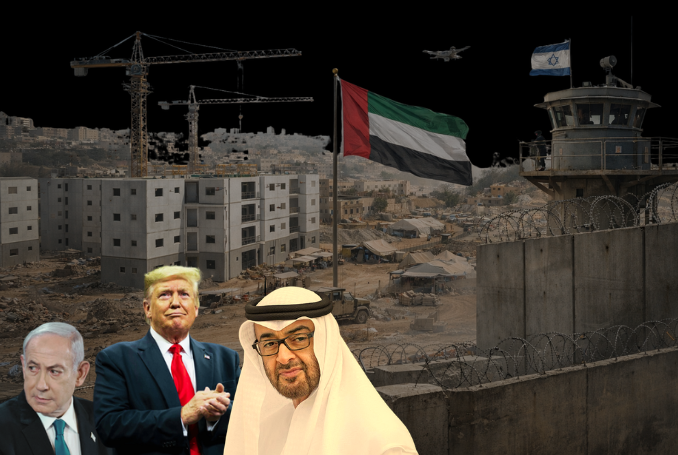

A new Reuters investigation has revealed that a Gaza-based contracting company has been tapped to build a large, UAE-funded housing compound in southern Gaza, near Rafah, in an area currently under Israeli military occupation.
Key Takeaways
- Reuters reports that Masoud & Ali Contracting Co (MACC), a Gaza-based firm, has been contracted to build a large UAE-funded housing compound near Rafah.
- The site is located in an area under Israeli military occupation, and construction reportedly requires Israeli approval.
- Earlier Reuters reporting described planning documents for a “UAE Temporary Emirates Housing Complex” in the same area.
- The Guardian reported in January on UAE-backed plans for a “planned community” in southern Gaza, raising concerns about security screening and governance frameworks.
- The project is unfolding within a broader framework linked to post-war governance proposals and reconstruction plans tied to US and regional actors.
Emirati Funding on Israeli-Occupied Land
According to an investigation published by Reuters on Thursday, Masoud & Ali Contracting Co (MACC), a Gaza-based construction company, has been contracted to build a large housing complex funded by the United Arab Emirates near Rafah, in the southern Gaza Strip
The compound is reportedly intended to house tens of thousands of displaced Palestinians.
Reuters states that the project has not been formally announced and that construction has not yet begun, pending Israeli authorization.
The land in question lies within a southern zone that Israeli occupation forces have maintained control over following a genocidal war and mass displacement in Rafah and the surrounding areas.
The report describes the planned structures as multi-storey, prefabricated housing units. It further notes that Egyptian firms may be involved in logistical and construction coordination under Emirati financing structures.
Reuters emphasized that the project remains contingent on Israeli approval,— a detail that underscores the layered sovereignty questions surrounding reconstruction in Gaza.
Earlier Planning Reports
This development follows earlier reporting that outlined the conceptual and logistical groundwork for Emirati-backed housing in southern Gaza.
On February 5, Reuters published a separate report describing planning materials for what was referred to as the “UAE Temporary Emirates Housing Complex.”
That report included maps and site details placing the proposed compound near Rafah, in territory under Israeli occupation administration.
Proxy Regime: Understanding the UAE-Israeli Conspiracy in Yemen, Saudi Arabia
Even earlier, in January 2026, the British newspaper The Guardian reported on UAE-backed plans to bankroll what it described as the first “planned community” in southern Gaza.
The Guardian framed the initiative as part of a broader post-war reconstruction model and noted that critics had raised concerns regarding governance, security vetting, and potential biometric screening mechanisms tied to access and residency in such developments.
The Guardian’s January reporting also situated the UAE’s role within a larger framework tied to US-led reconstruction discussions and emerging governance proposals for Gaza’s ‘day after’.
Our Strategic Assessment
The UAE’s role in Gaza’s reconstruction cannot be viewed solely as humanitarian assistance, but should be understood within a wider political strategy that aligns Emirati interests with Israeli security objectives and Western reconstruction plans.
In a recent analysis for the Palestine Chronicle, journalist and analyst Robert Inlakesh noted that while the UAE portrays itself as Gaza’s “top humanitarian aid donor,” its actions are intertwined with broader strategies that may serve to manage, control, or restructure the Palestinian population and social landscape rather than empower it.
He characterized the UAE’s involvement as central to what he terms a “concentration camp plot,” implying that large-scale housing complexes may function less as housing for the displaced and more as controlled zones where movement, security vetting, and surveillance shape Palestinian lives under external oversight.
Exposed – How the UAE Became Central to Gaza’s Concentration Camp Plot
According to this analysis, the Emirati investment aligns with operations such as the installation of infrastructure — including water and services — in designated southern Gaza areas.
These are the same locales being prepared for concentrated displacement and population management following intense Israeli military operations. Inlakesh’s framing suggests that by controlling infrastructure provision and reconstruction entry points, external actors — particularly the UAE in cooperation with Israel — could influence who enters, who remains, and under what conditions.
The core strategic concern raised by this perspective is that reconstruction efforts, rather than restoring rights and normalcy, could institutionalize controlled zones that replicate elements of detention, restricted movement, and external oversight.
(PC, Reuters, The Guardian, QNN)



Vile. No humanity left in these monsters