
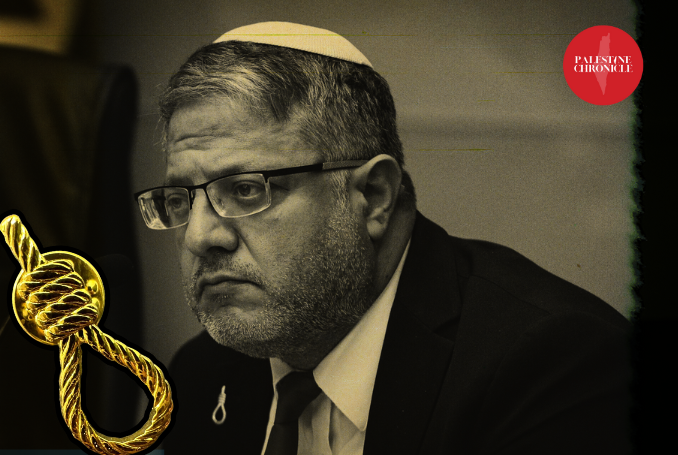

Israel is poised to finalize a law institutionalizing the execution of Palestinians, in a move widely condemned as discriminatory, unlawful, and a dangerous escalation of occupation rule.
The Final Vote
Israel’s parliament, the Knesset, is set on Monday to hold a final vote on a controversial bill that would make the death penalty the default punishment for Palestinians convicted of killing Israelis.
The vote follows years of political pressure from far-right factions within the governing coalition and comes just days before the parliament’s spring recess.
If passed, the legislation would mark a decisive shift in Israeli penal policy, transforming capital punishment from a rarely used provision into a central instrument applied in the context of the occupation.
Political Push
The bill is being championed by Israeli Minister Itamar Ben-Gvir, leader of the far-right Otzma Yehudit, whose party introduced the legislation.
Ben-Gvir, a key pillar in the coalition led by Prime Minister Benjamin Netanyahu, has framed the measure as a necessary escalation, describing it as “the most important law” in recent years.
In the lead-up to the vote, he publicly promoted the bill by wearing a noose-shaped pin, symbolizing execution by hanging — the method explicitly referenced in earlier versions of the legislation.
What the Bill Says
The proposed law introduces a framework that would significantly expand and formalize the use of capital punishment.
Under its provisions, military courts — which prosecute Palestinians in the occupied West Bank — would be required to impose the death penalty on individuals convicted of killing Israelis in acts defined as “terrorism.”
The sentence would become the default outcome, with only limited and undefined “special circumstances” allowing for commutation to life imprisonment.
At the same time, Israeli civilian courts — which try Israeli citizens, including settlers — would retain discretion, allowing judges to choose between life imprisonment and the death penalty.
The legislation also lowers procedural safeguards. Courts would be able to issue death sentences without requiring unanimity, relying instead on a simple majority of judges.
In addition, the law removes avenues for clemency or pardon and mandates that executions be carried out within a fixed timeframe, reportedly within 90 days of sentencing.
Additional provisions restrict access to legal counsel and isolate those sentenced to death, while legal consultations could be conducted remotely rather than in person.
Two Systems, One Law
Legal experts and rights groups have emphasized that the bill formalizes a dual legal structure.
Palestinians in the occupied West Bank would be subject to military law, where due process protections are widely criticized as inadequate under international standards.
Israeli citizens, including illegal Israeli Jewish settlers living in the same territory, would remain under civilian jurisdiction, where sentencing remains discretionary.
According to critics, this distinction effectively ensures that the law will be applied overwhelmingly — if not exclusively — to Palestinians.
“This distinction is discriminatory,” said Amichai Cohen of the Israel Democracy Institute, according to the Washington Post, noting that the structure of the law makes it highly unlikely that Jewish Israelis would be prosecuted under its most severe provisions.
Legal and International Concerns
The bill has drawn strong opposition from legal experts, human rights organizations, and international bodies.
United Nations experts warned in a statement last month that the legislation violates the fundamental right to life and fails to meet the threshold required under international law for the use of capital punishment.
They stressed that mandatory death sentences, particularly without full judicial discretion, are incompatible with international human rights standards.
The European Union has similarly condemned the proposal, stating that the death penalty inherently violates the right to life and risks constituting cruel, inhuman, or degrading punishment.
Legal objections have also focused on Israel’s lack of jurisdiction to legislate for Palestinians in the occupied West Bank.
Under international law, the occupied territory is not sovereign Israeli land, raising questions about the legality of imposing such penalties through military courts.
Due Process and Fair Trial Issues
Beyond the question of capital punishment itself, the bill raises broader concerns regarding due process.
Military courts in the occupied West Bank have long been criticized by international organizations for failing to meet fair trial standards. Critics argue that introducing the death penalty within such a system significantly heightens the risk of irreversible miscarriages of justice.
The proposed law further limits safeguards by restricting appeals, eliminating clemency, and allowing convictions and sentencing through simplified judicial procedures.
UN experts have warned that the combination of these factors — including vague definitions of “terrorism” — could result in death sentences being imposed in cases that do not meet the strict criteria required under international law.
(PC, The Guardian, Washington Post, UN News, B’tselem, Israeli media)




I am so sick of these pigs. If all of them died right now, no one would even care. They’re all scummy, shady, baby-killers. I sincerely hope they all die horrible deaths. I sincerely hope the citizens of Occupied Palestine take over and
‘ Mussolini ‘ all the leaders in the streets, as well as anyone who encouraged genocide; mass displacement to make way for the Israeli Nazis. They’re all shady and corrupt. Death to all of them who would encourage and further enable the murder of innocent people: including the Nazis in my US government.
Calm down, have a glass of kosher wine ana piece of matzah.
Calm down in the face of genocide? You should kill yourself for even daring to suggest that, zionist filth.
If only a dalek could be sent to the Knesset and in goid dalekterm start the call to “Exterminate” all tge Knesset members, starting with satanyahu, Ben Givr and Smotrish before proceeding through the rest, and then the IOF, both past and present. That should clear up the problem.
Of course we may need a bigger Dalek.