
By Romana Rubeo 
The Palestine Chronicle analyzed US President Donald Trump’s Truth Social posts alongside verified reporting, exposing contradictions, extreme claims, and shifting narratives on Iran.
Key Developments
- Trump denies US involvement in major attacks while credible reporting indicates coordination with Israel.
- Claims of Iran’s “total destruction” contradict both his own warnings and external intelligence assessments.
- Messaging shifts between rejecting allies and demanding their intervention in critical military and economic operations.
Denial and Escalation: The South Pars Gas Field
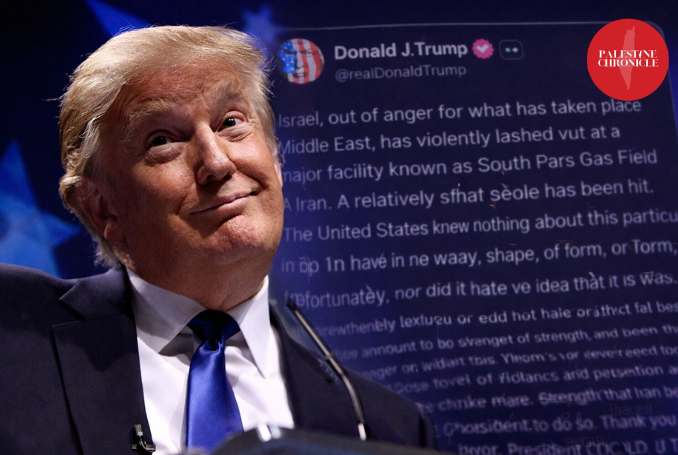
A central contradiction emerges in US President Donald Trump’s response to the attack on Iran’s South Pars gas field, where his public statements diverge sharply from verified reporting.
In a Truth Social post on Wednesday, Trump wrote that “Israel, out of anger for what has taken place in the Middle East, has violently lashed out at a major facility known as South Pars Gas Field in Iran,” insisting that “The United States knew nothing about this particular attack.” He further added that Qatar “was in no way, shape, or form, involved with it.”
However, according to the Wall Street Journal, citing US officials, Trump “ knew about the Israeli strike on South Pars in advance (and) supported it as a message to Tehran over its block of the Strait of Hormuz.”
The contradiction is further reinforced by Trump’s own escalation within the same statement. While denying US involvement, he warned that “the United States of America… will massively blow up the entirety of the South Pars Gas Field at an amount of strength and power that Iran has never seen or witnessed before.”
Total Defeat vs Continuing Threat
Trump’s repeated claims that Iran has been completely defeated are contradicted both internally and by external reporting.
In multiple posts, he asserted that “We have already destroyed 100% of Iran’s Military capability,” and that “The United States of America has beaten and completely decimated Iran, both Militarily, Economically, and in every other way.”
He further stated that “Iran’s Navy is gone, their Air Force is gone… their leaders have been wiped from the face of the earth.”
Yet these sweeping claims are undermined by his own acknowledgment that Iran retains operational capacity.
In the same sequence of statements, Trump noted that “it’s easy for them to send a drone or two, drop a mine, or deliver a close range missile,” while warning that any interference would prompt immediate escalation.
This contradiction is reflected in reporting by ABC News, which documented that Trump’s messaging presents Iran as both destroyed and an ongoing threat, often within the same speech or timeframe. In one instance, Trump declared that US operations had “obliterated the regime’s nuclear program,” while simultaneously describing Iran as a looming danger that required continued military attention.
ABC further noted that these inconsistencies extend beyond rhetoric into broader policy ambiguity. Trump has repeatedly suggested that the war could end “very soon,” while officials within his own administration have described the conflict as “just the beginning,” revealing a gap between presidential messaging and military assessments.
More broadly, ABC’s analysis concludes that “we’ve been getting mixed messages,” with the White House offering shifting and sometimes contradictory explanations for the war itself, including justifications that have been challenged by senior officials and even close allies.
This pattern aligns with additional assessments indicating that Iran’s capabilities, while degraded, remain intact in key areas.
US intelligence testimony and international reporting have consistently emphasized that the Iranian state and its military infrastructure have not been eliminated, contradicting claims of total destruction.
Allies: Unnecessary or Essential?
Trump’s statements on the role of US allies reveal a clear and repeated contradiction, presenting allies as unnecessary, indispensable, and unwilling — often within the same timeframe.
In one Truth Social post on Tuesday, Trump asserted unilateral US capability in absolute terms: “WE DO NOT NEED THE HELP OF ANYONE!”
Yet this position is directly contradicted by his repeated calls for allied intervention, particularly regarding the Strait of Hormuz.
In another post on Wednesday, he urged that “US allies need to get a grip – step up and help open the Strait of Hormuz,” while also claiming that “many Countries… will be sending War Ships… to keep the Strait open and safe.”
At the same time, Trump suggested that allies were reluctant to participate, stating that “most of our NATO ‘Allies’… don’t want to get involved with our Military Operation.”
This contradiction is reflected in external reporting.
The Guardian reported that US pressure on allies to join maritime and military operations in the region has been met with hesitation, with several governments expressing concern over escalation risks and domestic political constraints.
The report notes that while Washington has sought broader coalition support, European and regional partners have been cautious about direct involvement in a widening conflict.
Hyperbole, “Fake News,” and Narrative Control
Beyond direct contradictions, Trump’s messaging is characterized by the repeated use of absolute and expansive language, often accompanied by efforts to discredit conflicting accounts.
He describes Iran as “totally defeated,” “decimated,” and “being annihilated by the day,” while asserting that “We have unparalleled firepower, unlimited ammunition, and plenty of time.” In another post, he declared that Iran had plans of “completely obliterating Israel,” adding that “THOSE PLANS ARE NOW DEAD!”
At the same time, Trump dismisses opposing narratives, claiming that reports of damage or setbacks are “FAKE NEWS… generated by A.I.”
This attempt to discredit external reporting stands in contrast with the continued stream of information from international media and officials indicating that the conflict remains ongoing and unresolved.
(The Palestine Chronicle)

– Romana Rubeo is an Italian writer and the managing editor of The Palestine Chronicle. Her articles appeared in many online newspapers and academic journals. She holds a Master’s Degree in Foreign Languages and Literature and specializes in audio-visual and journalism translation.



Dondolf Trumpeldor has many faces: all of them are shady, shifty, scummy.
He’s a scumbag through and through.
But is he?
MK Ultra 101…
Trump’s entirely modus operandi is to lie. Constantly. Confuses people assuming Trump is “sane”. Evades responsibility, blame on everyone and everything. He assumes people like bombastic, over the top, noise (https://dictionary.cambridge.org/dictionary/english/bombastic — forceful and confident in a way that is intended to be very powerful and impressive, but may not have much real meaning or effect). But that behavior collapses quickly when it (and he) collides with reality. Everyone around him sees him the truth: a deeply insecure, weak, incapable foo.
Trump, on top of being a malignant narcissist and a congenital liar is showing signs of increasing dementia –
It is totally irresponsible for Congress to leave him in power …
I cannot believe PC writers waste time wondering whether Trump knows what he is saying or not.
We all know what the US will do – take over other countries and exploit and kill and steal resources.
If Israel commits horrendous crimes, the US gives them more money and weapons and does whatever they want.
Worked this way for decades. Get it?
Trump lies so naturally tha6t he would leave the world’s biggest scammer holding the world prize for truth telling.