
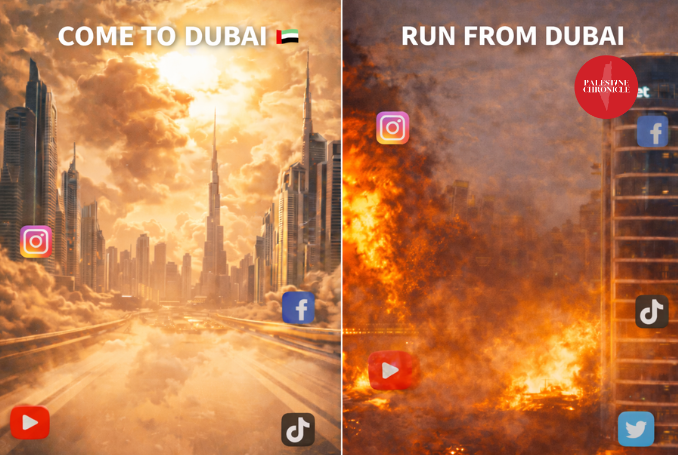

A viral influencer slogan celebrating Dubai’s luxury lifestyle has rapidly transformed online as war reaches the Gulf and reshapes perceptions.
Key Takeaways
- The viral social media slogan ‘Come to Dubai, Habibi’ has been widely parodied online as ‘Run from Dubai, Habibi’ amid the regional war.
- Iran has launched hundreds of missiles and drones toward the UAE, largely targeting US-linked military sites and strategic infrastructure.
- The meme reversal highlights how influencer-driven narratives about safety and luxury can collapse during geopolitical crises.
When a Meme Meets War
For years, Dubai and the United Arab Emirates cultivated a powerful image online: a glamorous global hub where luxury, safety, and opportunity converged.
Social media played a central role in spreading that narrative. Influencers across TikTok, Instagram, and YouTube popularized the phrase ‘Come to Dubai, Habibi’, inviting viewers to relocate to the emirate for a life of wealth and comfort.
@lungucristianpetru Habibi, runs from Dubai !😂 #dubai #habibi #cometodubai #runsfromdubai #dubailife ♬ New Sun – Chihei Hatakeyama
Videos often followed a familiar formula: influencers driving Lamborghinis, showcasing penthouses overlooking the Burj Khalifa, or relaxing on yachts in the Persian Gulf. Dubai seemed to represent the ultimate lifestyle upgrade.
The slogan itself became a viral meme across platforms. A single Instagram reel using the phrase accumulated hundreds of thousands of likes while repeating the invitation: “Habibi, come to Dubai.” Over time, the phrase evolved beyond tourism marketing. It became shorthand for a broader social media fantasy: a tax-free global city insulated from the turbulence of the Middle East.
That perception, however, began to shift dramatically once war reached the Gulf.
War Reaches the Gulf
Following the US-Israeli aggression on Iran, the regional war quickly expanded beyond the immediate battlefield when Tehran launched missile and drone attacks across the region, targeting countries that host American military infrastructure.
Among those countries was the United Arab Emirates. Iranian strikes were primarily aimed at US-linked facilities such as Al Dhafra Air Base in Abu Dhabi and Al Minhad Air Base near Dubai, both of which host foreign military forces.
But even when the targets were military, the effects were felt in civilian areas.
2021: Habibi come to Dubai 🫴
2026: Habibi run from Dubai 🏃♂️ https://t.co/DrtFg3WsX6— Dr Zee Q 🇵🇰 (@ar15507565) March 13, 2026
Explosions and falling debris from intercepted projectiles were reported across the Emirates, including Dubai and Abu Dhabi. Fires and infrastructure damage occurred after fragments landed in residential districts and commercial areas.
According to UAE defense officials, nearly 300 ballistic missiles and more than 1,600 drones have been launched toward the country since the conflict began, with most intercepted by air-defense systems.
The idea of Dubai as a completely insulated “luxury bubble” suddenly appeared far less convincing.
Why UAE is Targeted
The attacks on the UAE were not random. Analysts say Iran’s strategy was to target countries hosting US military infrastructure while avoiding full-scale war with the Gulf states themselves.
Tehran warned civilians in the UAE to avoid ports, docks, and sites hosting US forces, suggesting those locations could become targets in retaliation for attacks on Iran.
The strategy reflected a broader geopolitical calculation. By striking locations associated with US military operations, Iran aimed to signal that countries facilitating American military action could become part of the battlefield.
İran'ın gerçekleştirdiği füze saldırılarıyla, "Habibi Come to Dubai" akımı farklı bir anlam kazandı. pic.twitter.com/ksfErMH65v
— HUNINT (@hunintX) March 1, 2026
The UAE occupies a particularly sensitive position in this strategy. It hosts several major US military facilities and logistics hubs while also serving as a central financial and commercial gateway for the region. The country’s ports, airports, and financial centers are deeply integrated into global trade networks.
At the same time, the UAE normalized relations with Israel in 2020 under the Abraham Accords, further complicating its position in the regional conflict.
For Iran, this combination of military presence and geopolitical alignment makes the UAE more than just another Gulf state. It represents both a logistical hub for Western operations and a symbolic extension of the broader alliance confronting Tehran.
The Meme Reversal
As the war escalated, social media users began reinterpreting the original influencer slogan. The result was a wave of parody videos and memes replacing “Come to Dubai, Habibi” with “Run from Dubai, Habibi.”
Many clips juxtapose old influencer footage, featuring luxury cars, penthouses, and beaches, with new images of explosions, missile interceptions, or air-defense systems.
2025: habibi come to Dubai
2026: habibi run from Dubai pic.twitter.com/Lb9qoyZuDD— fuhad (@genuine_copy) March 2, 2026
Some posts show influencers enthusiastically promoting Dubai’s safety, followed immediately by footage of intercepted missiles lighting up the night sky.
Others mock the silence of influencers who once promoted Dubai’s lifestyle but stopped posting as the conflict intensified. The meme has spread widely across TikTok, Instagram, and X, where users increasingly question the gap between online branding and geopolitical reality.
(The Palestine Chronicle)

” Dubai, or not Dubai…that is the question… “