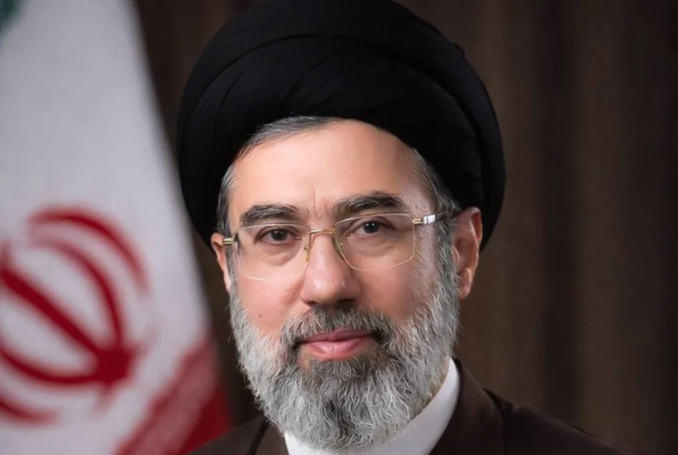

Iran’s leader Mojtaba Khamenei says in a statement on Friday that adversaries misjudged resilience, warning of expanding fronts as war continues and regional tensions intensify.
Key Developments
Khamenei says enemies believed Iran would collapse “in a day or two,” but failed to mobilize internal unrest.
Warns of activating new fronts and expanding operations if war continues, including targeting US-linked positions.
President Pezeshkian says assassinations failed to destabilize Iran, while calling for a regional security framework.
Khamenei: ‘Enemy Thought Iran Would Collapse in Days’
Iran’s Supreme Leader, Mojtaba Khamenei, said adversaries miscalculated Iran’s internal resilience, asserting that the war followed failed attempts to trigger unrest inside the country.
In a message marking Eid al-Fitr and Nowruz, Khamenei stated that “the enemy thought the people would be able to overthrow the Islamic regime in a day or two,” adding that the conflict escalated after “the enemy despaired of a popular movement in its favor.”
He emphasized that the Iranian population had formed “an impregnable fortress by their presence in the squares,” asserting that public mobilization had dealt “strong blows to the enemy.”
Khamenei also pointed to what he described as miscalculations by foreign powers, saying they believed that “with the martyrdom of the head of the regime, the people would leave the squares,” and that they could “dominate Iran and divide it.”
🚨 As the Supreme Leader, Mojtaba Khamenei, delivers his speech, Iranian missiles are launched toward the center of the entity, with sirens and interceptions reported. pic.twitter.com/jMfShtQi6X
— The Palestine Chronicle (@PalestineChron) March 20, 2026
‘Three Wars’ and Expanding Fronts
Khamenei outlined what he described as three distinct phases of confrontation over the past year.
The first, he said, involved direct military attacks supported by the United States targeting Iranian leaders and scientists, with the expectation that the system would collapse quickly. The second phase consisted of internal destabilization efforts—what he described as a “January coup”—in which economic pressure and unrest were expected to achieve similar outcomes.
The third phase, he said, is the current ongoing war, which began amid widespread mourning for those killed in earlier attacks, including military figures and civilians.
Despite these phases, Khamenei argued that the enemy failed to mobilize the population, stating that the people “set up a wide defensive line and fortified trenches in cities and mosques,” leaving adversaries “confused” and unable to achieve their objectives.
He warned that escalation could continue, stating that “if the war situation continues, fronts will be activated in which the enemy has no experience,” signaling potential expansion beyond current theaters.
Khamenei also called for utilizing all available capabilities, including strategic pressure points, explicitly urging action to “close the Strait of Hormuz” and to act across “all the soft areas of the enemies,” referring to the United States and Israel.
He added that Iranian forces had “blocked the enemy’s path with their powerful strikes and removed him from the illusion of being able to control and divide our homeland.”
Regional Denials and Accusations
Khamenei directly addressed recent incidents in Türkiye and the Sultanate of Oman, firmly denying Iranian involvement.
He stated that these attacks were “not carried out by the Iranian armed forces in any way,” instead claiming they were “orchestrated by the Zionist enemy with the aim of sowing discord among the nation.”
The US empire is in decline.
Feb. 17, 2026 pic.twitter.com/ZqFTXqXjBd— Khamenei.ir (@khamenei_ir) March 19, 2026
The remarks reflect Iran’s effort to counter accusations of regional escalation, while warning of attempts to draw neighboring countries into the conflict or disrupt Iran’s relations with them.
Khamenei stressed that Iran shares “beliefs, interests, and confrontation” with neighboring states, framing Tehran’s position as part of a broader regional alignment rather than a source of instability.
Media, ‘Soft War,’ and National Cohesion
A significant portion of Khamenei’s message focused on what he described as a “soft war” targeting Iran’s internal unity.
He warned that adversaries are attempting to exploit media narratives and internal weaknesses, urging domestic outlets to “refrain from focusing on weaknesses” in order to preserve national cohesion.
Khamenei emphasized the importance of public participation, describing mass gatherings, marches, and continuous presence in public spaces as central to strengthening social resilience.
He framed this participation as a defining factor in the country’s ability to withstand external pressure, presenting it as both a political and societal defense mechanism.
In this context, he announced the slogan for the coming year as “Resistance economy under national unity and national security,” identifying economic resilience as a central pillar of Iran’s strategy.
🚨 Published for the first time
A video of religious science teaching by Ayatollah Mojtaba Khamenei pic.twitter.com/uFtIvZ0POy
— IRIB (Islamic Republic of Iran Broadcasting) (@iribnews_irib) March 19, 2026
Pezeshkian: Assassinations Failed to Destabilize Iran
Iranian President Masoud Pezeshkian echoed similar themes on Friday, stating that targeted killings and attacks had failed to weaken the country.
He said that “the enemy assassinated the Supreme Leader, our military commanders, ministers from my government, and children in schools without justification or evidence,” adding that such actions did not achieve their intended outcome.
Pezeshkian stressed that “the enemy imagined that assassinating the Supreme Leader and military commanders would lead to the collapse of the country,” but maintained that Iran’s political structure remained intact.
He also confirmed that the Assembly of Experts had swiftly appointed Mojtaba Khamenei as Supreme Leader, ensuring continuity in leadership.
(PC, Al Mayadeen, Iranian media, Al Jazeera)