
What unfolds in Gaza is not humanitarianism. It is its inversion. Relief becomes containment. Recognition becomes erasure.
This is not a war. It is the cold, methodical erasure of a people, orchestrated through biometric scanners. Hunger is weaponized. Aid is militarized. Displacement is engineered.
And at the heart of it all, a Western-backed regime of necro-technocracy transforms genocide into governance, and murder into management.
There are junctures in history when violence ceases to be impulsive and becomes procedural. Hunger is no longer a humanitarian emergency but a variable in a broader calculation. Exile is no longer mourned — it is managed. Gaza today exemplifies this transition: the shift from cruelty as accident to cruelty as structure.
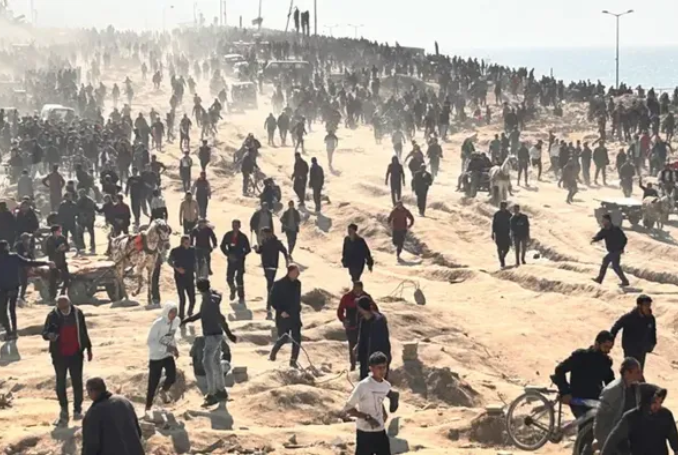
On May 28, 2025, in Rafah, an American firm — grimly named the Gaza Humanitarian Foundation — attempted to distribute aid under Israeli military supervision. The operation collapsed: thousands of starving civilians surged through the gates, Israeli forces opened fire, and helicopters evacuated the contractors. This was not a humanitarian failure. It was a controlled experiment. The message was not mercy. It was dominance.
Raymond Aron warned that when technical rationality governs human affairs, violence takes on the logic of procedure. Gaza is no longer subjected to episodic assault; it is governed by a bureaucratic regime of deprivation and control.
The replacement of UNRWA with private contractors is not reform — it is reconfiguration. Aid becomes a mechanism of management. Memory is neutralized. Injustice is rebranded as logistics. The Palestinian is no longer a political subject but a scanned body — cataloged, quantified, depersonalized.
The United States, in facilitating this shift, has forfeited any claim to moral leadership. By aligning with Israel’s machinery of logistical warfare, it exchanges its status as a superpower for that of strategic subcontractor. But let us speak plainly: the Americans are not auxiliaries of the genocidal state — they are its co-belligerents. They fund it, arm it, shield it, and defend it. They are not merely complicit in genocide; they are its co-authors — its architects.
What unfolds in Gaza is not humanitarianism. It is its inversion. Relief becomes containment. Recognition becomes erasure. The language of contractors — “traceability,” “impact,” “oversight” — cloaks a structure of domination. Every calorie is rationed with intent. Every delivery is calculated oppression.
The objective is unmistakable: to confine Palestinians to ever-shrinking zones, exhausted, starving, and stripped of agency, until existence itself becomes unbearable. Forced displacement, repeated endlessly, is not a policy failure — it is the policy. Movement without destination, without dignity, is a weapon. The goal is to provoke death through exhaustion, to make exile seem like mercy, and to carry out extermination in broad daylight — inside a vast open-air concentration camp.
This is no longer a regional conflict. It is a civilizational scandal. It calls into question the credibility of international law, the integrity of Western democracies, and the moral worth of their proclaimed values. Zionism, once cloaked in the language of refuge, now reveals itself as a doctrine of engineered exclusion. Western silence is not neutrality. It is complicity.
And yet Gaza resists. Not only with arms, but with memory, with presence, with the sheer refusal to vanish. The ruins speak. The children endure. The people, categorized and surveilled, remain the living contradiction to the narrative imposed upon them. The student uprisings across Western campuses are not side notes — they are seismic moral ruptures.
Neutrality is no longer a refuge. One must either consent —or confront.
History will not absolve this technocratic barbarism. It will not record this as a failed relief effort, but as the moment when humanitarianism was weaponized and administration became a tool of annihilation.
When a people fights to the very end — exhausting every ounce of strength in defense of its name, its faith, its land, its dignity, and its honor — what befalls it afterward is not defeat. It is something else. It is history at its most merciless. It is the bite of fate. It is destiny falling not as humiliation, but as a final shot of honor. This is not the failure of a people, nor the collapse of a movement — it is the triumph of fidelity.
And there is no nobler victory than that — the triumph of loyalty amid ruin, the final affirmation of dignity in the face of calculated erasure.
It is also the unveiling of cowardice, the exposure of hypocrisy, and the eternal curse upon those who stood by, complicit in murder, architects of infamy, heirs not to civilization, but to its betrayal.

– Mohamed El Mokhtar Sidi Haiba is a social and political analyst, whose research interest is focused on African and Middle Eastern Affairs. He contributed this article to The Palestine Chronicle.




Well Secretary General Antonio Gutteres says the same. Of course international law has failed utterly in this situation, and Western values show themselves as hypocritical empty claims to moral values merely.