
By Palestine Chronicle Editors
This legal opinion examines whether Iranian strikes on US bases in Gulf states violate international law or constitute lawful self-defense.
Key Takeaways
- Under UN General Assembly Resolution 3314, a state that allows its territory to be used for aggression may bear legal responsibility.
- Article 51 of the UN Charter recognizes the inherent right of self-defense against an armed attack.
- If attacks originate from military bases in third countries, those bases may become legitimate military targets.
- Any self-defense action must comply with necessity and proportionality, two core principles of international law.
- Host states that facilitate military operations may be viewed as co-belligerents, losing the protections normally afforded to neutral states.
A Legal Question in the Midst of War
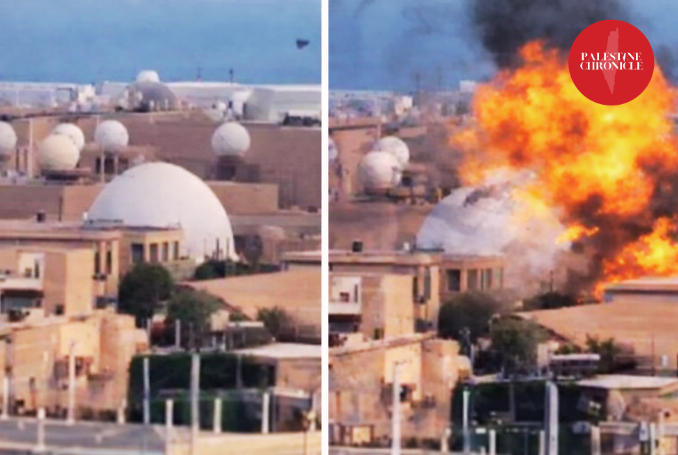
As the regional conflict between the United States, Israel, and Iran rapidly escalates, new legal questions have emerged regarding the expanding battlefield. Following US and Israeli strikes on Iranian territory in late February, Tehran launched retaliatory operations targeting American military facilities across the Gulf region.
The Palestine Chronicle consulted several legal sources and experts in international law to examine a central question now debated in diplomatic circles:
Are Iran’s strikes on US bases located in Gulf states legal under international law, or do they violate the sovereignty of those host countries?
The answer, legal scholars suggest, is not as straightforward as it may appear in political rhetoric. It requires examining the frameworks of the UN Charter, customary international law, and the legal responsibilities of states that allow their territory to be used for military operations.
Before addressing the legal arguments, however, it is important to understand the broader context of the unfolding war.
What Is Happening in the Region?
On February 28, 2026, tensions between Iran and the US-Israeli alliance erupted into a direct military confrontation after coordinated strikes targeted Iranian infrastructure, military facilities, and civilian targets. In response, Tehran launched a large-scale counter-offensive.
Iranian operations have not been limited to Israeli or US forces directly engaged in the attacks. Instead, several American military bases located across the Gulf Cooperation Council (GCC) states have reportedly come under Iranian missile and drone strikes. These installations include facilities used for logistics, surveillance, and aircraft operations.
The expansion of the battlefield beyond the immediate combatants has triggered a major legal debate: If US forces launch attacks on Iran from bases located in other countries, does international law permit Iran to strike those bases in return?
Does Hosting a Foreign Military Constitute an “Act of Aggression”?
Under what is often referred to in Western discourse as the “rules-based international order,” host states are frequently portrayed as neutral actors merely providing logistical support to allies.
However, international law contains a more explicit definition of aggression.
The UN General Assembly Resolution 3314 (1974) defines acts of aggression in several forms. Article 3(f) states that aggression includes:
“The action of a State in allowing its territory, which it has placed at the disposal of another State, to be used by that other State for perpetrating an act of aggression against a third State.”
From a legal standpoint, this provision carries significant implications. If a Gulf state allows its territory to be used as a launch platform for attacks on Iran, it is not simply hosting foreign forces. It may be considered legally responsible for enabling an act of aggression.
In such a case, the host state risks losing the legal protections normally associated with neutrality. Instead, it could be seen as a participant in the conflict, even if indirectly.
Is Iran’s Response Protected by Article 51?
The UN Charter’s Article 51 recognizes what it describes as the “inherent right of individual or collective self-defense” when a state is subjected to an armed attack.
Legal scholars often interpret this provision through what is sometimes referred to as the “source of fire” principle.
If a missile, drone, or aircraft that attacked Iran originated from a specific military base, that base becomes the operational source of the threat. Under this reasoning, international law does not require a state under attack to respect the territorial boundaries of a third country if those boundaries are being used to shield ongoing military operations.
In such cases, the key legal question becomes whether the host country is “unwilling or unable” to prevent its territory from being used for attacks.
If a state permits its territory to function as a launch point for strikes against another country, and fails to stop those operations, the targeted state may argue that it has the legal right to neutralize the threat at its source.
What Are the Mandatory Limits of Self-Defense?
Even if Iran can invoke the right to self-defense, international law imposes strict conditions on how that right can be exercised.
Two principles are particularly central: necessity and proportionality.
- The Rule of Necessity requires that any use of force in self-defense must be necessary to halt or prevent an ongoing attack. If the military action is primarily intended as retaliation or punishment, rather than to stop a continuing threat, the legal justification weakens.
- The Rule of Proportionality limits the scale and scope of the response. Military action must be restricted to what is reasonably required to neutralize the threat.
In practical terms, this means that certain targets could fall within the boundaries of lawful self-defense. For example:
A strike directed at hangars, radar installations, or personnel directly involved in attacks on Iran could potentially meet the proportionality requirement.
However, the legal argument would weaken significantly if Iranian forces targeted civilian infrastructure such as oil facilities, power grids, or unrelated military assets belonging to the host state.
In such cases, the response could be interpreted as exceeding the limits of lawful self-defense.
Does “Co-Belligerent” Status Change the Legal Framework?
Another concept raised by international law experts is that of co-belligerency.
Once a state knowingly allows its territory to be used for offensive military operations against another country, it may effectively enter the conflict itself. In such circumstances, it no longer qualifies as a neutral party under the legal framework established by the Hague Conventions governing neutrality in war.
By providing bases, airspace, or logistical infrastructure for military operations, the host state may be seen as placing its territory and resources at the disposal of one side of the conflict.
If that threshold is crossed, the theater of war may legally extend into that state’s territory.
This interpretation significantly complicates the narrative that Gulf states are merely passive hosts for foreign military deployments.
A Crisis of Responsibility?
The expanding war between Iran, the United States, and Israel is raising complex legal questions about sovereignty, neutrality, and the limits of self-defense.
While Iran must still operate within the boundaries of necessity and proportionality to maintain a legal claim to self-defense, the responsibility for the widening battlefield does not lie solely with Tehran.
International law suggests that states cannot provide their territory as platforms for military operations while simultaneously claiming the protections reserved for neutral actors.
If foreign military forces are allowed to conduct attacks from bases located within their borders, those bases may become legitimate targets under the logic of self-defense.
In that sense, the legal crisis unfolding in the Gulf reflects a broader breakdown in the norms governing sovereignty and war.
Under the strict lens of international law, a state cannot supply the instruments of war while expecting the privileges of peace.
(The Palestine Chronicle)


WHAT LAW????? Iran should keep fighting back and they should flatten ” Israel “.
Amessica ” can do no wrong ” …
Dondolf Twitler and his Nutzi Party are the only threat to world peace because they insist upon fellating the tiny mushroom tip that is ” Israel ” trying to make it a foot long. Ain’t gonna happen! Israel cannot exist without us, so let’s cut the friggin cord, huh? at least 85 girls, killed. For what? then Dondolf threatened them and said don’t retaliate. What tv show is he on! this is OUR country. We need to take it back and lose Wasrael. enough already.