
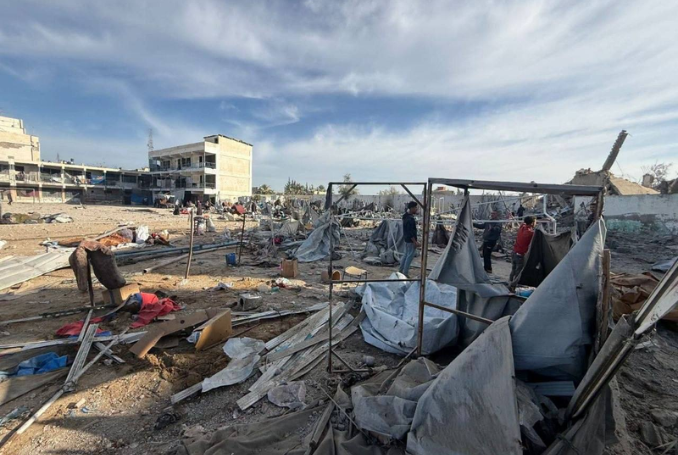

Israeli occupation forces demolished homes in central Gaza as a new ground offensive displaced families and closed roads despite the ceasefire.
Key Takeaways
- Israeli occupation forces blew up homes north of Nuseirat and east of Maghazi as their ground offensive in central Gaza entered its second day.
- Tanks and bulldozers advanced around refugee camps and Wadi Gaza, while families fled homes and tents without alternative shelter.
- A Palestinian wounded in an earlier drone strike died Thursday, while Israeli gunfire wounded a woman north of Khan Yunis.
Israeli occupation forces blew up Palestinian homes and other structures in central Gaza early Thursday, expanding the destruction accompanying a ground offensive launched a day earlier despite the ceasefire, as families fled threatened neighborhoods and displacement sites without alternative shelter.
Two powerful explosions were heard during demolition operations north of the Nuseirat refugee camp and east of the Maghazi refugee camp.
East of Maghazi, Israeli quadcopter drones dropped boxes containing explosives that destroyed several evacuated homes and caused extensive damage, according to witnesses and local sources.
The demolitions followed Wednesday’s announcement of a military offensive in three blocks around the Bureij and Nuseirat refugee camps.
Israeli occupation forces closed sections of Salah al-Din road, advanced toward residential areas and opened fire near homes and tents, forcing another wave of displacement among families already struggling to find safe accommodation.
🇮🇱🇵🇸 Footage from the site of Israel’s ground operation north of Nuseirat, in central Gaza.
Where are the mediators?? pic.twitter.com/yINZKc3ULU
— The Saviour (@TheSaviour) November 19, 2026
Tanks Advance Around Refugee Camps
The Israeli military’s Coordinator of Government Activities in the Territories, COGAT, announced in a statement on Wednesday that the operation covered blocks 660, 661 and 666 near the so-called yellow line, the boundary associated with Israel’s military withdrawal under the ceasefire.
The designated areas encompass locations north and northwest of Bureij, the al-Dawa neighborhood north of Nuseirat, and areas near Wadi Gaza. COGAT also announced the closure of Salah al-Din road within the affected blocks.
On the ground, Israeli occupation forces advanced into al-Mughraqa, near the Wadi Gaza Bridge on Salah al-Din road, and into al-Dawa. Tanks and military bulldozers were seen on the bridge as heavy artillery fire struck the entrance to al-Dawa and military vehicles fired north and east of Nuseirat.
Israeli tanks and bulldozers also advanced through the Atla al-Rais area east of Bureij. At the camp’s northeastern entrance, Salah al-Din road appeared deserted as the military operation disrupted movement through the area.
The offensive has brought demolition operations, shelling and gunfire into and around communities where residents and displaced families remain, further restricting their movement despite the ceasefire agreement.
Palestinian families fled central Gaza’s Nuseirat refugee camp on Wednesday as Israeli tanks and bulldozers advanced into the area amid artillery shelling and drone fire. At least three people were reported killed in strikes across Gaza. This is the first ground operation since… pic.twitter.com/BXkVa4KYe9
— حسام شبات (@HossamShabat) November 19, 2026
Families forcibly Displaced
Palestinian families began leaving homes and temporary accommodation in the areas covered by the offensive, while displaced Palestinians moved toward central Nuseirat after receiving warnings to evacuate their tents and locations surrounding the military operation.
Many had no alternative shelter. Families were forced to abandon the tents in which they had been living without knowing where they could find accommodation or safety, adding to the burden of repeated displacement.
The gunfire also disrupted commercial activity at the entrance to Nuseirat, where shops closed after shots from Israeli military vehicles reached the intersection. The closures compounded restrictions on residents’ movement and transportation as military vehicles operated around the camp.
For those leaving, the offensive has created an immediate need for shelter in a territory where extensive destruction has already forced large numbers of Palestinians into tents and damaged buildings.
Israel has dropped over 150,000 tonnes of explosives on Gaza — more than eight times the combined explosive power of the Hiroshima and Nagasaki atomic bombs. Dr. Mustafa Barghouti warns that the bombardment, equivalent to 66 kg of explosives per person, has consequences far… pic.twitter.com/Po6kwshlq4
— حسام شبات (@HossamShabat) November 19, 2026
Palestinian Dies of Wounds as Gunfire Continues
At Al-Aqsa Martyrs Hospital, a medical source confirmed Thursday that Ahmed Abu Armana died from injuries sustained several days earlier when an Israeli drone struck a gathering of civilians north of Bureij.
In southern Gaza, Israeli army fire directed toward homes and displacement tents wounded a Palestinian woman in the Hamad residential area north of Khan Yunis.
The latest demolitions and shootings come amid continuing Israeli violations of the ceasefire that took effect in October 2025. According to the Gaza Health Ministry figures cited by Anadolu news agency, those violations have killed more than 1,650 Palestinians and wounded around 6,000.
Since October 2023, Israel’s genocide in Gaza has killed more than 74,700 Palestinians and wounded over 176,000, according to the ministry. Around 90% of the territory’s infrastructure has been damaged or destroyed, while the UN has estimated reconstruction costs at approximately $71.4 billion.
The new offensive is adding further destruction and displacement to that devastation, forcing families from homes and tents while Israeli forces demolish buildings and restrict access to roads through central Gaza.
(PC, AA, QNN)




Be the first to comment