
By Benay Blend
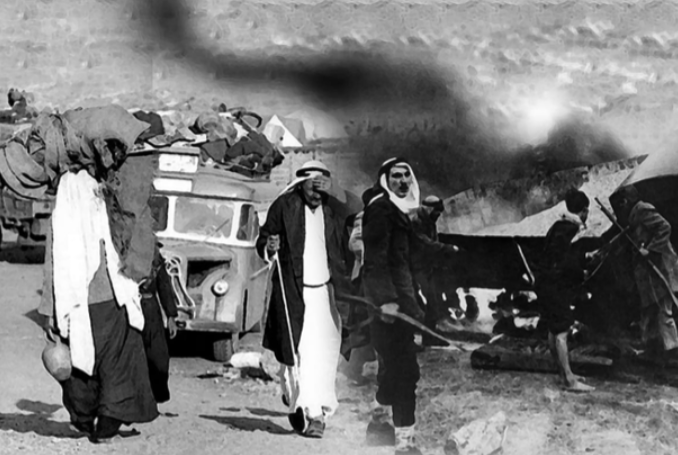
By making 1948 the origin story in both film and books, Dabis, Alyan, and Baroud, too, make clear that Israel’s ethnic cleansing did not begin in response to October 7, nor did Palestinian resistance begin on that later date.
“Making memories public affirms identity, tames trauma, and asserts Palestinian political and moral claims to justice, redress, and the right of return,” explain Ahmad H. Sa’di and Lila Abu-Lughod in Nakba: Palestine, 1948, and the Claims of Memory (2007, p. 3).
In Before the Flood: A Gaza Family Memoir (2026), Ramzy Baroud reiterates this theory. As Israeli historian Ilan Pappé notes in the foreword, the mere recitation of Palestinians killed, displaced and otherwise abused during the Nakba and since, while horrific, does not convey the story (p. xvi).
Nevertheless, it is important to understand the magnitude of the Nakba, partly because certain Zionists today who acknowledge the term “genocide” to describe the current situation in Gaza too often qualify that it is due to a “liberatory strand of Zionism” that has gone wrong.
For instance, genocide scholar Omer Bartov’s Israel: What Went Wrong?, recently reviewed in a Guardian article by Aaron Gell, is seen as an attempt to explain how a country founded on “complete equality of social and political rights to all its citizens irrespective of religion, race or sex” could have evolved into one intent on “settler colonialism and ethno-nationalism.”
While Gell admits that there has been some criticism of the book, namely that the author omits Israel’s colonial role since ’48, he does so only briefly. The focus of his review omits the Nakba, though he seems to accept that the horrors of the Holocaust somehow justified the granting of a Jewish state on what had been land belonging to Palestinians.
As Sa’di and Abu-Lughod note, the 1948 war that resulted in the creation of the State of Israel, the catastrophe that Bartov ignores, led to the “devastation of Palestinian society” (p. 3). While Bartov defends the Zionist movement by stating that it led to the “liberation and emancipation and rescue of a persecuted minority,” Sa’di and Abu-Lughod explain that Palestinians were “excluded from the unfolding of this history” (p. 4).
In his study, then, Bartov ignores that 80 percent of Palestinians who had lived on what became the State of Israel were forced to flee their land, becoming permanent residents of refugee camps or inhabitants of a diaspora. Those who stayed behind became second-class citizens under a separate system of military administration by a government who also stole the majority of their land (Sa’di and Abu-Lughod, p. 3).
On the one hand, Bartov contends that there were two strands of Zionism, one was liberatory (though ostensibly only for Jewish people), the other was ethno-nationalist.
On the other, if the Zionist movement is comparable to other imperialist doctrines, as Eric Cheyfitz notes, then there was only one ideology, a settler-colonial drive that justified displacing Palestinians, just as Indigenous tribes in the Americas lost their land.
Along with the Zionist’s “deliberate erasure” of the Palestinian story, this “lack of resolution” and unremitting ethnic cleansing has resulted in the “stubborn dissidence of their memory work” to this day (Sa’di and Abu-Lughod, p. 5).
“Memory is one of the few weapons available to those against whom the tide of history has turned,” Sa’di and Abu-Lughod write. “Palestinian memory is, by dent of its preservation and social production under the conditions of its silencing by the story of Zionism, dissident memory, counter memory,” and as such “contributes to counter-history” (p. 6).
Nevertheless, some memories have been more visible than others, particularly as in the case of Palestinian women’s words that often found no place in the accounts of armed resistance.
In the private sphere, however, women are more often responsible for the transfer of memories between generations. Reversing this logic, it is the current age group who are “creating the art and writing the books, trying to grasp the meaning of the Nakba, while fighting forgetfulness and making public claims on behalf of their parents’ and grandparents’ suffering” (Sa’di and Abu-Lughod, p. 21).
In I’ll Tell You When I’m Home (2025), Syrian/Palestinian writer Hala Alyan chronicles the lives of her ancestors, all of whom fled from one country to the next, journeys that characterized the lives of Arabic people.
Having fictionalized the tale of her Palestinian lineage in Salt Houses (2018) and her Syrian family in The Arsonist’s City (2021), Alyan turned to memoir to chronicle her foremothers’ impact on her life.
Significantly, Alyan begins her story in May 1948 when her grandmother’s village was stormed by Israeli soldiers, forcing her to flee to Gaza. After that she left for Kuwait, where Alyan’s father was born, but who would later leave for various destinations with his family.
Her grandmothers’ stories formed part of a larger tale, “thousands of stories” that shape a narrative of resilience in the face of displacement and families torn apart (p.11). At some point, Alyan hopes that the stories will be passed on “to an audience that isn’t even here yet, but also you hope against hope is coming” (p. 11).
“There is no such thing as an assault on people and land that doesn’t first” assault the truth (p. 201), Alyan asserts. Thus, it is her responsibility to witness, to not look away when Israel drops white phosphorous on small children, when a bulldozer destroys a house.
Even though the land is in fragments, as are the stories that get passed down, it is this stubborn refusal to forget that provides an imaginative return until the physical return is possible.
Like Hala Alyan’s memoir, Cherien Dabis’s most recent film tells the story of three generations of a Palestinian family. Also beginning with the Nakba, All That’s Left of You (2025) narrates the various ways that Palestinians have resisted, including armed resistance as well as the act of choosing to survive amidst political unrest and violence.
In an interview with Amy Goodman, Dabis relates her interpretation of the film:
“At its heart, it’s really about the extraordinary will that it takes to survive political turmoil and personal loss. And, you know, if you want to probe even deeper, I think it’s really about choosing our humanity, you know, looking for meaning in grief and choosing humanity even in the most difficult of circumstances, which Palestinians have done and do every single day, but, you know, for some reason, the world just never gets to see that.”
One of the most challenging things, Dabis explained, was “making a movie about what was happening as it was happening,” i.e., the Nakba that never ends.
By making 1948 the origin story in both film and books, Dabis, Alyan, and Baroud, too, make clear that Israel’s ethnic cleansing did not begin in response to October 7, nor did Palestinian resistance begin on that later date.
Growing up immersed in Western media that dehumanized Palestinians into “nameless, faceless numbers,” Dabis wanted to film a Nakba story, a movie that tells what happened to Palestinians after ’48.
In a review of Dabis’ film, Jamal Kanj writes that “to remain human, to insist on grief, memory, and dignity, is itself an act of resistance against a system that survives on our dehumanization.”
Having been born and raised in a refugee camp himself, Kanj experienced a layering of memories as he watched the film, his own brought about as the scenes of other lives unfolded on the screen.
By cutting through the numbness caused by numbers, Dabis joins Alyan and Baroud, whose work tells the full story of suffering caused by displacement, harassment, and assassination by Israeli forces. In so doing, she creates a counter-history, a story calculated to draw others into the movement to free Palestine.
Indeed, Nakba Day (May 15th) is marked by commemoration of the displacement of Palestinian people, but it is also a Global Day of Protest in solidarity with the struggle for liberation and freedom in a not far-off future.
In “Restoring the Day of Liberation Struggle,” Khaled Barakat explains how commemorating the day as an “open wound” does injustice to the reality of the people fighting a “battle for liberation and return.”
“The Palestinian national movement, particularly after the launch of the contemporary Palestinian revolution,” Baraket contends, “sought to move beyond the condition of the ‘Nakba’ as a title of defeat, toward redefining the Palestinian as the bearer of a project of resistance and liberation, not merely the victim of a historical catastrophe.”
At the closing session of the Gaza Tribunal in Istanbul last year, Dr. Ramzy Baroud concluded with the following: “Feel bad for the victims, for the innocent children pulverized with their families, but don’t think for a minute that resistance in Palestine will stop, under any circumstance,” he continued. “Gaza is on the frontline of this struggle—not only for the sake of Gaza, but for the sake of humanity.”

– Benay Blend earned her doctorate in American Studies from the University of New Mexico. Her scholarly works include Douglas Vakoch and Sam Mickey, Eds. (2017), “’Neither Homeland Nor Exile are Words’: ‘Situated Knowledge’ in the Works of Palestinian and Native American Writers”. She contributed this article to The Palestine Chronicle.
Be the first to comment