
The report concluded with a call for international enforcement of the Genocide Convention and a global arms embargo on Israel.
Israeli airstrikes on schools sheltering displaced Palestinian civilians in Gaza are part of a broader pattern of unlawful attacks that have decimated the territory’s education system and violated international humanitarian law, Human Rights Watch (HRW) said in a new report.
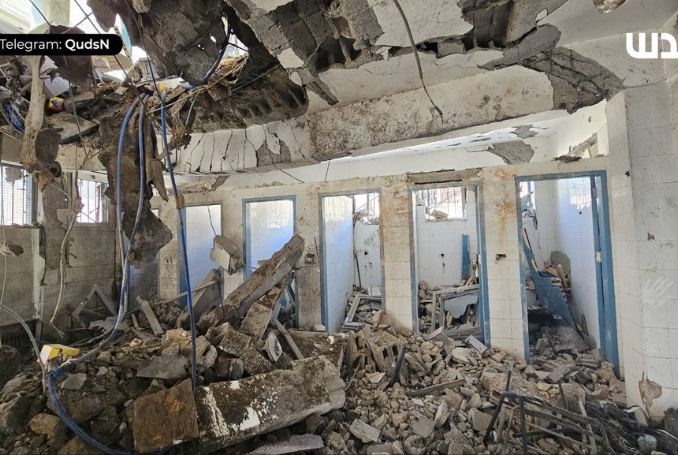
In a detailed investigation published on Thursday, the rights group documented two major strikes on schools-turned-shelters—the Khadija Girls’ School in Deir al-Balah on July 27, 2024, and the Zaytoun C School in Gaza City on September 21, 2024—finding no evidence of military presence at either site.
“These attacks provide a window into the widespread carnage that Israeli forces have carried out in Gaza,” said Gerry Simpson, associate crisis, conflict, and arms director at Human Rights Watch. “Other governments should not tolerate this horrendous slaughter of Palestinian civilians merely seeking safety.”
Both schools were crowded with displaced families who had nowhere else to go. HRW’s report, based on satellite imagery, witness testimonies, videos, and photo analysis, stated that the Israeli military failed to provide effective warnings and used US-supplied GBU-39 bombs in strikes that appeared to be indiscriminate.
The Moral Collapse of the West: B’Tselem’s Delayed Verdict and the Cost of Inaction
The Khadija Girls’ School, which had served as a shelter for about 4,000 displaced Palestinians, was bombed three times over the course of three hours, starting around noon on July 27.
At least 15 people were confirmed killed, although Gaza’s Ministry of Health said the number was over 30, with more than 100 wounded. The school also hosted a field hospital affiliated with al-Aqsa Martyrs Hospital nearby.
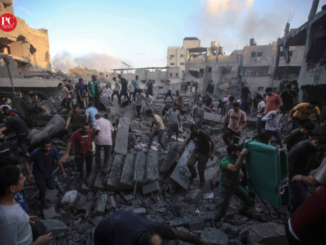
“When we arrived, I saw a horrific scene,” said a journalist who was at the hospital and ran to the school after the first strike. “I saw injured women, children, the elderly, and some doctors in their medical clothes. Women were shouting, ‘Where are my children?’”
Another journalist who arrived at the scene minutes later reportedly described a two-story building full of displaced families that had been completely flattened. “Can you imagine? A building full of displaced people leveled in the blink of an eye,” he was reported as saying.
HRW identified remnants of US-made GBU-39 Small Diameter Bombs at the site, confirmed through video and photographic analysis.
One video showed an unexploded munition lodged in the middle of the school courtyard. The report noted that witnesses said there were multiple blasts, and that Israeli authorities gave a warning only after the first, most deadly strike.
A man who lived near the school said residents received a call from Israeli forces warning of a second strike, after the first explosion had already taken lives. “They said people should leave the area as they were going to strike the school again,” he recounted.
While the Israeli military claimed the Khadija School housed a Hamas command center, it provided no evidence. HRW reviewed social media and statements from Palestinian armed groups and found no indications of any fighter presence.
None of the seven men identified among the dead were recognized by Hamas or Islamic Jihad as members.
A similar pattern was observed in the strike on Zaytoun C School on September 21. The school, part of a three-school complex, was hit at approximately 10:45 a.m., killing at least 34 people—most of them children. No warning was given before the strike, survivors said.
“Suddenly missiles started raining down on us – there was no warning,” said a woman who had been sheltering in the school.
One man told HRW that he lost eight members of his family in the attack, including children and women. “There were only civilians seeking safety,” he said.
Videos analyzed by HRW and open-source researchers show severely wounded children being pulled from the rubble, and images captured after the blast show remains of GBU-39 bombs inside the school.
The Israeli military later claimed to have conducted a strike on a Hamas command center at the nearby al-Falah school, about 200 meters from Zaytoun C, but offered no evidence that the building struck was being used for military purposes. It did not acknowledge or explain the attack on Zaytoun C School.
According to the UN Relief and Works Agency (UNRWA), at least one million Palestinians have been sheltered in schools across Gaza since the beginning of the Israeli assault in October 2023. As of mid-July 2025, at least 836 people taking refuge in schools had been killed and over 2,500 injured.
A recent assessment by the Occupied Palestinian Territory Education Cluster found that 97 percent of Gaza’s schools had sustained damage, with 76 percent directly hit and 92 percent requiring full reconstruction or major repairs to function again.
The damage to schools has not only denied civilians safe shelter, but has also dealt a catastrophic blow to education in Gaza. Rebuilding, HRW noted, will take years and require resources that are currently unavailable under the ongoing siege.
The rights group also referenced a July 2024 investigation by Israeli outlets +972 Magazine and Local Call, which revealed that the Israeli military had formed a “special strike cell” to systematically identify and target schools.
According to the report, schools were referred to internally as “centers of gravity,” and attacks were often carried out using a “double-tap” method—where a second strike follows the first to hit survivors and rescue workers.
The Israeli army has repeatedly claimed that Hamas or other armed groups were operating inside the schools it bombed. However, HRW noted that, out of dozens of attacks, Israel has only provided names and photos of alleged fighters in seven cases—some of which were proven to be inaccurate. In one instance, at least three of the people named were already confirmed dead before the strike.
NEW: Israeli forces’ deadly attacks on schools sheltering Palestinian civilians highlight the absence of safe places for displaced people, the vast majority of Gaza’s population.
Read more: https://t.co/VXoLMaeQUd pic.twitter.com/IOq5WxutuB
— Human Rights Watch (@hrw) August 7, 2025
Even if fighters were present, HRW emphasized, the presence of civilians imposes strict legal limits. Attacks must adhere to the principle of proportionality, and all feasible precautions must be taken to avoid civilian harm. Failure to do so, especially when carried out recklessly or deliberately, amounts to a war crime.
After nearly two years of attacks on schools and protected civilian infrastructure, HRW warned that continued weapons transfers to Israel make other governments complicit. “Governments providing military support to Israel can’t say they weren’t aware of the consequences of their actions,” said Simpson. “Governments should suspend all arms transfers to Israel and take other actions to prevent further mass atrocities.”
The report concluded with a call for international enforcement of the Genocide Convention and a global arms embargo on Israel. It also reiterated that serious violations of international law demand criminal accountability—not only for those who execute the strikes, but also for those who facilitate them.
Palestine endorsed the Safe Schools Declaration in 2015, a political commitment supported by 121 countries aimed at protecting education during armed conflict. Israel has not joined.
(The Palestine Chronicle)