
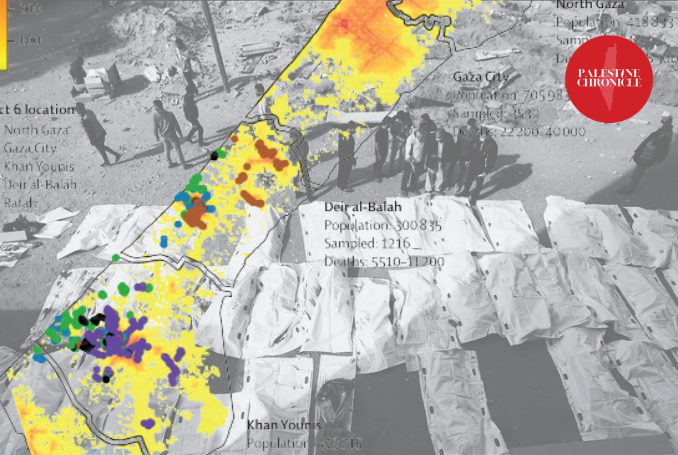
New Lancet survey estimates Gaza’s violent deaths 35% higher than official figures, confirming massive civilian toll.
Key Takeaways
- 75,200 violent deaths were estimated in Gaza between October 7, 2023, and January 5, 2025.
- The figure is 34.7% higher than the Gaza Ministry of Health’s reported 49,090 deaths for the same period.
- Violent deaths equal roughly 3.4% of Gaza’s pre-war population — about 1 in every 30 residents killed.
- 56.2% of those killed were women, children, or elderly people (42,200 civilians).
- The study estimates 22,800 children killed alone.
- Researchers recorded 16,300 non-violent deaths, including disease and deprivation.
- Of those, 8,540 were excess deaths beyond normal pre-war mortality levels.
- The crude death rate reached 40.3 deaths per 1,000 people per year (33.1 violent + 7.2 non-violent).
- The survey identified 12,200 missing persons, whose fate remains unknown and not counted as dead.
- The household survey achieved a 97.2% response rate across 2,000 households and 9,729 individuals, making it the first population-representative mortality dataset of the war.
First Independent Population Survey
For the first time since Israel launched its war on Gaza on October 7, 2023, a fully independent, population-representative mortality survey has measured the human cost of the assault. Published February 18, 2026, in The Lancet Global Health, the Gaza Mortality Survey (GMS) concludes that violent deaths in the Strip have “substantially exceeded official figures,” reaching an estimated 75,200 people killed between October 7, 2023, and January 5, 2025.
The number represents approximately 3.4% of Gaza’s pre-war population, meaning roughly one in every thirty residents was killed violently during the first 15 months of the war.
The authors state unequivocally:
“This first independent population survey of mortality from the conflict in the Gaza Strip establishes that violent deaths have substantially exceeded official figures whereas demographic patterns align with official reports.”
The Gaza Ministry of Health (MoH) had reported 49,090 violent deaths for the same period. According to the Lancet study, that figure is 34.7% below the central estimate produced by the survey.
Crucially, the findings contradict persistent political claims that the Gaza Health Ministry inflated casualty numbers. The researchers explicitly address this:
“Our findings contradict claims that the MoH has inflated the death toll from the war in the Gaza Strip. Instead, the MoH appears to provide conservative, reliable figures while working under extraordinary constraints.”
In effect, the study not only confirms the scale of killing — it validates Gaza’s own casualty documentation system.
How the Survey Was Conducted
The Gaza Mortality Survey was carried out between December 30, 2024, and January 5, 2025, under active military conditions. Researchers surveyed 2,000 households across 200 primary sampling units, documenting the vital status of 9,729 individuals who were members of those households on October 6, 2023.
The response rate reached 97.2%, with near-complete reporting of deaths and demographic data — an extraordinary figure in a conflict zone.
The researchers emphasize the significance of this achievement:
“This study provides the first independent, population-based household survey estimate of mortality in Gaza during the current conflict.”
The survey employed stratified cluster sampling and statistical weighting procedures (“raking”) to ensure the sample reflected Gaza’s pre-war demographic composition across age, gender, governorate, and household size.
Despite Israeli military restrictions that rendered parts of Northern Gaza, Gaza City, and Rafah inaccessible, displaced populations from those areas were sampled in shelters and tent encampments in Khan Yunis and Deir al-Balah.
The authors acknowledge limitations but stress that undercounting remains more plausible than overcounting:
“The net direction of bias in our estimates is uncertain, with multiple offsetting factors potentially leading to either underestimation or overestimation.”
Notably, households with no surviving adult members could not be surveyed — a factor that likely suppresses total mortality estimates.
Who Was Killed
One of the most politically contested aspects of the Gaza war has been the demographic composition of the dead. The Lancet study confirms that women, children, and elderly people comprised 56.2% of violent deaths.
The breakdown is stark:
- 22,800 children under 18
- 16,600 women aged 18–64
- 2,870 elderly over 64
- 32,900 men aged 18–64
The authors note:
“Women, children, and older people comprised 56.2% of violent deaths, consistent with MoH reporting.”
This alignment between independent survey data and the Ministry of Health figures strengthens the credibility of Gaza’s official reporting systems.
The study further finds that crude mortality from violence reached 33.1 deaths per 1,000 population per year, an extraordinarily high rate in modern conflict analysis.
Non-Violent Excess Deaths
Beyond direct killing, the study estimates 16,300 non-violent deaths during the study period. After subtracting expected baseline mortality projections, researchers calculate 8,540 excess non-violent deaths attributable indirectly to war conditions — including disease, medical system collapse, and deprivation.
While this figure is significant, it challenges earlier speculative projections that suggested indirect deaths might vastly outnumber direct casualties.
The authors clarify:
“Although non-violent excess deaths were substantial (ie, 8540), they were far lower than some projections and did not exceed violent deaths.”
This finding directly addresses prior claims — including projections that non-violent deaths could be four times higher than violent deaths — noting that such estimates lacked empirical foundation.
At the same time, the study warns that conditions deteriorated significantly after data collection ended, particularly following the collapse of the ceasefire in March 2025 and the declaration of famine conditions in Gaza City later that year.
The researchers caution:
“The ratio of non-violent to violent deaths has probably increased since our data collection period.”
In other words, indirect mortality may now be significantly higher than measured in early 2025.
Previous Estimates
The new survey aligns closely with earlier independent statistical modeling. A 2025 capture–recapture study by Jamaluddine et al. estimated 64,260 violent deaths through June 2024, finding that the MoH undercounted fatalities by approximately 40%.
The Lancet team notes the rare methodological convergence:
“This rare validation between survey and capture–recapture methodologies strengthens confidence in both approaches.”
In July 2024, a separate modeling letter published in The Lancet suggested that indirect deaths could eventually push total mortality far higher, potentially exceeding 180,000 over time. That projection was based on historical ratios observed in other conflicts, not primary data.
The new 2026 survey does not support extreme short-term indirect death ratios but confirms that direct violent deaths alone already exceed 75,000 — a figure dramatically higher than official reporting.
Missing Persons
The survey estimates 12,200 missing persons, predominantly men aged 18–64. Their fate remains unknown.
Importantly, the study conservatively treats missing individuals as alive in its primary estimates. Even under the “extreme and implausible assumption” that all missing persons are deceased, the demographic composition of casualties remains consistent with MoH reporting.
This methodological conservatism suggests the 75,200 figure may still represent an undercount.
Meaning of the Numbers
By early January 2025, according to this peer-reviewed survey, between 3% and 4% of Gaza’s entire population had been killed violently.
The study underscores the broader significance:
“High-quality war mortality estimates play a crucial role in illuminating the human cost of conflict.”
It also emphasizes the moral dimension of casualty documentation:
“By naming individual victims, the MoH endows each person with human dignity.”
While statistical estimates quantify scale, the authors stress that administrative records — including names — remain essential for historical accountability.
Record of Destruction
The Lancet study is not a political statement. It is a statistical document grounded in survey methodology. Yet its conclusions carry undeniable weight.
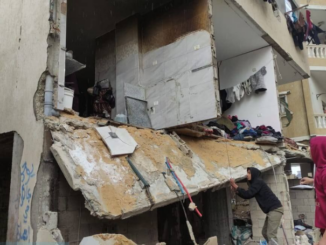
Violent deaths exceeded official counts by roughly one-third. Civilian demographics confirm widespread impact on women and children. Indirect deaths, while substantial, do not yet eclipse direct killing — though worsening humanitarian collapse may alter that ratio.
Most significantly, the study rejects narratives that Gaza’s casualty figures were exaggerated. Instead, it finds that official reporting has likely been conservative.
The research demonstrates that even amid bombardment, displacement, and siege, mortality surveillance remains possible — and necessary.
As the authors conclude:
“These results underscore the feasibility of mortality surveillance in highly challenging conflict settings and provide a crucial empirical foundation for assessing the true human cost of the conflict.”
The human cost, as now independently measured, is staggering — and still unfolding.
(The Lancet, PC)


Be the first to comment