
By Romana Rubeo 
Solicited to examine Mahmoud Khalil’s latest remarks, The Palestine Chronicle reviews his own words on Zionism, resistance, Hamas, October 7, and antisemitism.
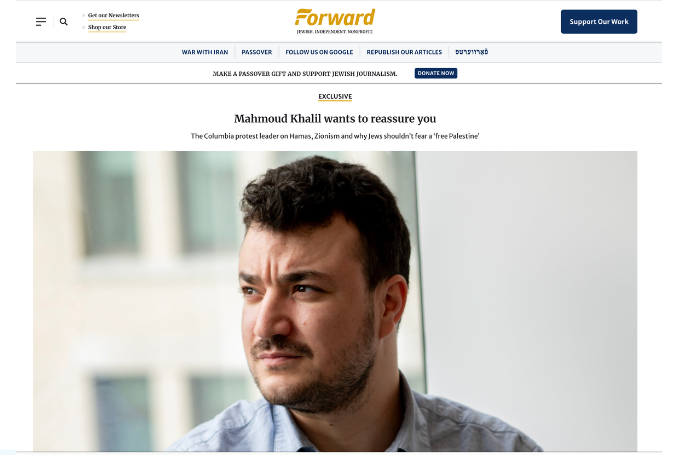
The Palestine Chronicle was asked by readers to examine the recent interview given by Mahmoud Khalil to The Forward, published on April 7, 2026, and conducted by Arno Rosenfeld.
The article was published under the title and subheading:
“Mahmoud Khalil wants to reassure you
The Columbia protest leader on Hamas, Zionism and why Jews shouldn’t fear a ‘free Palestine’.”
Khalil, a Palestinian-Algerian activist who emerged as a prominent negotiator during the Columbia Gaza solidarity encampment, became nationally known after federal agents arrested him at Columbia student housing in March 2025.
In the interview, The Forward presents him as a figure seeking to “reassure” a Jewish audience, while Khalil offers extended comments on Zionism, Hamas, October 7, the student movement, and the political future of Palestine.
The Forward’s own communications note that this was Khalil’s first interview with a major US Jewish outlet and state that “he wanted to speak directly to a major Jewish audience.”
What follows is a fact-check in question-and-answer form, built around Khalil’s own words and the record presented in the interview itself.
Note: At the time of publication, I am not aware of any known statement by Khalil objecting to or distancing himself from the quotes and comments attributed to him in The Forward. This article will be updated should any such statement be issued.
On Who Reached Out to Whom
Did Khalil merely respond to a media request, or did he deliberately choose this platform and audience?
According to The Forward, Khalil “wanted to speak directly to a major Jewish audience.”
The publication described the conversation as an “exclusive, in-depth interview” and his first with a major US Jewish news outlet.
On ‘Good’ vs Bad Zionists
Did Khalil move away from treating Zionism as a singular settler-colonial ideology?
Khalil explicitly said, “For a lot of people, all Zionists are bad. To me, no — it’s not like that.”
In the same interview, he also said he has “a nuanced view of the Zionist project” and argued that there are “different layers” to it.
Basically, the former Columbia student does not present Zionism simply as one coherent colonial structure, but as something to be differentiated and reinterpreted.
On ‘Globalize the Intifada’
Did Khalil distance himself from one of the most visible slogans of the protest movement?
He partly did. Khalil said he does not use the slogan because, for him, the goal at Columbia was divestment.
Khalil said, “I don’t use it just because — to me, my goal at Columbia is to get it to divest.”
At the same time, he avoided condemning the slogan itself, adding:
“Even if the students used a normal word like globalize the ‘uprising’ they would receive the same sort of backlash. The point is not about their slogan, the point is about silencing them.”
On the Understanding of Resistance
Did Khalil imply that some of the movement’s most militant rhetoric came from people detached from what he perceived as Palestinian lived reality?
He did. Khalil said there were “maybe some bad actors” who “believed only in the theory of resistance” and “believed themselves to be part of it”. He claimed that Palestinians were saying, “No, it doesn’t work this way.”
He added that many of them had “only read the literature of the Palestinian struggle, rather than living within it.”
The implication is that sections of the movement adopted the language of Palestinian resistance while lacking the grounding to speak in its name.
On Hamas and ‘Legitimate Armed Resistance’
How did Khalil handle the question of support for Hamas?
Khalil argued repeatedly for a distinction between Hamas and “legitimate armed resistance.”
He said Hamas is “not up to the Palestinian aspiration for liberation”.
He further said, “There should be a distinction between supporting legitimate armed resistance and supporting Hamas.” In other words, he criticized Hamas while preserving the political legitimacy of armed struggle in principle.
On Hamas as a Product of Israeli Policy
Did Khalil attribute Hamas’ rise partly to Israel itself?
Yes. Khalil said Hamas came to power through Israel’s “concerted effort to delegitimize the PLO” and added that Netanyahu’s government allowed funding for Hamas in order to preserve Palestinian division.
Khalil’s formulation echoes a widely circulated claim that Israel helped enable Hamas in order to weaken the PLO.
While versions of this argument have been made in political and media discourse, it is also frequently described by analysts as an oversimplified narrative — or even a “myth” — that obscures Hamas’ independent origins within the Muslim Brotherhood and reduces a complex historical process to a single causal explanation.
On Political Islam
Was Khalil simply criticizing Hamas politically, or also ideologically?
He was explicit on the ideological point. Khalil said, “I come from a family that doesn’t believe in political Islam,” and insisted that this should be separated from the broader question of Palestinian resistance.
On October 7
How did Khalil describe Hamas’ actions on October 7?
Khalil said there should be an “independent and transparent international investigation” into October 7.
He acknowledged that “crimes were committed” and that Hamas bears responsibility, including for targeting civilians to take them “hostage”.
“I wouldn’t rule out that Hamas targeted civilians, but I wouldn’t confirm it either,” he said.
On His Vision for a ‘Free Palestine’
How did Khalil address ‘Jewish fears’ regarding a free Palestine?
Khalil claimed that, for many Jews, opposition to the encampments and to calls for a “free Palestine” is rooted in genuine fear.
He said explicitly that he rejects “driving anyone out of the place that they were born in,” including Israeli Jews.
He added, “It’s too late to tell people like, ‘Go back to Poland, go back to Russia,’” and described his vision as a place open to anyone who wishes to call it home or holy land.
The emphasis here was not on dismantling settler-colonial privilege as such, but on recognizing those fears as legitimate concerns and responding with a framework of reassurance.
On Endorsing Liberal Zionism
Did Khalil show sympathy for liberal Zionist narratives?
Yes. The Forward notes that Khalil recommended Ari Shavit’s My Promised Land on Ezra Klein’s podcast and quoted him saying that many Jews subscribe to Zionism out of fear of persecution.
He added that his view “goes beyond ‘Zionism is bad’” and that “different layers” of the project are not being seen across the Arab world or among Palestinians.
On Anti-Zionism and Antisemitism
Did Khalil accuse some anti-Zionist activism of crossing into antisemitism?
He said, “Some anti-Zionist actions may touch on antisemitism that we absolutely oppose and don’t want and need to be educated about.”
Although stating that the protest movement has largely kept this in check, in doing so, Khalil adopts a framing long used in mainstream Western discourse.
(The Palestine Chronicle)
– Romana Rubeo is an Italian writer and the managing editor of The Palestine Chronicle. Her articles appeared in many online newspapers and academic journals. She holds a Master’s Degree in Foreign Languages and Literature and specializes in audio-visual and journalism translation.

That last point should be put in the context of there being a frighteningly large number of Zionists who are quite antisemitic – Benjamin Netanyahu being the case in point, having pressed Trump to begin the war against Iran, then not made any complain when Trump talked about destroying Iran en masse. As Iran still has a Jewish community, one may safely say that Trump called for the extermination of that Jewish community en masse, and that Netanyahu wasn’t upset about it – both points being genuine antisemitism red flags.
You should see the follow-up opinion piece in Forward, April 9, 2026, “Mahmoud Khalil’s reassurances are bad for Jews but even worse for Palestinians” by Zach Iscol. Very craftily put together, reflecting characteristic Zionist deflection; distortion, omission, ignorance of history; moral relativism; the “why are you picking on us?” whine; delusion; falsehoods; the attempt to minimize the genocide; and so much more. American Jews can’t have it both ways. To try to shift blame away from, to maintain any support for Israel is not only the same as being ignorant of history, but in being complicit in genocide.
SUPPORT !!!
This is the path to peace. Whether its two states or one state, this is a land with two distinct ethnic groups which each have a long-standing ancestral claim to it. Mutual recognition of the validity of those claims is the first step to a peaceful existence
BUB:, Beautiful in words :should we forget an 80 years-long genocide for the the 80 millions palestinians massacred since 1946 ???
Best summed up by Norman Finkelstein: “The only right the Israelis have is to pack their bags and leave.”