
By Benay Blend
Collective political education and organizing become particularly important during periods when the government is cracking down not just on courses relevant to Palestinian liberation.
Directed by Jan Haaken and Jennifer Ruth, Palestine Exception serves as the most recent documentary exploring the wave of crackdown from college administrators, the media, police and politicians who oppose calls for a ceasefire and divestment from corporations that do business with “Israel.”
On May 1st, 2025, the US House passed legislation defining criticism of Israel as anti-Semitic, thus codifying in legal terms what many call the “Palestine Exception” to free speech.
Zionist attacks on the solidarity movement also hinder organizing around the Palestinian cause, as well as the exclusion of various study programs from the college curriculum.
To its credit, the film places October 7 and beyond in historical context, going back to the Nakba as a logical starting point to discuss the Zionist goal of severing Palestinians from their land.
It also looks back to the beginnings of McCarthyism in 1947, an anti-Communist crusade that cast a wide net for what were considered “un-American” activities of the day. These proceedings that resulted in destruction of many lives and careers set a precedent for the current rounding up of anyone deemed pro-Palestinian.
None of this is new. Years ago, the Dean of my department told me that several students had complained that it appeared their teacher hated America, so he suggested that I put a more positive spin on my lectures. At that point in the chronology, we had reached the Vietnam War, a catastrophe that seemed impossible to frame as an example of American Exceptionalism, so perhaps best to totally exclude, along with manifest destiny, slavery, sweatshops and everything else that belied America as the best country in the world.
Much earlier, on March 14, 2005, the late historian Howard Zinn delivered a speech at the Massachusetts Institute of Technology (MIT), pointing out the ways that “The Myth of American Exceptionalism” impacted its dealings with problems at home as well as with the rest of the world.
Scholars who buy into this myth must expunge all negativity that detracts from the preferred trajectory of uninterrupted progress towards a perfect state. Thus, America’s origin story must leave out the extermination of Native people, slavery in the American South, along with any other ugly truths that undermine the glorious course of American history.
For Israel, too, there is an origin story that totally erases the indigenous Palestinians from the land. In this version, there was no Nakba, no ethnic cleansing, nothing that detracts from the account of a landless people who deserved a land.
Indeed, as Ramzy Baroud explains, the Zionist project has always sought to “erase Palestinian history, identity and presence. It framed Palestinians as a people without history, a land without a people, and their resistance as mere acts of ‘terrorism’” (“The Long War for Meaning,” New Internationalist, November-December 2025, Issue 558).
The current confrontation, Baroud contends, is the culmination of a 77-year-old “struggle over whose narrative defines reality – whether the Zionist project’s claim to legitimacy can overwrite the lived history and rights of the Palestinian people, or whether Palestinian steadfastness will assert its own meaning against erasure” (“The Long War for Meaning,” New Internationalist, November-December 2025, Issue 558).
There are thus crossovers between the two narratives that continue to this day. American Exceptionalism omits all fault lines in the country’s history; Palestine Exception allows no criticism of Israel, particularly if it implicates the US as complicit in the genocide of Palestinians.
Given several years ago, Zinn’s talk at MIT unknowingly predicted much of what is happening today.
“What this idea of special American dispensation in the world, what it leads to is an abrogation of all sorts of responsibilities to the human race, to everybody else in the world,” Zinn explained. “And it means that the United States is exempt from these responsibilities.”
This history does not get taught in schools. For example, there is the history of American expansionism, particularly overseas. Zinn contends that textbooks have substituted “something called diplomatic history,” because “if they learn the history of the massacres and invasions that accompanied American expansion in the world, they could not possibly believe the president of the United States when he gets up before the nation and says, ‘We’re going into this country for liberty and democracy.’”
“This misuse of histories continues to be perpetuated by our political leaders, and not really caught or criticized by that part of the American culture which is supposed to check up on and criticize what the government does,” Zinn concluded. “That is the press, the media.”
In the realm of education, media, and the press, Palestine Exception mirrors American Exceptionalism, another rather ugly facet of American history when the country that once fought a war against fascism now funds a government committing genocide, allegedly in self-defense.
While these facts do not get taught in classrooms or reported by mainstream news, opposition to “Israel’s” genocide in Gaza has inspired large rallies and campus protests around the world. These gatherings, along with alternative-media accounts, are filling in where assaults on classroom curriculum and journalism have left a void.
Clearly, there are other ways to provide political education outside of classroom walls. Baltimore-based founder of Education Through Reading, Erica Caines, explains how her project “breaks down systemic barriers to education, offering avenues for self-expression, critical thinking, community engagement, and self-determination.”
Invited to attend the Second International Meeting of Theoretical Publications of Left Parties and Movements in Cuba, Caines used the opportunity to promote transnational communal exchange between Africans in the Americas and those on the African continent.
“Ultimately, literacy campaigns and initiatives promoting grounded representation are not only about providing access to books and education but also about empowering African youth to become agents of change in their communities and beyond,” Caines explains. “By gaining a deeper understanding of heritage, creating connections across borders, and promoting critical consciousness,” she concludes, “taking Liberation Through Reading beyond the US has been but one aspect of a foundation for a more inclusive and equitable world where all voices are heard and valued.”
In “Reject Anti-Intellectualism,” Caines speaks to the need for political education aimed also at adults. Spearheaded by “prominent leftists and prominent progressive figures,” the drive to undermine the importance of study assumes that “reading does not tackle one’s immediate needs under the primary contradiction of imperialism.”
“When 54% of US adults 16-74 years old – about 130 million people – lack proficiency in literacy, reading below the equivalent of a sixth-grade level, the aggressive anti-intellectualism increasingly growing online and spilling over should be cause for alarm,” Caines contends.
Collective political education and organizing become particularly important during periods when the government is cracking down not just on courses relevant to Palestinian liberation, but also any curriculum that provides tools “to comprehend and verbalize the causes of (colonial) conditions that (collective) reading and organization helps [the colonized] better understand and fight to win.” Political education helps to fill that void, thus affording the means to obtain immediate needs through self-determination and communal organizing.
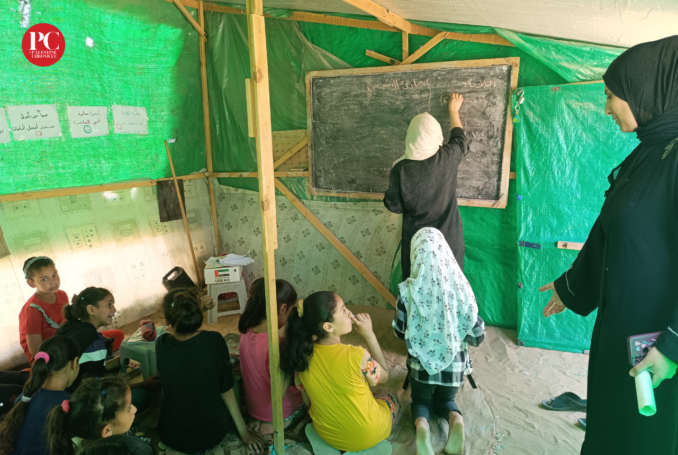
In Gaza, too, literacy has been seen as an important facet in the struggle against colonial powers. As Ramzy Baroud explains, Palestinian society has poured energy into the educational sector in the Strip, seeing it as a “crucial tool for liberation and self-determination. Early footage shows classrooms being held in tents and open spaces, a testament to this community’s tenacious pursuit of knowledge.”
Opposed to negotiating with the colonist entity, the late Ghassan Kanafani assumed instead the role of the “combatant writer,” what Tahrir Hamdi describes as resistance through “political organization and armed struggle, poetry, art, science and the resilient olive trees that dot the Palestinian landscape” (“Between the Sword and the Neck,” New Internationalist, December 2025, Issue 558, p. 34).
According to Baroud, the entity’s “war on the Palestinian thinker” will fail, partly for reasons that Kanafani penned many years ago.
“Ideas are not tied to specific individuals, and resilience and resistance are a culture, not a job title,” Baroud explains. “Gaza shall once more emerge,” he predicts, “not only as the culturally thriving place it has always been, but as the cornerstone of a new liberation discourse that is set to inspire the globe regarding the power of intellect to stand firm, to fight for what is right, and to live with purpose for a higher cause.”

– Benay Blend earned her doctorate in American Studies from the University of New Mexico. Her scholarly works include Douglas Vakoch and Sam Mickey, Eds. (2017), “’Neither Homeland Nor Exile are Words’: ‘Situated Knowledge’ in the Works of Palestinian and Native American Writers”. She contributed this article to The Palestine Chronicle.


Be the first to comment