
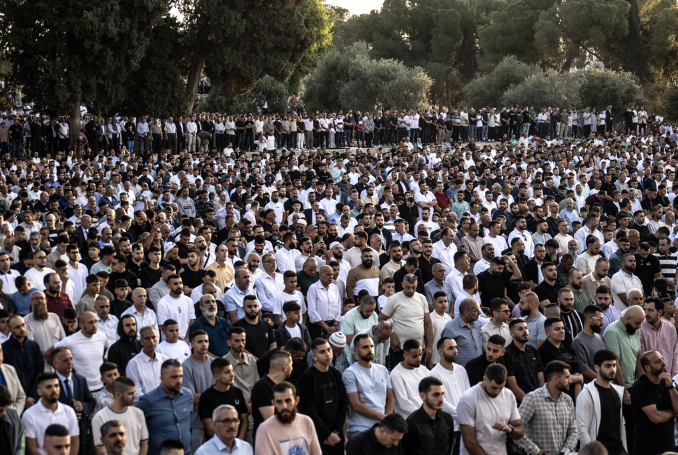

Palestinians marked Eid al-Adha under war, bombardment and restrictions, celebrating the holiday under vastly different realities.
Key Developments
- Israeli strikes in Gaza killed Palestinians hours before Eid prayers, including six in Gaza City’s Al-Rimal neighborhood.
- Around 140,000 Palestinians performed Eid prayers at Al-Aqsa despite extensive Israeli restrictions and military deployments.
- Across the West Bank, Eid began amid raids, arrests, settler attacks and restrictions on worshippers and families.
While Eid al-Adha was celebrated throughout much of the world with collective prayers, family gatherings and festive traditions, Palestinians also marked the first day of Eid—but under entirely different conditions.
For Palestinians across occupied Jerusalem, the West Bank and Gaza, Eid arrived amid bombardment, military restrictions, displacement, arrests and continuing war. While takbeerat echoed from mosques and prayer grounds, they unfolded against the backdrop of airstrikes, destroyed homes and expanding military operations.
Across Palestine, the holiday became a reflection of sharply contrasting realities: mass worship at holy sites despite military restrictions, prayers among ruins in Gaza and military incursions continuing even on one of the holiest occasions in the Muslim calendar.
الأهالي يصدحون بتكبيرات العيد من قلب المصلى القبلي في المسجد الأقصى المبارك pic.twitter.com/yegoOSEkiq
— القسطل الإخباري (@AlQastalps) May 27, 2026
Gaza: Eid under Bombardment
In Gaza, the first day of Eid began under continued Israeli attacks.
Al Mayadeen reported that the number of Palestinians killed in an overnight Israeli strike on the Al-Rimal neighborhood in western Gaza City rose to six.
The attack came only hours before Eid prayers as Israeli bombardment continued across different areas of the Gaza Strip.
Earlier attacks targeted western Gaza City and eastern Khan Yunis. Israeli warplanes struck a residential apartment west of Gaza City, while artillery shelling hit eastern Khan Yunis. More than ten Palestinians were reportedly injured.
Gaza’s Health Ministry said hospitals received six killed and thirty-four wounded over the previous twenty-four hours. It also stated that victims remain trapped beneath rubble and in streets inaccessible to rescue teams due to continuing attacks and deteriorating field conditions.
Images from Al-Shifa Hospital showed bodies and wounded civilians arriving following the strikes, including children.
For many Palestinians in Gaza, Eid has increasingly become associated with loss rather than celebration.
For the third consecutive year, Palestinians in Gaza have been unable to perform Hajj. Sacrificial rituals traditionally associated with Eid al-Adha have also largely disappeared due to continuing siege conditions, destruction and severe shortages.
Prayer this year was again performed on the ruins of destroyed mosques and in open spaces amid widespread devastation.
Israel’s genocide in Gaza has killed more than 72,000 Palestinians and injured over 172,000 since October 2023, while approximately ninety percent of civilian infrastructure has sustained damage or destruction.
Israeli Strikes Kill Six in Gaza City as Israel Claims Targeting New Qassam Leader
140,000 Reach Al-Aqsa
In occupied Jerusalem, tens of thousands of Palestinians gathered at the Al-Aqsa Mosque despite extensive Israeli restrictions.
The Islamic Waqf Department estimated that approximately 140,000 worshippers performed Eid prayers at Al-Aqsa.
Israeli forces deployed heavily throughout Jerusalem’s Old City, around entrances to the mosque compound and along surrounding streets and alleys.
Since the beginning of the Gaza genocide in October 2023, Israeli authorities have continued restricting access for many Palestinians from the occupied West Bank seeking to pray at the site. Additional restrictions intensified during the US-Israeli war on Iran earlier this year.
Still, worshippers filled the mosque courtyards from the early morning hours.
Takbeerat announcing the beginning of Eid echoed throughout the compound as thousands gathered despite military barriers and security restrictions.
Gaza Marks Third Eid al-Adha under Genocide as Hunger and Attacks Deepen Crisis
Raids, Arrests and Restrictions
Elsewhere in the occupied West Bank, Eid began amid military incursions and arrests.
Quds News Network reported that Israeli forces raided multiple cities and towns including Nablus, Hebron, Jericho, Tubas and surrounding areas, carrying out arrest campaigns and home searches.
Settler attacks were also reported during the holiday period.
In one incident, settlers reportedly stole a Palestinian vehicle near Ramallah, while another attack involved arson targeting a vehicle near Jenin.
In Jenin, Israeli forces reportedly prevented families of slain Palestinians from reaching cemeteries to visit the graves of relatives as part of longstanding Eid traditions.
According to local reports, families attempting to approach the cemetery near Jenin refugee camp were met with tear gas and prevented from entering.
At the Ibrahimi Mosque in Hebron, worshippers also faced restrictions.
Israeli occupation forces reportedly closed entrances, searched worshippers and fired stun grenades near the site, significantly reducing attendance.
While much of the world celebrated Eid through gatherings and festivities, Palestinians marked the holiday under very different circumstances: praying among ruins, navigating military checkpoints and burying their dead even as the holiday began.
(The Palestine Chronicle)


Be the first to comment