
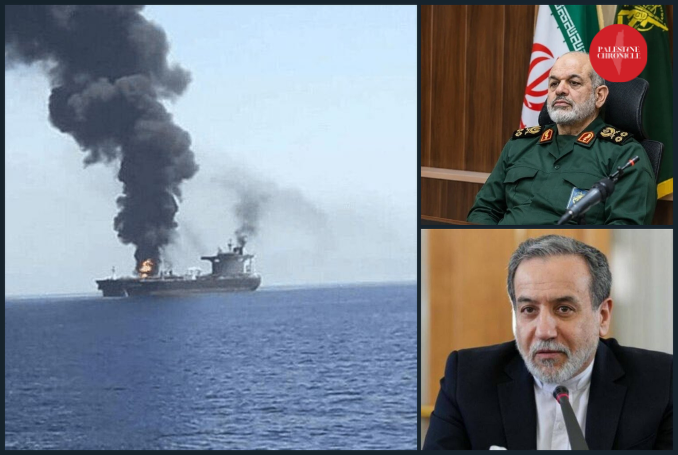

Iran told Washington to accept defeat and leave the region as the Revolutionary Guard reported a tanker explosion in Hormuz.
Key Developments
- Iran’s Revolutionary Guard commander said Washington had no choice but to acknowledge defeat and leave the region.
- The Guard reported that an oil tanker struck a naval mine near Khasab in the Strait of Hormuz.
- Foreign Minister Abbas Araghchi demanded an end to the US naval blockade, while American lawmakers remained divided over war funding.
- Israeli analysts accused Benjamin Netanyahu of using the Iranian threat to obstruct efforts to replace his government.
Iran’s Islamic Revolutionary Guard Corps commander, Major General Ahmad Vahidi, told the United States on Friday to acknowledge defeat and withdraw from the region, as Tehran reported another tanker explosion in the Strait of Hormuz and demanded that Washington’s naval blockade be broken.
“The enemy must know that it has no choice but to acknowledge defeat, and no other choice remains but to leave the region,” Vahidi said, according to Al Mayadeen.
Speaking at the closing ceremony of a conference, Vahidi claimed that Iranian naval forces controlled the Gulf, the Strait of Hormuz and waters extending more than 500 kilometers beyond them.
He said opposing warships were remaining 500–600 kilometers away and argued that attempts to seize Iranian islands or coastal territory had been abandoned over fears that troops would be killed or captured.
Tanker Explosion in Hormuz
Later Friday, the Revolutionary Guard announced that an oil tanker had suffered an explosion after striking a naval mine near Khasab port in the Strait of Hormuz.
Its navy accused the vessel of attempting an unauthorized passage and warned that shipping movements throughout the strait and Gulf remained under Iranian surveillance.
The Guard attributed repeated mine incidents to vessels disregarding Iranian navigation instructions and relying on US military assurances. Tehran’s warnings contradict US Central Command’s claims that principal shipping routes had been cleared of mines and were safe.
We did not know that the Israeli Ambassador to Washington was the Commander-in-Chief of the U.S. Military. https://t.co/aWY0isJoBM
— Seyed Abbas Araghchi (@araghchi) November 20, 2026
‘Blockade Must Be Broken’
Araghchi, meanwhile, said Iran was pursuing both oil exports and negotiations while seeking to overcome the US blockade.
“We are making every possible effort regarding oil exports and negotiations. The naval blockade must be broken,” he told reporters in Tehran, Anadolu reported.
Iran closed the Strait of Hormuz on March 2 following the US-Israeli assault. Washington imposed its naval blockade on April 13, severely disrupting Iranian oil exports.
US Senate Rejects Iran War Limits as Pentagon Bill Tops $47 Billion
War Funding Divides Congress
In Washington, disagreements over the war threatened negotiations to keep the federal government operating beyond December 11, when current funding expires.
According to Al Mayadeen, Trump has requested an additional $350 billion for the Pentagon. Senate Republicans have instead opened negotiations with Democrats over a $1.1 trillion defense spending bill incorporating $69 billion of that request.
Democrats remain divided over whether to insist on restrictions on Trump’s use of military force against Iran as part of a funding agreement.
Representative Rosa DeLauro, the leading Democrat on the House Appropriations Committee, argued that a government shutdown would not stop the war.
Lawmakers have three weeks to reach an agreement, with the Thanksgiving recess further narrowing the negotiating window.
The United States of Genocide: Empty Promises after the Big Blue Wave
Netanyahu Accused
Israeli analysts also accused caretaker Prime Minister Benjamin Netanyahu of using the Iranian threat to derail Gadi Eisenkot’s efforts to form a government or secure a unity administration under his own leadership.
Haaretz military analyst Amos Harel said Netanyahu had revived the issue to prevent the opposition bloc from forming a coalition, Anadolu reported.
According to Harel, Israeli Chief of Staff Eyal Zamir opposes an immediate attack, with the military assessing that the Iranian threat is real but not imminent.
Harel nevertheless said Zamir broadly accepted the argument for another campaign in the future.
Maariv analyst Ben Caspit similarly accused Netanyahu of seeking another confrontation despite the absence of an urgent military recommendation.
The New York Times reported Wednesday that Netanyahu was attempting to persuade Washington to join an air campaign lasting four to seven days. Trump said Thursday that he was in no hurry to decide.
Eisenkot received the mandate to form a government on November 8. Netanyahu’s allies hold 53 parliamentary seats, while parties opposing him hold 67, including 19 belonging to Arab parties.
The premiership remains a central obstacle to unity negotiations, with Netanyahu insisting on leading the government despite Eisenkot holding the mandate.
(PC, Al Mayadeen, Anadolu)




Be the first to comment