
Palestine Action hunger strikers force the UK to block a £2 billion Elbit contract, exposing British complicity in genocide and proving the power of direct action.
In a defiant stand that has shaken the corridors of British power, imprisoned activists of Palestine Action have suspended their grueling hunger strike after forcing a significant political concession from the UK government.
As of January 14, 2026, the last holdouts — including Heba Muraisi after 73 days without food, Kamran Ahmed at 66 days, and Lewie Chiaramello, who alternated days due to Type 1 diabetes — declared victory.
They ended the protest upon news that Elbit Systems UK, Israel’s largest arms manufacturer, was denied a £2 billion Ministry of Defence contract to train British troops.
They joined four others who had already paused their strikes — Teuta Hoxha, Jon Cink, Qesser Zuhrah, and Amu Gib — bringing the total to seven activists who stared down death to expose Britain’s complicity in genocide.
This was no mere pause. It was a strategic victory in the struggle against apartheid’s enablers.
The strikers are part of the “Filton 24,” arrested in November 2024 for allegedly storming and vandalizing an Elbit site near Bristol. Their demands were clear: immediate bail, unrestricted communication, reversal of Palestine Action’s terrorist designation, and the closure of all 16 Elbit UK sites.
They began their action on Balfour Day — November 2, 2025 — a deliberate rebuke to Britain’s colonial crime in Palestine.
Facing pre-trial detention that could stretch 18 months or more, they weaponized their bodies against a system that jails dissenters while arming colonialism and genocide.
Their resolve echoes the ghosts of Long Kesh, where Bobby Sands and his IRA comrades waged a similar battle against British imperialism in 1981.
Sands died after 66 days, his death igniting global outrage and propelling the Irish struggle forward. A previous CounterPunch article drew a direct line between Sands and today’s resisters, framing hunger strikes as the ultimate indictment of the empire’s cruelty.
Three Palestine Action Activists End Hunger Strike after Elbit UK Loses £2bn Contract
Here, Heba Muraisi surpassed Sands’ endurance. Her labored breaths became a testament to unbreakable Palestinian sumud — steadfastness under annihilation.
Like the ten IRA hunger strikers who died demanding political prisoner status, these activists exposed the farce of “justice” administered by the occupation’s allies.
The UK government’s silence was deafening, despite appeals from dozens of global intellectuals, former hunger strikers from Palestine, Ireland, and Guantánamo, and even Human Rights Watch.
Only sustained international pressure fractured the façade.
At the center of this saga lies an Orwellian absurdity: the UK’s designation of Palestine Action as a “terrorist organization” in July 2025.
Imposed under the Terrorism Act 2000 after activists spray-painted RAF planes at Brize Norton, the designation criminalizes membership, support, or even clothing that might “arouse suspicion.”
It represents a blatant misuse of counter-terror laws to crush nonviolent direct action against genocide enablers.
UN Human Rights Chief Volker Türk condemned the move as “disproportionate and unnecessary,” noting that the broadened definition of terrorism now includes property damage aimed at influencing policy, while Israel’s state terror in Gaza goes unpunished.
A declassified intelligence report even admitted that most of Palestine Action’s activities “would not be classified as terrorism.”
Yet the ban proceeded, backed by 385 MPs against just 26.
Amnesty International, Liberty, and the UN denounced the decision as an assault on free speech. Still, Keir Starmer’s government pressed on, proscribing Palestine Action alongside neo-Nazi groups like the “Maniac Murder Cult,” which has attempted violent antisemitic attacks against the Jewish community.
The International Bar Association has since described the proscription as “a major and dangerous shift in the law.”
Human rights barrister and former Liberty director Martha Spurrier called it an “exaggerated response,” warning that criminalizing targeted property damage connected directly to protest objectives fundamentally alters the legal threshold for terrorism.
Toby Cadman of the IBA War Crimes Committee Advisory Board described the move as a “blunt instrument” designed to silence pro-Palestinian voices at a moment when public opinion and government policy sharply diverge.
Broadening terrorism powers to suppress disruptive but non-lethal protest, he warned, is an alarming precedent that recasts civil disobedience as a security threat.
This farce follows a familiar imperial script: delegitimize resistance.
Palestine Action’s real “crime” is disrupting Elbit’s blood-soaked supply chain — the machinery that arms Israel’s apartheid and genocide.
Meanwhile, those bombing Gaza’s children, razing homes, and starving millions receive billion-pound contracts and diplomatic cover.
The ban has only accelerated political radicalization, eroding trust in a democracy that criminalizes protest while exporting death.
The Body as the Final Weapon: Palestine Action and the Spirit of Bobby Sands
The UK’s decision to block the Elbit contract came after days of intensifying international solidarity and mounting media scrutiny.
Coordinated protests across the globe, explicitly called as part of a global escalation in solidarity with the hunger strikers, sent a clear message: continued complicity would carry high political and reputational costs.
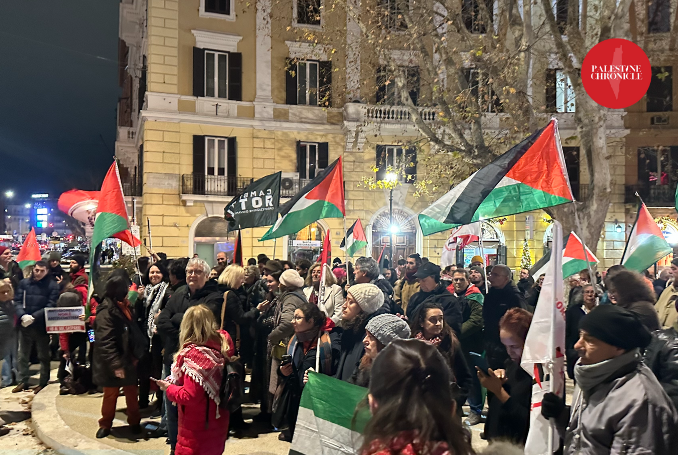
In Italy, hundreds took to the streets in Rome and Milan, including large numbers of high school students.
In Rome, demonstrators gathered outside the UK Embassy near Porta Pia, waving Palestinian flags and denouncing the UK, Europe, the US, and Italy for their ongoing complicity in genocide.
The protest was a direct rebuke to Meloni’s pro-Israel government.
Palestinian student leader Maya Issa highlighted the growing repression against Palestinian activists in Italy, declaring: “We will not be silent in the face of the ongoing genocide in Gaza and the continued complicity of the Italian government.”
In Milan, students and workers rallied outside the British Consulate, demanding sanctions and an arms embargo.
These actions, echoed in dozens of cities worldwide, helped tip the balance against the Elbit deal.
Yet the victory comes at a severe human cost.
Heba Muraisi and Kamran Ahmed remain in extremely fragile health. After more than two months without food, the refeeding process carries serious risks, including refeeding syndrome, organ damage, and long-term complications.
Both have moved repeatedly between prison and emergency hospitalization and remain under close medical supervision. Full recovery may take months.
Meanwhile, one striker, Umer Khalid, has resumed his hunger strike and continues on Day 6 — embodying a sumud that refuses to retreat even as others step back from the brink.
From Sands’ cell to Britain’s prisons today, history shows that empires fracture under unbreakable will.
This victory is a crack in the wall — proof that direct action, amplified by global solidarity, works.
But the struggle continues. Elbit still operates. Gaza still bleeds. The West still arms and normalizes genocide.
The call is clear: boycott, divest, sanction, and dismantle the apartheid machine.
As the Palestinian BDS National Committee reminds us: “Our future depends on your solidarity, your organization, your pressure.”
Honor these resisters by making complicity impossible.
Free Palestine, from the river to the sea.
– Michael Leonardi is an Italy-based journalist. He contributed this article to the Palestine Chronicle.



Be the first to comment