
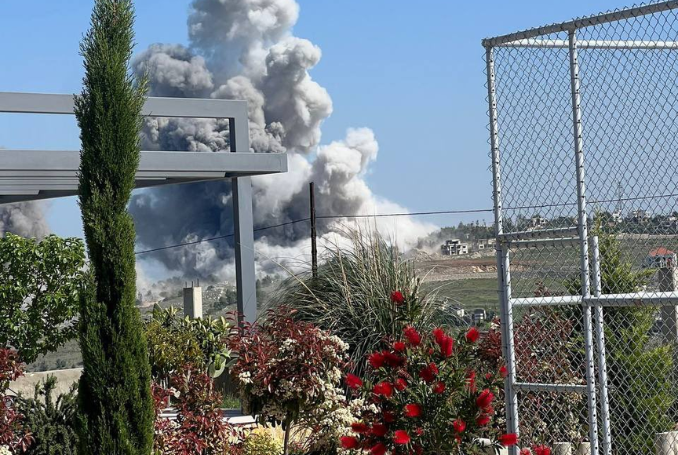
To assert its dominance, Hezbollah must be prepared for an all-out war with no limits from the get-go. Such a war will dramatically change Israeli calculations, forcing it into a new military reality.
It is no secret that Israel is on the verge of a new offensive against Lebanon and has attempted to stir as much chaos internally in order to encourage the dismantlement of Hezbollah from within. Despite its best attempts to draw the group into a tit-for-tat, it appears that the next war will be much different.
On November 27, 2024, the Lebanon ceasefire agreement went into effect, after two months of war. While Hezbollah adhered to the deal, the Israelis began violating it instantly. A year on, the Israelis have violated the ceasefire over 7,000 times, expanded their occupation of southern Lebanese lands, and demonstrated that it can even bomb Beirut at any time of its choosing.
The majority of Israel’s military achievements against Hezbollah had occurred in September of 2024, with the initiation of the pager attacks and then the assassination strikes against its senior leadership figures. Yet, during the war itself, which really began after the killing of Hezbollah’s Secretary-General, Seyyed Hassan Nasrallah, along with 300 civilians in southern Beirut, the Israelis failed to achieve their goals.
On to the Next Front: Israel Threatens Lebanon with a New War
For around two months, the Lebanese group managed to slowly escalate the pace of its attacks, deter Israeli ground incursions and reveal new weapons which it introduced to the battlefield. When the war officially ended, the situation rested on the verge of an all-out battle, in which Hezbollah was ready to escalate its strikes on Tel Aviv, while Israel would drop all restrictions on what it would be willing to hit in Beirut.
Now, one year later, it is clear that Hezbollah has found its footing, once more, and is rebuilding its military arsenal. Yet, it is not behaving recklessly and refuses to respond to Israel’s daily aggression.
What Kind of War?
The Israelis understand that their failure to defeat Hezbollah now spells an even greater threat from the group than previously existed; they also understand full well that the desire for revenge is immense amongst the Lebanese supporters of the group. This means that war is inevitable.
What Tel Aviv has attempted to do for some time is to draw a response from Hezbollah, through escalating its operations and assassinations. If the Lebanese group were to respond with some kind of attack that would serve to level the playing field, then a new tit-for-tat equation could be imposed, whereby the Israelis could dictate rounds of fighting that are limited.
It is clear, through the Israeli Hebrew media reports on the issue, that the regime has been preparing its people for a new round with Lebanon, one which they began by claiming it would last a number of days; now Channel 14 is finally saying “weeks”. The aim of the upcoming operation is said to be designed to degrade Hezbollah’s power.
Realistically speaking, an attack that only lasts a few days cannot conceivably weaken Hezbollah’s military capabilities to a significant degree. Even if that was the intention then, at the very least, such a conflict is more likely to last for weeks or months.
Gaza’s Blackwater: Despite Denials, US Boots Will Be on the Ground in Gaza
Yet, it appears as if Hezbollah is not interested in engaging in such a battle. Beginning on October 8, 2023, this tit-for-tat style battle is what the group committed itself to, as a support front for Gaza.
The major issue for a group like Hezbollah is that there is no military parity between it and its enemy; the Israelis have better equipment, more advanced weapons and an endless supply from their Western allies. Therefore, victory is very unlikely if it is to engage in limited exchanges that are unlikely to change the regional equation.
Instead, to assert their dominance, the group must be prepared for an all-out war with no limits from the get-go. Such a war will dramatically change Israeli calculations, forcing it into a new military reality.
If Hezbollah’s behavior, such as refusing to respond to the recent assassination of its top military leader, Haitham Ali Tabatabai, who was murdered in the southern suburbs of Beirut, can be interpreted as them refusing to engage in a limited exchange, then the Israelis will only have two real options: The first is an all-out war that seeks to seriously damage Hezbollah’s military infrastructure; the second is a war focused on assassinations and civilian massacres.
In the event of an all-out war, the Israelis are likely to use Syrian territory to invade the Beqa’a Valley region of Lebanon. This move would indicate that they are actually attempting to significantly degrade the group’s capabilities. Such a war will take many months, potentially years, and cost the Israeli military thousands of casualties. This is the only way that it could actually take out significant portions of Hezbollah’s weapons.
The second option will be to focus on more assassinations, with a particular focus on killing the current Secretary-General, Sheikh Naim Qassem, likely in the opening round. In the media, the Israelis will sell such a conflict as an attempt to crush Hezbollah’s capabilities, but it will actually be geared towards inflicting a psychological blow on both the group and Lebanese society. Then, depending upon how much damage Hezbollah manages to inflict on Israeli cities, the civilian death toll in Lebanon will be adjusted.
Israeli Prime Minister Benjamin Netanyahu likely favors the latter style of war, one that he can switch off at the moment of his choosing, not achieving any real military objectives, but managing to cause more issues inside Lebanon by doing so. If this model of intense warfare, lasting around a few weeks, proves feasible, they will do this repeatedly. From there, this would place huge internal stresses on Hezbollah and could forward the goal of the pro-US Lebanese government to push ahead to disarm them.
However, Hezbollah knows all of this and will have to be vigilant. Another major factor here is that the other members of the Iranian-led Axis of Resistance also see the potential dangers. For the Islamic Republic of Iran, in particular, they understand that it is only a matter of time before another round between them and the Israelis occurs.
During the 12-day Iran-Israel war, back in June, the Israelis proved to have many proxies and agents working on the ground for them inside Iranian territory and that it could even trigger armed groups from other countries to engage in battle, too. On Iran’s side, its only way of putting up a ground front against the Israelis is through Lebanon currently, meaning that Hezbollah’s survival is crucial to their national security.
Hezbollah vs. Israel: Why a New War is on the Horizon – Analysis
It should also be taken into consideration that Israel’s insistence on attacking Hezbollah is not drawn from any immediate threat or need to respond, as there is no fire from Lebanon towards them; they are the aggressors through and through. The reason for this is that they seek to destroy Iran, and taking out Hezbollah or, at least, taking it out of the fight when the time to attack Tehran comes, is crucial to this mission.
The Israeli regime understands that, because of its actions towards Lebanon both last year and after the ceasefire, Hezbollah desires revenge and to expel the occupying forces from the south of the country. This also factors into its urgency.
What appears to be driving the Israelis crazy is that Hezbollah is not responding at all; it is not issuing threats or red lines, it is sitting back, planning and rebuilding. Meaning that Tel Aviv is left in the dark and incapable of reading its intentions.
Nevertheless, the Israeli thirst for more war is insatiable as it pushes full steam ahead towards achieving its desired “Greater Israel” project. In line with this view, Israel’s Alma think-tank, focused on threats to the north, has developed what could be interpreted as a new Hezbollah hit list.
Those named, as part of the military leadership in Hezbollah, include Mohammed Haidar, Haj Khalil Harb, Talal Hosni Hamiyeh and Khader Yousef Nader. They also named Sheikh Naim Qassem, in addition to Wafiq Safa, the head of the coordination and liaison unit.
A Mandate for Force: What the UNSC’s Gaza Resolution Means in Practice
Even when Israel fought Hezbollah last year, with every conceivable advantage on its side, its main achievements came in the form of assassinations, as its soldiers proved incapable of completing their goals on the ground. What will face them, the next time round, will likely be much more formidable and prepared.
These assassinations, undoubtedly, have a psychological impact that cannot be ignored, with the assassination of Seyyed Hassan Nasrallah serving as a major blow that cannot be discounted. Yet, at the same time, the organization has managed to harness the emotions of its base and channel this into a desire to inflict a major blow on the enemy at all costs, down to the very last drop of blood.
The mentality of the supporters of Hezbollah and those who fill its ranks has to be taken very seriously in any analysis of the situation and what a new war will look like. They would rather meet death than be dealt a humiliating blow.
If we extract some crucial lessons from the way Iran responded to the Israelis, the picture becomes even clearer. Israel was essentially forced to back off and accept a ceasefire with the Iranians, as the Islamic Revolutionary Guard Corps landed the final blows against them.
Why was Israel forced into retreat? Because Iran demonstrated its willingness to batter cities like Haifa, Beir Saba’a and Tel Aviv with wave after wave of ballistic missiles. In the end, the intensity of the attacks was becoming too much as Israeli air defenses ran out of interceptor munitions.
If anything, the message communicated through Israel’s adherence to the ceasefire with Iran was that it can be battered into submission, relying almost exclusively on assassinations and Mossad operations to achieve its objectives.
Even when it comes to the Gaza Strip, its soldiers have been receiving danger money salaries, some between US $7,000 to $8,000 per month, in order to fight. In addition to this, the northern Israeli settlements have still not been rebuilt and significant portions of their populations have not returned to their homes. This has led to threats from the remaining Israeli residents to flee if their areas are, once again, subjected to fire from Lebanon.
Blackmail, Power, and Foreign Policy: The Epstein-Barrack Question
There are serious questions about Israel’s ability to actually sustain a meaningful war front in Lebanon at this stage, which, in large part, is down to the morale of its fighting force. On the ground, the Israeli military has proven itself an objectively terrible army, incapable of even defeating much smaller armed groups in Gaza. Where it shines is in its overwhelming technological advantages.
While the above-mentioned scenarios, in which the Israelis are the aggressors, are more likely to unfold, it is also possible that Hezbollah could launch a pre-emptive offensive of its own. If it goes this route, it would be more than likely that a move of this nature would be coordinated with the other actors in the Axis of Resistance and that other fronts will open in a calculated manner.
The Iranian-led Axis had adopted a policy of containment following October 7, 2023, hoping to bring hostilities to an end in Gaza. The US-Israeli alliance had other ideas, instead hedging their bets on the collapse of the entire regional alliance that Hamas was a party to.
In my opinion, this reality only truly set in for Iran, Hezbollah and the others when Israel assassinated Seyyed Hassan Nasrallah. Since then, their discourse has dramatically shifted to a much more confrontational one. The idea of a ‘final battle of liberation’ and ‘existential threats’ appears to predominate.
Although it may appear as if the Israelis have achieved significant victories across different fronts, the truth is very different. Benjamin Netanyahu has presided over operations across the region, in what he calls a “seven-front war” that no other Israeli administration, even the ones he previously ran, would have dared to carry out.
At the end of all these operations, all that the Israelis have to show for it is the degradation of Hezbollah and the Palestinian armed groups. Iran is still a major strategic military threat, Yemen’s Ansarallah is only growing stronger militarily and neither Israel nor the US proved capable of landing significant blows; the Palestinian groups are still alive and refuse to give up their weapons, while Hezbollah rebuilds and remains a much more powerful force than Hamas ever was.
Bashar Al-Assad’s Syria fell, resulting in the Israeli occupation of southern Syria and the destruction of the country’s strategic arsenal. However, this did not stop weapons transfers to Lebanon, despite the removal of much of Iran’s footprint in the war-torn nation. It will likely take years for Syria to develop any kind of resistance force, as the current regime is opposed to it and allies itself with the US, although that timeline could, in fact, change given Turkiye’s developing role inside the country. Eventually, some kind of equation will be set there, likely through southern Syrian forces and Palestinian factions.
‘I Wished for Death’: New Evidence of Israel’s Rape Campaign against Palestinians Ignored
Regardless of the predicament of Syria, which has been sidelined and will remain at Israel’s mercy in the immediate future, as its President continues to play basketball with his CENTCOM pals, the Israelis are not actually in the dominant position that they portray. What currently exists is a range of stalemates, war fronts that could reopen at any moment. Such a predicament is not sustainable for any nation.
Returning to the issue of a Lebanon-Israel war, in the event that a new conflict opens, it will more than likely be very intense from the outside. Israel is likely to experience major blows, some that will come to the surprise of many, while it will inflict large-scale destruction across Lebanon and commit countless civilian massacres.
If Tel Aviv feels as if the threat – or blows – it is receiving, are too extreme, it will carry out the Gaza Doctrine in Lebanon and launch a war of extermination, targeting civilians and civil infrastructure. The worst possible outcome for Hezbollah would be a limited conflict where they, once again, lose their senior leadership.
(The Palestine Chronicle)
– Robert Inlakesh is a journalist, writer, and documentary filmmaker. He focuses on the Middle East, specializing in Palestine. He contributed this article to The Palestine Chronicle.



WHY can’t Mr. Inlakesh realize that elections Really Do change things, including national policy?… israel will be what he describes ONLY while netan and his henchmen are in control,.. and their time is rapidly running out! … they do not have years, but ONLY a few more months… Every poll in israel indicates that come the next election, the israeli right-wing is finished!… israel will move in a liberal direction and settler parties will be out in the cold… There was talk like that of Mr. Inlakesh when the 2nd bush was president— he’d be crowned emperor of the world— it ended with him!… netan WILL BE in Prison soon, NOT carrying on wars that even the israeli majority are sick of
” level Israel “