
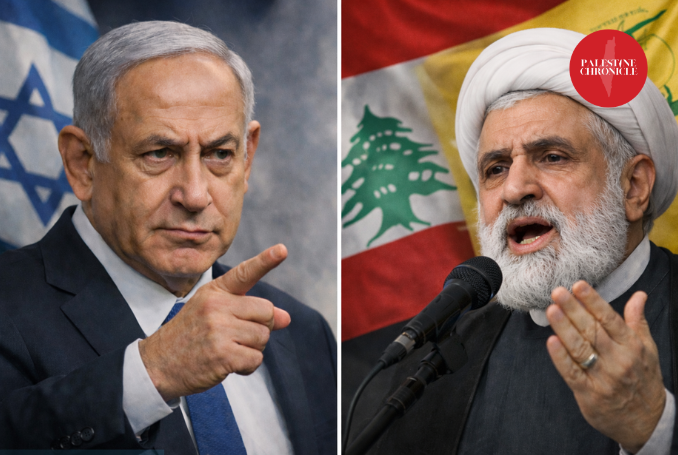

Israel warns of strikes on civilian infrastructure as the Lebanese army reinforces the border post and orders a response.
Key Developments
- Lebanese army says Israeli forces opened fire on a newly established monitoring post near Sarda–Marjayoun.
- An Israeli drone reportedly flew at low altitude, issuing threats to force Lebanese troops to withdraw.
- Occupation army ordered reinforcements and instructed forces to respond to sources of fire.
- Cairo hosted a preparatory meeting for a Paris conference to support the Lebanese army and internal security forces.
- Israel reportedly warned Lebanon it would strike civilian infrastructure if Hezbollah entered any US-Iran war.
- Hezbollah vowed resistance following deadly Israeli strikes in the Bekaa.
Israeli Fire
The Lebanese army announced Tuesday that Israeli forces opened fire on the vicinity of a newly established monitoring point along the southern border, in what it described as a new violation of the November 27, 2024, ceasefire and UN Security Council Resolution 1701.
According to an official military statement, army units were in the process of setting up a monitoring post in the Sarda area of the Marjayoun district when “the vicinity of the post came under fire from the Israeli side.”
The army added that an Israeli drone flew at low altitude over the area and issued threats aimed at forcing Lebanese troops to withdraw.
In response, “the army command issued orders to reinforce the position, remain in place, and respond to sources of fire,” the statement said.
It added that the matter is being followed up in coordination with the ceasefire oversight committee and the UN Interim Force in Lebanon (UNIFIL).
The incident comes as the Lebanese army continues to establish and reinforce military positions in the south, part of an effort to extend state authority and secure the border following the 2024 war.
Lebanese officials have repeatedly accused Israel of ongoing ceasefire violations, including near-daily strikes and continued occupation of five strategic hilltops seized during the latest conflict.
Why Israel Is Escalating Its War Crimes Against Lebanon – Analysis
Cairo Meeting
The escalation unfolded as Egypt hosted a preparatory meeting in Cairo for an upcoming international conference in Paris aimed at supporting the Lebanese army and internal security forces.
The meeting, which included broad international participation, focused on urgent operational needs for the army, institutional and logistical requirements for the internal security forces, and coordination mechanisms ahead of the March 5 conference in Paris.
Egyptian Foreign Minister Badr Abdelatty said the wide international presence sends “a strong message of solidarity with the Lebanese state” and aims to help national institutions, foremost the army and internal security forces, strengthen sovereignty and assert full control.
Abdelatty warned of the “danger of continued Israeli violations” and called for Israel’s “full and unconditional withdrawal from all Lebanese territory,” including the five points it occupied during its 2024 aggression.
He stressed the need for full, synchronized implementation of the ceasefire agreement and Resolution 1701 “without selectivity,” arguing that ongoing violations weaken the army’s ability to implement plans for consolidating state authority.
On the sidelines of the meeting, Abdelatty met with French envoy Jean-Yves Le Drian. Both sides reaffirmed their commitment to mobilizing financial and technical resources to support Lebanese institutions and discussed coordination within the five-member group on Lebanon, which includes Egypt, Saudi Arabia, Qatar, France, and the United States.
Iran-China Missile Deal Advances Amid IRGC Drills and Deadly Helicopter Crash
Israeli Threats
Against the backdrop of rising US-Iran tensions, two senior Lebanese officials told Reuters that Israel has conveyed warnings that it would strike Lebanon “hard,” including civilian infrastructure such as Beirut’s airport, if Hezbollah becomes involved in any potential US-Iran war.
The message was reportedly delivered indirectly. Israeli Prime Minister Benjamin Netanyahu’s office and the Lebanese presidency did not immediately comment.
Lebanese Foreign Minister Youssef Rajji, speaking in Geneva, confirmed that authorities have urged Hezbollah not to take actions that could trigger “bad situations” for Lebanese civilians.
“Lebanon has received signs that the Israelis could strike civilian infrastructure and maybe the airport,” Rajji said, adding that the government is appealing to Western partners to press Israel against targeting civilian facilities.
The warnings come amid growing speculation that Washington could resort to military action if nuclear negotiations with Tehran collapse. The US State Department has ordered nonessential embassy personnel and their families to leave Lebanon, citing heightened regional tensions.
The Toxic Border: How Israel’s Chemical Spraying is Reshaping Life in South Lebanon
‘No Option Other Than Resistance’
The tensions intensified following Israeli strikes in eastern Lebanon’s Bekaa Valley and the south, which killed 10 Lebanese. Hezbollah official Mahmud Qamati described the strikes as “a new massacre and a new aggression.”
“What option do we have left to defend ourselves and our country? What option do we have other than resistance? We no longer have any option,” he said in remarks broadcast by Al-Manar.
Lebanese President Joseph Aoun condemned the attacks as “a blatant act of aggression aimed at thwarting diplomatic efforts” to restore stability.
The strikes occurred as the Lebanese government moves forward with a phased plan to disarm Hezbollah in the south. The army announced last month that it had completed the first phase near the Israeli border.
Israel, however, claims Hezbollah continues to rearm and has described Lebanese army efforts as insufficient.
Since the November 2024 ceasefire, Israel has carried out near-daily strikes, asserting they target Hezbollah. Lebanese officials argue these operations constitute persistent violations of the truce and undermine efforts to restore state authority.
From Gaza to Quneitra: Israel’s Chemical Spraying Expands Across Borders
Our Strategic Assessment
The latest border incident must be understood within Israel’s broader objective of weakening — and ultimately destroying — Hezbollah as a military and political force.
Since the 2024 war, Israel has maintained near-daily strikes despite the ceasefire, suggesting the truce is viewed as a temporary pause rather than a lasting settlement. Continued military pressure, coupled with warnings about targeting civilian infrastructure, points to a strategy that seeks to reshape Lebanon’s internal balance. Israel appears keen to exploit political divisions and anti-Hezbollah sentiment within segments of Lebanon’s political class to weaken the resistance from within.
Hezbollah, however, is exercising strategic patience. Despite losing fighters in recent Israeli strikes, it has avoided large-scale retaliation. This restraint likely reflects an understanding that Israel may be seeking escalation to justify a return to full-scale war and further destabilize Lebanon internally. The ceasefire, in this reading, was never an endpoint but a respite in an ongoing confrontation.
There is also no clear indication that Hezbollah intends to disarm. The movement continues to frame its weapons as essential for deterrence. Meanwhile, the Lebanese army — constrained by financial weakness and political fragmentation — is unlikely to have either the capacity or the backing to forcibly disarm a powerful and entrenched resistance movement.
Crucially, developments in Lebanon are inseparable from tensions surrounding Iran. Israel’s warnings about a broader confrontation if Hezbollah enters any US-Iran war underscore the intrinsic link between the Iranian file and Lebanon’s future stability.
In strategic terms, the war has paused — but it has not ended.
(Al-Mayadeen, Anadolu, Israeli Media, PC)



HA!
the Israeli Jewish Nazis are scared!
Hit them now, while they’re shaking in their panties.
“violations weaken the army’s ability to implement plans for consolidating state authority” — who’s “state authority” is this referring too? Cairo & Paris see the Lebanese army and Hezbollah helpless and then “Israel” will “implement plans for consolidating state authority”. Never.