

Iran names delegation after Minab school victims as talks begin, signaling distrust and linking diplomacy to battlefield realities.
Key Developments
- Iran names delegation after Minab school victims killed in a US airstrike on February 28.
- Talks conditioned on Lebanon ceasefire and release of frozen Iranian assets.
- Conflicting US positions and Israeli attacks threaten fragile ceasefire framework.
‘Minab 168′
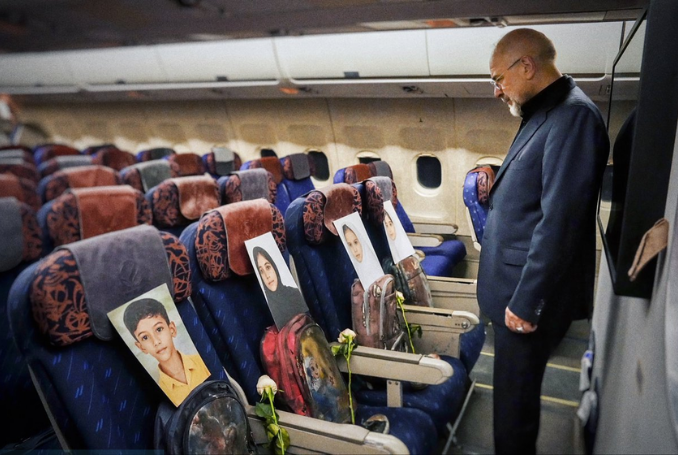
The Iranian delegation to Islamabad was symbolically named after the victims of the Minab school strike, in which dozens of students were killed in a US airstrike on February 28.
Parliament Speaker Mohammad Baqer Qalibaf reinforced this message by publishing an image from inside the aircraft carrying the delegation, showing photos and belongings of the children placed on the seats.
He captioned the image: “My companions on this trip,” directly linking the diplomatic mission to the victims of the attack and framing the negotiations within the broader context of the war.
Distrust despite Engagement
Iranian Parliament Speaker Mohammad Baqer Qalibaf said upon arrival in Islamabad on Friday that Tehran is approaching negotiations with good intentions, but without trust.
“Our past experiences in negotiations have not been encouraging,” he stated, according to Al Mayadeen, noting that Iran had faced two wars while engaged in diplomatic processes, underscoring skepticism toward Washington’s commitments.
همراهان من در این پرواز#Minab168 pic.twitter.com/xvXmDlSDiF
— محمدباقر قالیباف | MB Ghalibaf (@mb_ghalibaf) April 10, 2026
Iranian officials have repeatedly stressed that negotiations are not viewed as a resolution to the conflict, but rather as a continuation of confrontation through political means, with military readiness maintained in parallel.
Al Mayadeen reported that Iranian Presidential Assistant Mehdi Tabatabaei reinforced this position, stating that “the armed forces have their hands on the trigger,” while diplomacy is prepared to “seize victory,” pointing to alignment between military posture, public sentiment, and diplomatic efforts.
Full-State Iranian Delegation
The Iranian delegation, headed by Qalibaf, has arrived in Islamabad ahead of expected negotiations with the United States, according to Fars News Agency.
The delegation includes Foreign Minister Abbas Araqchi, Secretary of the Supreme National Security Council Ali Akbar Ahmadian, Central Bank Governor Abdolnaser Hemmati, and members of the Shura Council, alongside representatives from security, political, military, economic, and legal committees.
According to Al Mayadeen, the delegation was met by the Pakistani Air Force upon entering the country’s airspace and escorted to Islamabad, highlighting the level of coordination surrounding the talks.
Fars reported that negotiations will not begin unless Washington accepts Iran’s preconditions, emphasizing that prior commitments must be fulfilled before any formal process starts.
Wow… Iran’s delegation honored the 168 Iranian children who were horrifically murdered by the U.S. bombing of a school in Minab on the first day of the attacks. pic.twitter.com/Sz64NXRCxP
— Rachel Blevins (@RachBlevins) April 11, 2026
Preconditions: Lebanon and Frozen Assets
Qalibaf reiterated that negotiations cannot begin unless two central conditions are met: a ceasefire in Lebanon and the release of Iran’s blocked financial assets.
“These two matters must be fulfilled before negotiations begin,” he said, noting that both points had already been agreed upon but remain unimplemented.
Tasnim news agency reported that the Iranian delegation plans to raise US breaches of commitments directly with Pakistani officials, including Shehbaz Sharif, before deciding whether to proceed with talks.
Iranian Deputy Foreign Minister Majid Takht Ravanchi confirmed that negotiations would be based on Tehran’s 10-point proposal, while stressing that Iran is evaluating US compliance before moving forward.
Lebanon Central to Negotiation Framework
Iranian officials have made clear that Lebanon is inseparable from the broader ceasefire and negotiation process.
Qalibaf and other officials emphasized that a ceasefire in Lebanon is a prerequisite, not a secondary issue, rejecting any attempt to isolate the Lebanese front from regional arrangements.
A high-ranking security source told Press TV that Iran made the halt of Israeli attacks on Beirut a firm condition for participation, stressing that “the unity of the resistance front was non-negotiable.”
The source added that Iran delayed sending its delegation multiple times due to continued Israeli attacks on Lebanon.
Escorted by Fighter Jets – Iranian Delegation Arrives in Pakistan, Sets Conditions
Halt of Strikes on Beirut
According to Press TV, Iran applied sustained pressure and threatened to withdraw from negotiations, forcing the United States to intervene.
“The Americans were forced to make the Zionist regime halt its assaults on Beirut,” the source said, describing the pause in Israeli strikes as a direct outcome of Tehran’s position.
The source warned that the continuation of negotiations remains conditional, and that any renewed Israeli attacks on Beirut or its southern suburbs would immediately terminate the process.
Iran also signaled that continued violations could void the negotiation framework entirely.
Conflicting US Position
The ceasefire framework remains unstable, particularly due to contradictions in Washington’s position on Lebanon.
Israeli Prime Minister Benjamin Netanyahu’s office stated that Lebanon was not included in the ceasefire. However, diplomatic sources cited by CBS News said US President Donald Trump had initially been informed that the agreement applied to the broader region, including Lebanon, and had agreed.
A White House official also confirmed to CBS News that Israel had agreed to the terms of the deal, reinforcing that Lebanon was initially understood to be included.
Despite this, the US position reportedly shifted following a call between Trump and Netanyahu, raising questions about consistency in US decision-making.
Sources cited by Al Mayadeen described these shifts as abrupt and destabilizing, complicating diplomatic efforts and making negotiations increasingly difficult to manage.
(PC, Al Mayadeen, Tasnim, Fars, Press TV, CBS)



” Despite this, the US position reportedly shifted following a call between Trump and Netanyahu, raising questions about consistency in US decision-making. ”
it also raises the question, who is the actual POTUS: Dondolf Twitler, or Bibi the Baby-Killer?
Obviously Trump is open to ” suggestion ” and has Nazinyahu whispering commands into his ear. A president who takes commands?
They both need to go. Do the Israeli Jewish Nazis have enough WW2 cred yet? because enough is enough. In fact, we should attack Israel and bomb them into submission.