
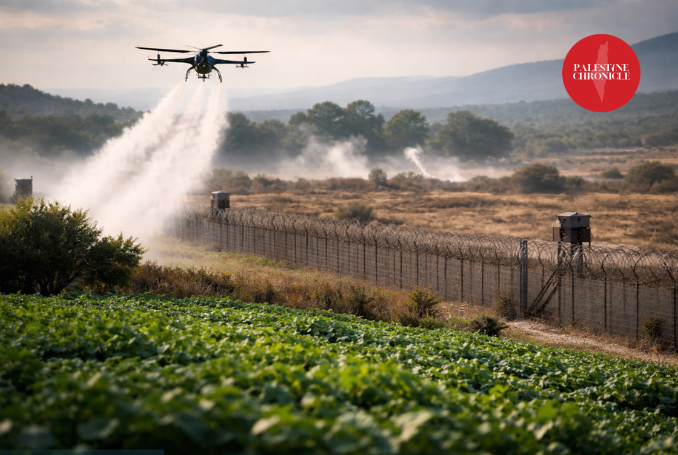

Israel expands aerial herbicide spraying from Gaza and Lebanon to southern Syria, damaging farmland and raising concerns over environmental warfare and forced displacement.
Key Takeaways
- Thousands of dunams of farmland, pastures, and olive groves were damaged within days.
- Syrian authorities confirmed environmental damage, though acute toxicity tests did not classify the substances as immediately poisonous.
- Similar spraying operations have been documented in Lebanon in early 2026, where laboratory tests identified Glyphosate at concentrations 20–30 times above normal levels.
- Israel has carried out documented aerial herbicide spraying along Gaza’s border since 2014, contributing to widespread agricultural devastation.
- Human rights organizations warn that the repeated use of chemical spraying may constitute environmental warfare and potentially amount to a war crime.
Herbicide Operations in Southern Syria
Israeli occupation forces have adopted a pattern of chemical spraying in southern Syria, targeting agricultural and grazing lands along the separation line in Quneitra governorate.
According to monitoring by the Syrian documentation center “Sajel,” the first spraying operation took place on January 25, 2026, affecting the villages of Kodna, al-Asha, and al-Asbah in southern Quneitra countryside. Aircraft reportedly remained airborne for nearly four hours, dispersing an unidentified substance across farmland.
Subsequent operations were documented on January 27 in Sayda al-Hanout, and on January 30 across northern Quneitra villages, including Jabatha al-Khashab, Ofania, al-Hurriya, al-Hamidiyah, al-Adnaniyah, Ruwayhina, and Bir Ajam. The spraying extended across more than 65 kilometers along the disengagement line.
Within a single week, large areas of green vegetation withered. In southern Quneitra alone, an estimated 3,500 dunams of pastureland were damaged, including 1,500 dunams of forested areas previously cut by Israeli forces in early 2025. Around 450 dunams of winter crops — wheat, barley, and beans — were affected, in addition to roughly 50 dunams of olive trees, according to figures cited by the Quneitra Directorate of Agriculture.
Farmers described immediate impacts. Khaled Shams al-Rahil told Sajel that grazing lands were effectively destroyed, forcing livestock owners to purchase expensive feed. His son, who was tending sheep during the spraying, reportedly suffered severe eye irritation for hours. Livestock appeared exhausted and unable to graze normally the following day.
Another farmer, Fadi al-Mughtari, reported the death of several sheep days after spraying in the al-Razaniya farm area.
The Syrian Ministry of Agriculture stated on February 11 that laboratory tests did not detect acutely toxic substances in water samples. However, it acknowledged the presence of broadleaf and narrowleaf herbicides in some plant samples and confirmed significant visible damage to vegetation.
Officials cautioned residents against entering affected areas pending further monitoring.
Israeli Troops Push Deeper into Southern Syria, Targeting Quneitra and Daraa Areas
Lebanon: Chemical Warfare
In southern Lebanon, Israeli aircraft have carried out aerial herbicide spraying along the Blue Line, raising alarm over environmental destruction and civilian harm.
On February 1, UNIFIL temporarily suspended patrols after being notified that chemical agents would be dispersed in the area. Although Israeli authorities reportedly described the substance as “non-toxic,” subsequent toxicology findings identified it as a defoliant herbicide linked to cancer.
In a recent analysis for The Palestine Chronicle, Robert Inlakesh described the campaign as part of a broader escalation pattern. He noted that Israel has committed thousands of ceasefire violations since November 27, 2024, while “no recorded violations” were attributed to Hezbollah or the Lebanese Army during the same period.
According to Inlakesh, the spraying serves a dual purpose: land clearing for military objectives and pressure on civilian populations.
“The deliberate targeting of civilian farmland violates international humanitarian law, particularly the prohibition on attacking or destroying objects indispensable to civilian survival,” the Euro-Med Human Rights Monitor stated, warning that such acts may amount to war crimes and undermine food security.
Inlakesh argued that the use of chemical agents—despite Israel’s ability to clear land through conventional means—signals a strategy that risks long-term environmental and health consequences. Similar incidents have been reported in southern Syria, reinforcing concerns that the policy is not isolated but part of a wider pattern affecting border communities.
The Toxic Border: How Israel’s Chemical Spraying is Reshaping Life in South Lebanon
Gaza: Environmental Destruction
The chemical spraying in Syria and Lebanon reflects a documented pattern previously established in Gaza.
Israeli aerial herbicide spraying along Gaza’s perimeter fence has been recorded since at least late 2014. Investigations by Forensic Architecture and Palestinian human rights groups documented aircraft dispersing herbicides that drifted hundreds of meters into Gaza’s farmland, destroying crops and contaminating soil.
Israel’s Ministry of Defense acknowledged using a mixture including Glyphosate, Oxygal, and Diurex along the Gaza border between 2014 and 2018. Reports indicated that spraying was conducted repeatedly, often twice annually.
The impact was severe. Farmers reported crop destruction within days of spraying, with losses affecting wheat, vegetables, and grazing lands. Human rights organizations, including Al Mezan, Adalah, and Gisha, characterized the practice as disproportionate and harmful to civilians.
The environmental destruction in Gaza expanded dramatically during the ongoing genocide. According to UN assessments and environmental monitoring bodies, the majority of Gaza’s agricultural land has been damaged or rendered inaccessible due to bombing, bulldozing, contamination, and infrastructure collapse. Satellite analyses have shown widespread destruction of orchards, greenhouses, irrigation systems, and water infrastructure.
The United Nations Environment Programme (UNEP) and other monitoring bodies have warned that damage to soil, groundwater, sewage systems, and agricultural land will have long-term ecological consequences. The collapse of sanitation infrastructure has led to severe contamination risks, further undermining food security.
Environmental researchers and legal scholars have increasingly discussed whether the scale of environmental destruction in Gaza could meet emerging definitions of ecocide under international law frameworks.
Assault on Survival: What Israel’s Destruction of Gaza’s Fishing Industry Reveals
Legal and Humanitarian Implications
International humanitarian law prohibits the destruction of civilian objects not justified by military necessity. It also protects objects indispensable to the survival of civilian populations, including agricultural areas and food production systems.
The Euro-Mediterranean Human Rights Monitor, in a February 4, 2026, analysis, argued that chemical spraying across Syria and Lebanon may constitute a war crime if conducted deliberately to damage civilian livelihoods.
The pattern across Gaza, Lebanon, and now southern Syria suggests that chemical spraying functions not merely as border management but as a tool of territorial reshaping. By undermining agriculture and grazing, such practices gradually depopulate buffer zones and reduce civilian presence in contested border areas.
The cumulative effect extends beyond economic loss. It disrupts food systems, threatens public health, damages soil fertility, and alters ecosystems for years.
As chemical spraying operations continue across multiple fronts, rights organizations are calling for independent investigations into the environmental, humanitarian, and legal consequences of these actions.
(QNN, Sajel, Syrian Ministry of Agriculture, Lebanese Ministries of Agriculture, Al Mezan, Euro-Med, UNEP, PC)





Once again, the Zionists are using chemical weapons. Perhaps they’ll scream & bark at Germany to send Zyklon B as they did with Saddam Hussein https://archive.seattletimes.com/archive/19901004/1096522/how-german-firms-built-up-iraqs-arsenal