
By Palestine Chronicle Editors
A tense televised interruption, contradictory statements, and mounting setbacks suggest Washington’s war on Iran is proving far more difficult.
Key Takeaways
- Treasury Secretary Scott Bessent’s abrupt removal from a live interview exposed the urgency surrounding the war’s economic consequences.
- Trump’s repeated claims of victory contrast with growing signs of military, political, and economic complications.
- Aircraft losses, Hormuz tensions, and oil disruptions suggest the conflict may be far longer and more costly than Washington expected.
The Interview That Revealed the Pressure
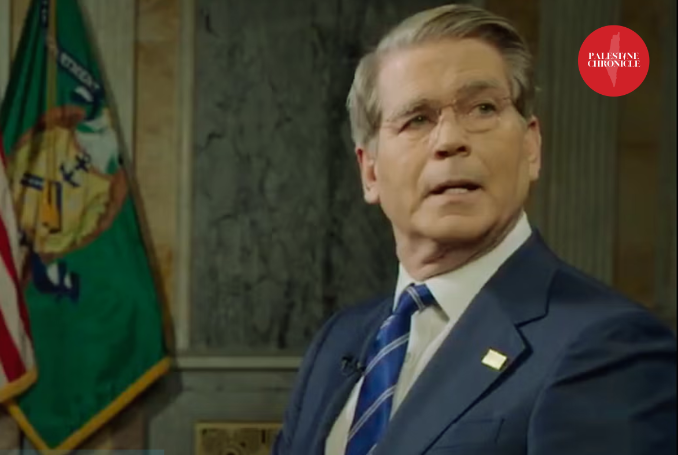
On March 13, US Treasury Secretary Scott Bessent was speaking live on Sky News about the war’s impact on global energy markets when a staff member interrupted the interview.
“The president wants you right away,” the aide told him.
Bessent immediately removed his microphone and left the broadcast to attend an urgent meeting in the White House Situation Room, where officials were reportedly discussing developments linked to the conflict with Iran and the growing instability in global oil markets.
When he returned later to resume the interview, the contrast was noticeable. Bessent attempted to reassure viewers that the situation remained under control, but his voice appeared tense and his tone cautious as he tried to project confidence.
“The president is in great spirits,” Bessent said, insisting the military operation was “ahead of schedule.”
At the same time, his remarks acknowledged the scale of the crisis facing Washington. Bessent said the United States was prepared to ensure the “free flow of commerce” and suggested the US Navy could escort oil tankers through the Strait of Hormuz if necessary.
The moment offered an unusually revealing glimpse into the atmosphere inside the administration. A cabinet secretary being pulled from a live interview to attend an emergency Situation Room meeting suggested that events were moving quickly—and not necessarily according to plan.
That brief exchange has since come to symbolize the broader tension surrounding Washington’s war effort: confident rhetoric on the surface, but growing signs of pressure underneath.
Watch the moment a call from the White House situation room interrupts U.S. treasury secretary Scott Bessent's interview with Sky's @WilfredFrost ⬇️ pic.twitter.com/4XNNvRuHJX
— Sky News (@SkyNews) March 12, 2026
Trump’s Contradictory Victory Claims
While Bessent was attempting to calm markets, President Donald Trump continued delivering a very different message.
In a CBS interview earlier this week, Trump insisted the war was already nearing completion.
“I think the war is very complete, pretty much,” he said.
At the same time, he also declared that the United States had already achieved victory.
“We’ve already won in many ways,” Trump said.
Yet the president’s own remarks quickly complicated that narrative. In the same conversation, Trump acknowledged that the United States “hasn’t won enough” and suggested the campaign must continue.
The result has been a confusing mix of triumphal declarations and warnings of further escalation.
One day the war is described as nearly finished. The next day the White House signals that additional strikes may be coming.
That contradiction has become increasingly difficult to ignore as the conflict expands beyond its initial military objectives.
Years of US Munitions ‘Burned’ in Days of War on Iran – Financial Times
Aircraft Losses Raise Questions
Compounding the uncertainty are reports of operational setbacks.
The US military confirmed the loss of a KC-135 aerial refueling tanker during operations linked to the campaign against Iran. All crew members were killed when the aircraft crashed while supporting air missions in the region.
Refueling tankers play a critical role in sustaining long-range air operations. Their loss does not merely represent an isolated ‘incident’—it highlights the logistical strain placed on the US military as the conflict widens.
The event was further complicated by conflicting accounts of what happened. Some early reports suggested a collision between aircraft, while others indicated the tanker had been damaged during operations.
In wartime, confusion surrounding such incidents is not unusual. But in a conflict being presented as tightly controlled, even isolated losses quickly raise broader questions about the pace and intensity of operations.
US KC-135 Refueling Aircraft Downed in Western Iraq; Iran Says Crew Killed
Hormuz and the Oil Shock
If the battlefield has produced uncertainty, the global energy market has delivered something closer to shock.
The Strait of Hormuz, through which roughly one-fifth of the world’s oil supply passes, has emerged as the central economic front of the war.
Earlier warnings from Washington suggested Iran might attempt to mine the strait or disrupt shipping routes. Yet US Defense Secretary Pete Hegseth later acknowledged that there was no confirmed evidence that Iran had placed mines there.
Despite the lack of confirmation, the mere possibility of disruption was enough to rattle markets.
Oil prices surged as tanker traffic slowed and shipping companies reassessed security risks in the Gulf. Energy traders began pricing in the possibility that the war could interfere with one of the world’s most important supply corridors.
It was precisely this scenario that Bessent had been addressing when his interview was interrupted.
The war had suddenly become not only a military confrontation but also an economic crisis with global consequences.
Signs of a Longer War
Taken together, the past several days point toward a troubling reality for Washington.
The war that many officials initially presented as a swift operation is beginning to look far more complicated.
Iran’s strategy has focused less on direct military confrontation and more on widening the battlefield—pressuring energy markets, threatening shipping routes, and forcing Washington to respond across multiple fronts at once.
Such tactics do not necessarily produce immediate battlefield victories. Instead, they stretch an opponent’s political, economic, and military resources over time.
For the United States, that dynamic poses a difficult challenge.
Maintaining a narrative of quick success becomes increasingly difficult when aircraft are lost, oil markets surge, and cabinet officials are summoned from live television broadcasts to emergency meetings.
The brief moment during Bessent’s interrupted interview may ultimately be remembered as more than a curious television clip.It captured, in real time, a glimpse of the tension now surrounding Washington’s war effort—one that is beginning to look far less predictable than the confident language coming from the White House suggests.
Despite repeated assurances from Washington, the war is clearly not unfolding as planned. While some analysts are already suggesting that the United States may be losing the conflict, one conclusion is already unavoidable: the quick victory once promised by the White House is no longer an option.
Instead, Trump and his team now face a far more complicated reality—one in which Israel’s Prime Minister Benjamin Netanyahu appears to have pushed Washington into a dangerous strategic gamble. Iran, despite the pressure and devastation of the war, may ultimately emerge from the confrontation politically and strategically stronger.
(PC, Anadolu, AJA, Al-Mayadeen, US CENTCOM, Pentagon Press Briefing, Sky News, Reuters)


Bessent’s rattled demeanor on his return to the interview strongly suggests he witnessed Trump behaving like an enraged Fuhrer. They’re waltzing around Stalingrad. The war is lost.
I did not see the entire interview, but the posted snippet above makes me think the ‘war room’ talked about sending troops and potential draft.
This is going to be worse than Vietnam.
trump hegseth ARE RANK AMATEURS and have NO UNDERSTANDING of WAR…..WORSE, embodying Western dismissal of GOD, they CANNOT UNDERSTAND what GOD MEANS to a BELIEVING PEOPLE like the IRANIANS…..there IS NO more chance of overturning the ISLAMIC REVOLUTION in IRAN than there is in trying to overturn the VATICAN in ROMAN CATHOLICISM……EVERYTHING trump ASS-UMED about IRAN is a CATASTROPHIC MISCALCULATION, and YES, the outcome WILL BE WORSE than Vietnam……for the usa IS GOING TO LOSE ALL of WEST ASIA, ALL of the OIL in tthe MIDDLE EAST, SEE the RADICALIZATION of THE ENTIRE UMMAH, and WITNESS the DEATH of israel….as Western churches and synagogues collapse and close forever